
What Is an Index Fund? How It Works and How to Invest
Investing can seem complicated when you hear about individual stocks, fund managers, market timing, and constantly changing prices. An index fund offers a simpler approach. Instead of trying to pick the next winning company, an investor can buy a fund designed to follow a specific part of the market.
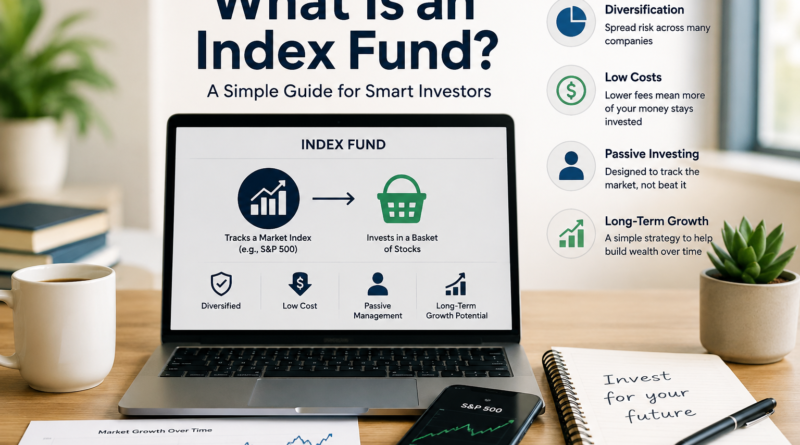
So, What Is an Index Fund? In simple terms, an index fund is an investment fund that aims to track the performance of a particular market index or benchmark index. It may follow a broad stock market index, a group of large companies, bonds, international markets, or another defined basket of securities.
This approach is commonly associated with passive investing. The goal is usually not to beat the market through constant stock picking. Instead, the fund attempts to follow a benchmark and deliver returns that are broadly similar to that market’s performance, before accounting for fees and other costs.
For beginners, this can make index investing easier to understand. Rather than researching dozens of individual stocks, you can gain exposure to many securities through a single investment product. That does not remove investment risk, but it can simplify the process of building a diversified portfolio.
This guide explains the index fund meaning, how index funds work, the main types, costs, benefits, risks, comparisons with ETFs and mutual funds, and practical steps for getting started.
What Is an Index Fund?
An index fund is a type of investment fund designed to follow the performance of a specific market index. A market index is a measurement tool that represents the performance of a selected group of investments.
For example, an index might represent large companies, smaller companies, a particular country, international markets, or a group of bonds. Well-known indexes include the S&P 500, Dow Jones, FTSE 100, and Russell 2000.
An investor usually cannot buy a market index directly because an index is essentially a benchmark or measurement system. An index fund provides a way to invest in securities that aim to reflect that index.
Index Fund Meaning in Simple Terms
Imagine a market index as a shopping list containing hundreds of companies.
You could try to buy every item on that list yourself. That could be expensive, time-consuming, and difficult to manage.
An index fund does much of that work for you. The fund pools money from investors and creates a portfolio designed to follow the selected list or underlying index.
Quick Reference Chart: How an Index Fund Works
| Term | Simple Meaning |
|---|---|
| Market index | A benchmark measuring a group of investments |
| Index fund | A fund designed to track that benchmark |
| Passive investing | Following a market strategy rather than frequent stock picking |
| Underlying index | The specific index the fund aims to follow |
| Expense ratio | The annual cost charged for managing the fund |
| Diversification | Spreading money across multiple investments |
| Tracking error | The difference between the fund’s performance and its benchmark |
Practical example: Suppose you want exposure to 500 large companies but do not want to research and purchase shares in each company. A fund that follows an index containing those companies can give you broad market exposure through one investment.
That does not guarantee a profit. If the market index falls, the value of the index fund may also fall.
What Does an Index Fund Invest In?
Depending on its investment strategy, an index fund may hold:
- Individual stocks
- Stocks and bonds
- Government or corporate bonds
- International securities
- Smaller-company securities
- Other assets included in the index methodology
The exact portfolio holdings depend on the index the fund follows.
Some indexes are market-cap weighted, meaning larger companies receive a larger weighting because of their market capitalization. Others may use different rules to determine which index constituents are included and how much influence each security has.
Worked example: If Company A represents 10% of an index and Company B represents 1%, a market-cap weighted index fund may invest substantially more in Company A. The fund is not necessarily deciding that Company A is a better investment. It is following the rules of the benchmark.
How Does an Index Fund Work?
The basic objective is straightforward: the fund attempts to track the performance of a selected benchmark.
This is different from an actively managed fund, where a fund manager may research securities and try to choose investments that can outperform the market.
With an index fund, the fund’s investment strategy is usually based on the rules of the index.
How Index Funds Track a Market Index
There are several ways a fund can attempt to replicate an index.
The most direct approach is to buy every security in the index, often in approximately the same proportions. This approach is known as full replication.
However, full replication is not always practical. Some indexes contain hundreds or thousands of securities, including investments that may be difficult or expensive to buy.
In those situations, the fund may use representative sampling. It selects a group of investments intended to reflect the major characteristics of the broader index.
The fund may also make adjustments when:
- Companies enter or leave the index
- Index constituents change weight
- Corporate actions occur
- Cash flows enter or leave the fund
- The index methodology changes
This process can create some portfolio turnover, although passive management generally involves less frequent trading than many active strategies.
Worked example: Imagine an index contains 1,000 companies. A fund may own all 1,000 through full replication, or it may use a carefully selected sample that mirrors major sectors, company sizes, and risk characteristics.
Full Replication vs Representative Sampling
Full replication is often easier to understand because the fund attempts to own every security in the benchmark.
Representative sampling can be more practical when the index is very large or contains difficult-to-trade securities.
Neither method automatically makes one fund better than another. What matters is how effectively the fund follows its benchmark, its costs, and the risks involved.
How Do Index Funds Make Money?
Index funds generally do not “make money” in a separate way from the investments they hold.
Your potential return can come from:
- An increase in the value of the securities in the portfolio
- Dividends or interest paid by those investments
- Reinvestment of income, depending on the fund’s structure
For example, if the companies in a stock index increase in value over time, the index fund’s net asset value may also rise. If the market declines, the fund can lose value.
Practical scenario: You invest $1,000 in a fund. If the underlying investments rise by 8% over a period, your investment could gain value before fees and taxes. If they fall by 8%, your investment could also decline. Returns are not guaranteed.
Common Types of Index Funds
Not all index funds invest in the same market. The type you choose should match your investment goals, time horizon, and risk tolerance.
Stock Index Funds
A stock index fund invests primarily in shares of companies.
It may follow:
- Large companies
- Small companies
- A broad stock market index
- A specific sector
- Companies from one country or region
Stock index funds can offer strong long-term growth potential, but they may also experience significant market volatility.
Example: A broad stock market fund may provide exposure to hundreds or thousands of companies rather than relying on the performance of one business.
Bond Index Funds
Bond index funds follow indexes made up of fixed-income securities.
They may hold:
- Government bonds
- Corporate bonds
- Municipal bonds
- Short-term bonds
- Long-term bonds
Bond funds can help add another asset class to an investment portfolio, although they still carry risks such as interest-rate risk and credit risk.
Broad Market Index Funds
A broad market fund aims to provide exposure to a large section of the overall market.
This can be useful for investors who want a simple core holding rather than building a portfolio one stock at a time.
Worked example: Instead of selecting 40 companies from different industries, an investor could use one broad market index fund as the foundation of a portfolio.
International Index Funds
International index funds provide exposure to securities outside an investor’s home market.
This may improve geographic diversification, but it can also introduce additional risks, including currency movements, political changes, and differences between financial markets.
Sector Index Funds
A sector index fund focuses on a specific industry, such as technology, healthcare, energy, or financial services.
These funds can be useful for targeted exposure, but they usually provide less diversification than a broad market fund.
Practical scenario: An investor who already owns a diversified portfolio might add a small sector fund for additional exposure. However, making one sector the majority of a portfolio could increase concentration risk.
Index Mutual Funds vs Index ETFs
An index fund can be structured as either a mutual fund or an exchange-traded fund (ETF).
Both can follow an index, but the way investors buy and sell them differs.
An index mutual fund is generally purchased or redeemed based on its net asset value, commonly calculated at the end of the trading day.
An index ETF trades on an exchange during market hours, similar to individual stocks. Its market price can change throughout the day.
Worked example: If you place an order for a mutual fund during the day, the final transaction price may be based on the fund’s end-of-day NAV. With an ETF, the price can move while the market is open.
The best structure depends on factors such as:
- Your investment account
- Trading preferences
- Minimum investment requirements
- Fees and expenses
- Whether you want intraday trading
For long-term investors making regular investments, both structures can potentially serve the same broad purpose: gaining diversified exposure to a benchmark.
Benefits of Investing in Index Funds
Index funds have become popular because they combine simplicity with broad market exposure.
Built-In Diversification
One of the biggest benefits of index funds is diversification.
Instead of depending entirely on one or two individual stocks, your money can be spread across a basket of securities.
Diversification cannot eliminate market risk, but it can reduce the impact of one company’s poor performance on your overall investment portfolio.
Worked example: If you invest everything in one company and that company loses 50% of its value, your portfolio could suffer heavily. A diversified fund holding hundreds of companies is less dependent on a single business.
Lower Costs and Fees
Passive management can often result in lower costs than actively managed strategies.
An index fund generally does not require a manager to constantly search for undervalued stocks or make frequent trading decisions.
However, low-cost investing does not mean every index fund has identical fees. Investors should compare:
- Expense ratio
- Trading costs
- Transaction costs
- Account fees
- Other fund expenses
Simple and Low-Maintenance Investing
Many investors prefer a buy and hold strategy because they do not want to constantly monitor individual companies.
An index fund can simplify regular investing. You can choose a suitable fund and make ongoing contributions instead of repeatedly deciding which stock to buy next.
Practical scenario: An investor adds money every month to a diversified index fund. When markets rise or fall, they continue their regular investing plan instead of trying to predict every market movement.
Broad Market Exposure
Broad market exposure allows investors to participate in the performance of many companies or securities.
This can be particularly useful for long-term wealth building because the portfolio is not based on predicting which single company will become the biggest winner.
What Are the Risks of Index Funds?
A common misunderstanding is that index funds are automatically safe.
They can be simpler than owning a concentrated portfolio of individual stocks, but every index fund carries investment risk.
Market Risk and Market Volatility
If the market benchmark falls, an index fund designed to follow it will generally fall as well.
Market volatility can be uncomfortable, especially during economic uncertainty.
Worked example: You invest $10,000 in a stock index fund. A major market decline causes the underlying index to drop 20%. Your investment could also lose a significant amount of value.
No Guaranteed Returns
Index funds do not guarantee that you will earn a profit.
Past performance does not guarantee future results. A fund can perform strongly over one period and poorly over another.
Tracking Error
Tracking error is the difference between the fund’s returns and the performance of the benchmark it follows.
This difference may result from:
- Fund expenses
- Trading costs
- Cash holdings
- Taxes
- Sampling methods
- Timing differences
A small difference can be normal. Investors should understand how consistently a fund has followed its stated benchmark.
Concentration Risk
Not every index is broadly diversified.
A fund following a narrow sector may be heavily dependent on one industry. A market-cap weighted index may also have large positions in a relatively small number of major companies.
Practical scenario: A technology index fund might contain dozens of companies, but if technology as a sector declines sharply, the entire fund could be affected.
Limited Flexibility
An actively managed fund manager can potentially reduce exposure to a security if they believe it faces problems.
An index fund generally follows its rules. If a company remains in the index, the fund may continue holding it according to the index methodology.
That is part of the trade-off between active vs passive investing.
How Much Do Index Funds Cost?
Costs can have a major impact on long-term investment returns.
Even when two funds follow similar markets, the one with lower fees may leave more of the return in the investor’s account over time.
What Is an Expense Ratio?
The expense ratio represents the annual percentage of fund assets used to cover management fees and operating costs.
For example, a 0.10% expense ratio means approximately $10 per year for every $10,000 invested, although the actual calculation and deductions occur within the fund.
A lower expense ratio is not the only factor to consider, but it is an important one.
How Fees Affect Long-Term Returns
Consider two hypothetical investments:
| Investment | Starting Amount | Annual Gross Return | Annual Fee | 20-Year Result |
|---|---|---|---|---|
| Fund A | $10,000 | 7% | 0.10% | Higher potential net value |
| Fund B | $10,000 | 7% | 1.00% | Lower potential net value |
The actual results will depend on real market performance, and returns are not guaranteed. The example simply shows why the cost impact on returns can grow over long periods.
Worked example: A small annual difference in fees may not seem significant during one year. Over decades, compounding can magnify that difference.
Index Funds vs Actively Managed Funds
The main difference is the investment approach.
An index fund typically follows a benchmark through passive management.
An actively managed fund relies more heavily on a fund manager or investment team to select securities and attempt to outperform the market.
Index Fund
- Usually follows a defined benchmark
- Often has lower fees
- Less frequent trading in many cases
- Does not generally try to beat the market
- Performance aims to match market returns before costs
Actively Managed Fund
- Uses professional investment decisions
- May attempt to outperform the market
- Can make tactical changes
- Often has higher management fees
- Results depend partly on manager decisions
Practical scenario: An active manager may sell a stock because they expect earnings to weaken. An index fund may continue holding the stock until the benchmark’s rules remove or reduce it.
Neither approach guarantees better results. The right choice depends on your goals, costs, confidence in the strategy, and tolerance for different risks.
Index Fund vs Mutual Fund vs ETF
These terms are often confused because they describe different aspects of investing.
An index fund describes an investment strategy: following a market index.
A mutual fund describes one type of investment structure.
An ETF describes another fund structure that trades on an exchange.
This means an index fund can be a mutual fund or an ETF.
| Feature | Index Mutual Fund | Index ETF |
|---|---|---|
| Can track an index | Yes | Yes |
| Trades during market hours | Usually no | Yes |
| Pricing | Typically end-of-day NAV | Market price during trading hours |
| Can be used for passive investing | Yes | Yes |
| May have expense ratio | Yes | Yes |
Worked example: Two funds may both follow the same market benchmark. One could be purchased as an index mutual fund, while the other could be traded as an index ETF.
The decision should focus on the complete package rather than the label alone.
How to Invest in Index Funds
Starting does not require choosing the fund with the most impressive recent return. A more structured approach can help.
Define Your Investment Goals
Start by asking what the money is for.
Possible investment goals include:
- Retirement
- Long-term wealth building
- Education costs
- Financial independence
- General long-term savings
Your goal affects your time horizon and the amount of risk you may be willing to accept.
Worked example: Someone investing for a goal five years away may use a different asset allocation from someone investing for retirement 30 years away.
Assess Your Risk Tolerance
Risk tolerance is your ability and willingness to handle potential losses.
Ask yourself:
- How would I react if my portfolio fell 20%?
- When will I need this money?
- Do I have an emergency fund for short-term needs?
- Can I continue investing during a market decline?
A higher potential return does not come without risk.
Choose an Index to Track
Next, decide what type of market exposure fits your investment strategy.
You might consider:
- A broad stock market index
- Large-company stocks
- Small-company stocks
- International markets
- Bonds
- A combination of asset classes
Practical scenario: An investor who wants broad exposure may prefer a broad market fund rather than selecting a narrow sector index.
Compare Index Funds and Check Expense Ratios
Once you identify a market, compare available funds.
Look at:
- Underlying index
- Expense ratio
- Fund holdings
- Historical tracking difference
- Fund structure
- Investment minimum
- Liquidity, where relevant
Do not choose based only on the lowest fee. A fund should also fit your intended market exposure.
Open a Brokerage or Investment Account
You generally need a suitable brokerage account or other investment account to purchase an index ETF or mutual fund.
The available account options depend on your country, tax rules, and financial provider.
Worked example: A beginner might choose an account that allows regular contributions and provides access to the fund they want to buy.
Invest Regularly and Build a Portfolio
Regular investing can help investors avoid waiting indefinitely for the “perfect” market entry point.
A consistent contribution schedule may also support a long-term buy and hold strategy.
Practical scenario: Rather than investing one large amount and trying to predict next month’s market movement, an investor contributes a fixed amount each month as part of a broader financial plan.
How to Choose the Right Index Fund
The best index fund is not the same for every investor.
Look at the Underlying Index
Start with the actual benchmark.
Two funds may both contain the words “market index” in their descriptions while tracking very different groups of securities.
Understand:
- What countries are included
- Which sectors dominate
- How many holdings exist
- How the index is weighted
Review Fund Holdings and Diversification
Check whether the fund gives you the type of diversification you expect.
A fund with 500 holdings can still have concentration risk if a small number of large companies represent a major portion of the portfolio.
Compare Costs and Fund Structure
Review:
- Expense ratio
- Management fees
- Other investment costs
- Mutual fund or ETF structure
- Trading costs, if applicable
Worked example: If two funds offer very similar exposure, a lower total cost may be attractive. However, differences in tracking method, account access, or tax treatment can also matter.
Avoid Choosing Based Only on Past Performance
A fund that performed exceptionally well over the past year may have benefited from a specific market trend.
Past performance should not be the only reason to invest.
Focus first on whether the fund fits your investment goals and overall asset allocation.
Are Index Funds Good for Beginners?
Index funds can be a useful option for beginners because they are relatively simple to understand and can provide diversification through a single fund.
They may suit investors who:
- Do not want to research many individual stocks
- Prefer passive investing
- Have long-term goals
- Want to keep costs under control
- Plan to invest regularly
However, beginners still need to understand what they are buying.
An index fund is not automatically low-risk simply because it is diversified. A stock-focused fund can experience large losses during a market decline.
Worked example: A beginner who invests money needed next year for rent or an emergency expense may be taking an inappropriate risk by placing that money in a volatile stock index fund.
The key is matching the investment to the purpose of the money.
Are Index Funds a Good Long-Term Investment?
Index funds can be suitable for long-term investing because they offer a way to participate in broad market performance without requiring frequent stock picking.
Long-term investors may benefit from:
- Diversification
- Lower costs
- Regular investing
- Compounding potential
- A disciplined investment strategy
However, the right approach depends on your financial situation, risk tolerance, asset allocation, and time horizon.
Practical scenario: A 25-year-old investing for retirement may have decades to manage market volatility. Someone saving for a home purchase in two years may need a more conservative approach.
Time horizon matters as much as expected return.
Can You Lose Money in an Index Fund?
Yes. You can lose money in an index fund.
If the securities in the underlying index lose value, the fund can decline.
The amount of risk depends on what the fund owns. A diversified bond fund and a concentrated stock sector fund can have very different levels of volatility.
Potential losses may occur because of:
- Market declines
- Economic recessions
- Interest-rate changes
- Sector weakness
- Currency movements
- Concentration risk
Worked example: If you invest $5,000 and the fund declines by 15%, the value could fall to approximately $4,250 before considering additional contributions, fees, or other factors.
Diversification can reduce exposure to individual company failures, but it cannot eliminate overall market risk.
Practical Index Fund Investing Example
Consider Sara, a hypothetical investor with a long-term goal of building wealth over 25 years.
She follows these steps:
- She defines her investment goals and time horizon.
- She assesses her risk tolerance and recognizes that markets can decline.
- She chooses broad market exposure rather than trying to identify the next winning individual stock.
- She compares several index funds.
- She checks expense ratios and fund holdings.
- She opens an appropriate investment account.
- She invests regularly according to her budget.
- She reviews her portfolio periodically rather than reacting to every market headline.
Sara’s approach does not guarantee positive returns.
The market may experience periods of sharp volatility. Her fund can lose value. But her strategy is based on consistency, diversification, and long-term planning rather than attempting to beat the market through frequent trading.
This example shows why index fund investing is often connected with discipline. The fund itself is only one part of the process. Your savings rate, investment goals, asset allocation, costs, and behavior also influence your long-term financial results.
Final Thoughts: Should You Invest in Index Funds?
An index fund can be a practical way to gain diversified exposure to a market without building a portfolio security by security. Understand the benchmark, compare costs, know the risks, and choose an investment strategy that fits your goals.
Simple, diversified, and long-term focused: that is the core appeal of index investing.
Frequently Asked Questions
What is an index fund in simple words?
An index fund is an investment fund that aims to follow a specific market index. Instead of choosing individual stocks, the fund holds a group of securities designed to reflect the benchmark.
How do index funds make money?
Your potential return comes from changes in the value of the investments held by the fund and from income such as dividends or interest. Returns are not guaranteed, and you can lose money.
How do index funds track an index?
They may use full replication by owning all securities in the benchmark or representative sampling by owning a selected group designed to closely reflect the index.
Are index funds safe?
Index funds carry investment risk. Diversification may reduce company-specific risk, but market risk remains. The level of risk depends on the underlying investments.
Are index funds good for beginners?
They can be suitable for beginners who want a simple and diversified approach, but beginners should still understand the fund’s holdings, costs, risks, and investment objectives.
What is the difference between an index fund and an ETF?
An index fund describes the investment strategy of tracking an index. An ETF is a fund structure that trades on an exchange. Many ETFs are index funds, and many index funds are structured as mutual funds.
What is the difference between an index fund and a mutual fund?
An index fund follows an index-based strategy. A mutual fund is a type of investment structure. A mutual fund can be actively managed or can operate as an index mutual fund.
Can you lose money in an index fund?
Yes. If the underlying market declines, the value of the fund can fall. Diversification does not guarantee against losses.
How much money do you need to invest in an index fund?
The minimum depends on the specific fund, platform, and investment account. Some funds or platforms may allow investors to start with relatively small amounts.
Are index funds good for long-term investing?
They can be useful for long-term investors because of broad market exposure, diversification, and potentially lower costs. Suitability depends on individual goals, time horizon, and risk tolerance.
REad Next
Pingback: Beginner Investing Guide: 7 Proven Steps to Start