
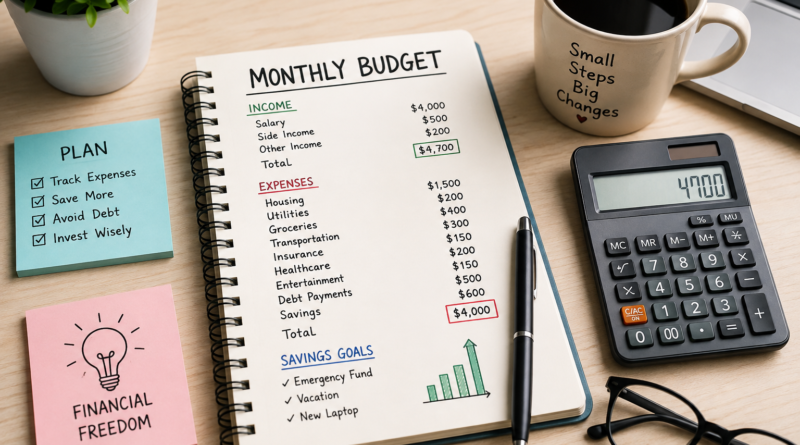
How to Make a Monthly Budget: Easy Guide
How to Make a Monthly Budget Complete Guide
Learning how to make a monthly budget can give you a clearer picture of where your money goes and help you make better financial decisions. A good budget does more than tell you what you cannot spend. It gives every dollar a purpose while making room for bills, savings, debt repayment, and the things you enjoy.
Whether you are creating your first personal budget or trying to improve an existing one, the process can be simple. You need to know how much money comes in, understand your regular expenses, identify spending patterns, and create realistic limits.
The goal is not to create a perfect plan that never changes. Your monthly budget should be flexible enough to adapt when your income, expenses, priorities, or financial goals change.
This guide explains how to create a monthly budget step by step, what expenses to include, which budgeting methods you can use, and how to stay on budget throughout the month.
What Is a Monthly Budget?
A monthly budget is a spending plan that compares your expected income with your expected expenses for a specific month. It helps you decide how much money should go toward housing, food, transportation, debt, savings, entertainment, and other priorities.
Your budget can be as simple as a spreadsheet with two columns: money coming in and money going out. A more detailed budget can divide expenses into dozens of categories.
The basic calculation is:
Monthly Income − Monthly Expenses = Money Left Over
Ideally, the amount left over is assigned to savings, investing, debt payoff, or another financial priority.
For example, imagine someone takes home $3,500 per month. Their planned expenses total $2,700, leaving $800. Instead of allowing that $800 to disappear through unplanned spending, the budget could assign $400 to an emergency fund, $250 to additional debt repayment, and $150 to long-term savings.
That is the central purpose of budgeting: making a plan for your money before you spend it.
Why Create a Monthly Budget?
A monthly budget can help you understand your financial situation and make intentional decisions about your money. It can also reveal areas where your spending is higher than expected.
Control Your Spending
Without a spending plan, it is easy to underestimate how much small purchases add up over time. Coffee, delivery fees, subscriptions, online purchases, and entertainment may seem insignificant individually but can become a substantial monthly expense.
A budget gives these purchases a place within your overall plan.
For example, if you decide that $200 is available for restaurants and entertainment, you have a clear spending limit instead of making decisions randomly throughout the month.
Increase Your Savings
Budgeting makes saving a planned expense rather than something you do only when money remains at the end of the month.
You can create specific savings goals for an emergency fund, a vehicle, education, a vacation, a home, or retirement.
Suppose you want to save $2,400 in one year. Dividing that goal into 12 months gives you a target of $200 per month.
That simple calculation turns a broad goal into a measurable savings plan.
Reduce Debt and Financial Stress
A budget can help you identify how much money is available for debt payments after essential expenses are covered.
Instead of making random payments, you can create a debt repayment strategy and include it as a regular part of your monthly financial plan.
For example, if your minimum debt payments are $300 and your budget allows another $150, you could direct that additional amount toward one debt according to your chosen payoff strategy.
Reach Your Financial Goals
Financial goals are easier to pursue when they are connected to actual numbers.
Short-term goals might include building an emergency fund or paying a credit card balance. Long-term goals might include retirement savings, investing, buying a home, or achieving greater financial independence.
A budget connects these goals to your monthly cash flow.
How to Make a Monthly Budget Step by Step
The easiest way to create a monthly budget is to work from actual numbers rather than guesses. Review your bank statements, pay records, bills, and recent spending before setting limits.
Calculate Your Monthly Income
Start with the money you actually expect to receive during the month.
For employees, this usually means using take-home pay rather than gross salary. Take-home pay is the amount that reaches your account after taxes and other deductions.
If you have recurring income from multiple sources, include those amounts separately.
Possible income sources include:
- Salary or wages
- Freelance income
- Side income
- Business income
- Benefits
- Rental income
- Other recurring income
If your income changes each month, do not automatically base your budget on your best month. Use a conservative estimate that gives you enough flexibility during lower-income periods.
Example:
If your expected monthly income is:
- Main job: $3,000
- Side income: $400
- Other income: $100
Your planned monthly income is $3,500.
List All Your Monthly Expenses
Next, write down everything you expect to spend.
Start with major bills and then work toward smaller purchases. Reviewing several months of bank or card statements can help you identify expenses that are easy to forget.
Your list may include:
- Rent or mortgage
- Utilities
- Groceries
- Transportation
- Insurance
- Healthcare
- Debt payments
- Phone and internet
- Subscriptions
- Entertainment
- Personal expenses
- Savings
- Investments
Do not leave out small recurring costs. A $10 subscription may seem irrelevant, but several subscriptions can create a meaningful monthly expense.
Separate Fixed and Variable Expenses
Separating expenses makes your budget easier to understand.
Fixed expenses generally remain similar from month to month. Rent, mortgage payments, insurance premiums, and some loan payments are common examples.
Variable expenses can change depending on usage or behavior. Groceries, entertainment, fuel, dining out, and some utility costs may vary.
This distinction helps when you need to reduce expenses.
If your budget is short, you may have little flexibility with a fixed mortgage payment, but you might be able to reduce restaurant spending or entertainment costs.
Add Up Income and Expenses
Once you have listed your income and expenses, calculate the difference.
For example:
| Category | Monthly Amount |
|---|---|
| Take-home income | $3,500 |
| Housing | $1,100 |
| Utilities | $250 |
| Groceries | $400 |
| Transportation | $250 |
| Insurance | $200 |
| Debt payments | $350 |
| Entertainment | $150 |
| Other expenses | $200 |
| Savings | $400 |
| Remaining amount | $200 |
The numbers should balance with your actual financial situation.
If expenses are greater than income, your budget is showing you a problem that needs attention. You can reduce discretionary spending, change certain expenses, increase income, or combine these approaches.
Set Savings and Debt-Payment Goals
Do not treat savings as whatever happens to be left over.
Instead, give savings a specific place in your budget. The same applies to debt repayment.
For example:
- Emergency fund: $200
- Retirement savings: $150
- Additional debt payment: $100
Your exact amounts depend on your income, debt, financial priorities, and existing savings.
The key is consistency.
Adjust Your Spending Plan
Your first budget will rarely be perfect.
If your planned expenses are higher than your income, look for areas that can be adjusted.
Start with non-essential expenses before cutting important necessities. Review subscriptions, dining out, entertainment, impulse purchases, and other flexible categories.
For example, reducing three subscriptions by $15 each saves $45 per month. Reducing restaurant spending by $75 saves another $75. Together, those changes create $120 of additional monthly flexibility.
Track Your Spending
Creating a budget is only the beginning. You also need to compare your plan with what actually happens.
Use a spreadsheet, notebook, banking app, or spending tracker to record purchases.
Tracking helps answer questions such as:
- Did groceries cost more than expected?
- Did entertainment spending exceed the limit?
- Were there unexpected expenses?
- Did you save the amount you planned?
- Which categories consistently go over budget?
The purpose is not to criticize yourself. It is to collect information that makes your next budget more accurate.
Review and Update Your Budget
At the end of each month, compare your planned numbers with your actual spending.
A simple budget review can take 15 to 30 minutes.
Look for three things:
- Categories where you consistently overspend.
- Expenses that can be reduced or eliminated.
- Areas where your original estimate was unrealistic.
Then make appropriate budget adjustments for the next month.
What Should Be Included in a Monthly Budget?
A useful budget should reflect your real life rather than only your biggest bills.
Housing and Rent
Housing is often one of the largest monthly expenses.
Include rent, mortgage payments, property-related costs, and other housing expenses that apply to you.
If you own a home, remember that maintenance and occasional repairs also need consideration.
Utilities and Household Bills
Common household bills include:
- Electricity
- Gas
- Water
- Internet
- Mobile phone
- Waste services
- Other recurring household services
Some utility costs fluctuate, so using an average from previous months can make your budget more realistic.
Groceries and Food
Separate groceries from dining out if possible.
This makes it easier to see whether food costs are increasing because of grocery prices, restaurant purchases, delivery, or other spending.
For example, you might set a $400 grocery budget and a separate $100 dining budget.
Transportation
Transportation may include:
- Fuel
- Public transportation
- Car payments
- Repairs
- Maintenance
- Parking
- Registration
- Ride-sharing
Some transportation costs occur only occasionally, so include them in your annual planning as well.
Insurance and Healthcare
Insurance premiums, prescriptions, medical appointments, dental care, and other healthcare costs can affect your budget.
Even if a medical expense does not occur every month, setting aside money for expected future costs can prevent a large surprise from disrupting your plan.
Debt Payments
Include all required debt payments in your monthly budget.
These might include credit cards, personal loans, student loans, auto loans, or other obligations.
Then decide whether additional debt payoff fits your financial priorities.
Entertainment and Subscriptions
Entertainment is not automatically a bad expense. A realistic budget should leave room for enjoyable activities when possible.
The problem occurs when discretionary spending repeatedly prevents you from paying bills, saving, or reaching important goals.
Review subscriptions regularly. Cancel services you rarely use.
Savings and Investments
Savings should be visible in your budget.
Depending on your situation, you might allocate money toward:
- Emergency savings
- Retirement savings
- Short-term goals
- Long-term goals
- Investments
- Major purchases
The right allocation depends on your circumstances.
Annual and Unexpected Expenses
One of the most common budgeting mistakes is pretending that expenses that occur once or twice a year do not exist.
Examples include:
- Vehicle registration
- Annual insurance
- Holiday spending
- Property taxes
- School costs
- Membership renewals
- Home repairs
- Medical expenses
If you expect a $600 annual expense, setting aside $50 per month can make it easier to handle.
Unexpected expenses are harder to predict, which is why an emergency fund is useful.
Fixed vs. Variable Expenses
Understanding the difference between fixed and variable expenses can make budgeting much easier.
What Are Fixed Expenses?
Fixed expenses are costs that generally remain stable over a period.
Examples include:
- Rent
- Mortgage
- Loan payments
- Insurance premiums
- Certain subscriptions
Fixed does not necessarily mean permanent. A fixed expense can change when a contract, loan, insurance policy, or housing arrangement changes.
What Are Variable Expenses?
Variable expenses change from month to month.
Examples include:
- Groceries
- Fuel
- Dining out
- Entertainment
- Clothing
- Household purchases
These categories often provide more opportunities for adjustments.
Examples of Fixed and Variable Expenses
| Expense | Type | Usually Flexible? |
|---|---|---|
| Rent | Fixed | Low |
| Mortgage | Fixed | Low |
| Insurance | Fixed | Sometimes |
| Groceries | Variable | Yes |
| Dining out | Variable | Yes |
| Entertainment | Variable | Yes |
| Fuel | Variable | Sometimes |
| Subscription | Fixed/Recurring | Often |
| Medical expenses | Variable | Limited |
The purpose of this classification is not to label expenses as good or bad. It helps you understand where your financial flexibility exists.
How to Calculate a Monthly Budget
Calculating a monthly budget does not require complicated financial software.
Use this basic formula:
Total Monthly Income − Essential Expenses − Financial Goals − Discretionary Spending = Remaining Money
For example:
Monthly income = $4,000
Essential expenses = $2,300
Savings and debt goals = $800
Discretionary spending = $500
Remaining amount = $400
That $400 could become additional savings, extra debt repayment, or a buffer for irregular expenses.
A budget calculator or spreadsheet can automate the mathematics, but the quality of your budget depends mainly on the accuracy of your inputs.
Popular Monthly Budgeting Methods
There is no single budgeting method that works for everyone. Choose a system that fits your financial habits.
50/30/20 Budget Rule
The 50/30/20 budget rule divides after-tax income into three broad categories:
- 50% for needs
- 30% for wants
- 20% for savings and debt goals
It is a useful starting framework, but it should not be treated as a universal requirement.
Someone living in an expensive area may need more than 50% for essential expenses. Someone aggressively paying down debt may choose to direct more than 20% toward financial goals.
Zero-Based Budgeting
Zero-based budgeting gives every dollar a planned purpose.
The basic idea is:
Income − Planned Expenses − Savings − Debt Payments = $0
A zero balance does not mean you spend all your money. It means all available income has been assigned to a category.
For example, if you earn $3,000, you might allocate the entire $3,000 among housing, food, transportation, savings, debt, and discretionary categories.
Envelope Budgeting
Envelope budgeting assigns spending limits to categories.
Traditionally, people used physical envelopes containing cash. Today, the same concept can be applied digitally.
For example:
- Groceries: $400
- Dining: $100
- Entertainment: $100
- Personal spending: $150
When a category reaches its limit, you either stop spending in that category or consciously move money from another category.
Pay Yourself First
With this method, savings are treated as a priority rather than an afterthought.
You decide on a savings amount and move it to savings soon after receiving income.
Automation can make this easier because the money is transferred before you have an opportunity to spend it.
Monthly Budget Example
Consider a person with $4,500 in monthly take-home pay.
Their budget might look like this:
| Category | Amount |
|---|---|
| Housing | $1,400 |
| Utilities | $300 |
| Groceries | $500 |
| Transportation | $350 |
| Insurance | $250 |
| Healthcare | $150 |
| Debt payments | $400 |
| Entertainment | $200 |
| Subscriptions | $50 |
| Emergency savings | $300 |
| Retirement savings | $300 |
| Miscellaneous | $200 |
| Total | $4,400 |
| Remaining buffer | $100 |
This budget leaves a $100 buffer.
That buffer can help absorb a small unexpected cost without immediately disrupting another category.
The exact amounts are not the lesson. The important point is that the person has assigned income to expenses and financial priorities before the month unfolds.
How to Make a Budget on a Low Income
Budgeting can be especially useful when money is limited because there is less room for financial mistakes.
Start by identifying essential expenses first.
Prioritize:
- Housing
- Utilities
- Food
- Transportation
- Healthcare
- Required debt payments
- Essential insurance
Then examine discretionary expenses.
If your income is low, do not assume that every category can simply be reduced by the same percentage. Some costs have minimum levels that cannot easily be lowered.
Instead, look for specific opportunities.
For example, reducing unnecessary subscriptions, shopping around for certain services, planning meals, using lower-cost transportation, and reducing impulse spending may create small but meaningful improvements.
Even a $25 monthly improvement equals $300 over a year.
How to Budget With Irregular Income
People with freelance, seasonal, commission-based, or variable income need a slightly different approach.
Instead of building your lifestyle around your highest earning month, use a conservative income estimate.
For example, suppose your recent monthly income was:
- $2,800
- $3,500
- $2,600
- $4,000
You should be cautious about assuming that $4,000 will arrive every month.
One approach is to budget essential expenses using a lower baseline and treat income above that amount as additional money for savings, debt payoff, taxes, or future expenses.
A strong emergency fund is particularly valuable when income is irregular.
How to Stick to Your Monthly Budget
A budget only works when your actual behavior has some connection to the plan.
Track Every Purchase
You do not need to obsess over every transaction, but tracking is useful when you are learning your spending habits.
Record purchases in a spreadsheet, budgeting app, banking tool, or notebook.
At the end of each week, compare actual spending with your category limits.
Avoid Impulse Spending
Impulse spending can quickly weaken an otherwise realistic budget.
Try creating a waiting period for non-essential purchases. For example, wait 24 hours before buying something that was not planned.
You may discover that you do not actually need the item.
Set Realistic Spending Limits
A budget that allows zero entertainment may look excellent on paper but become difficult to follow.
If you normally spend $200 on entertainment and immediately reduce the category to $20, you may constantly exceed the limit.
A better approach could be reducing it to $150 initially and gradually improving it.
A realistic budget is easier to maintain than an extremely restrictive one.
Automate Your Savings
Automatic transfers can make saving more consistent.
For example, if you want to save $200 per month, you can schedule two $100 transfers or one $200 transfer depending on your income schedule and account setup.
Automation removes some of the decision-making from the process.
Review Your Spending Habits
Look at your spending patterns rather than focusing only on individual transactions.
If restaurant spending exceeds your limit every month, the problem may be the budget itself or the behavior behind it.
Ask:
- Is the spending necessary?
- Is the category limit realistic?
- Can the expense be reduced?
- Can the same need be met more cheaply?
This approach turns budgeting into an ongoing money-management process.
Common Monthly Budgeting Mistakes
Forgetting Irregular Expenses
A budget can look balanced until an annual bill arrives.
Create a category for irregular expenses and estimate how much you need to set aside each month.
Underestimating Monthly Expenses
People often remember major bills but forget small costs.
Review several months of financial records before setting spending limits.
Actual historical data is usually more useful than memory.
Ignoring Small Purchases
Small purchases are not automatically a problem, but many small purchases can become a significant total.
If you spend $8 several times a week, calculate the monthly total rather than judging each purchase separately.
Setting Unrealistic Goals
Do not create a budget that depends on extreme restrictions you cannot maintain.
A sustainable plan is better than a perfect plan that lasts two weeks.
Not Tracking Actual Spending
Without tracking, you cannot know whether your budget reflects reality.
If your grocery budget is $300 but you regularly spend $450, the solution may require either reducing grocery costs or changing the planned amount.
How to Adjust Your Budget When You Overspend
Overspending does not mean the entire budget has failed.
First, identify why it happened.
Was there an unexpected expense? Did you underestimate a category? Did you make several impulse purchases? Did your income change?
Then decide what adjustment makes sense.
For example, suppose you overspent by $100 on dining out but underspent by $75 on transportation. You may be able to move some money between categories rather than abandoning the entire plan.
If overspending happens repeatedly, the category may need a permanent change.
Budget adjustments are normal. Your financial plan should evolve as your life changes.
Monthly Budgeting Tips for Beginners
If you are new to budgeting, keep your first system simple.
Start with these steps:
1. Use real numbers.
Review recent bank statements and bills instead of guessing.
2. Start with essential expenses.
Make sure housing, food, transportation, healthcare, and required payments are covered.
3. Give savings a category.
Even a small amount creates the habit of saving.
4. Include irregular expenses.
Divide predictable annual costs into monthly amounts.
5. Leave some flexibility.
A small buffer can prevent minor surprises from breaking the budget.
6. Track spending weekly.
Frequent reviews are easier than trying to reconstruct an entire month at once.
7. Adjust instead of quitting.
A budget is a tool, not a test that you either pass or fail.
8. Increase your savings gradually.
When income increases or an expense disappears, redirect part of the extra money toward your financial goals.
Frequently Asked Questions About Monthly Budgeting
How Do I Make a Monthly Budget?
Start by calculating your take-home income. Then list fixed and variable expenses, identify essential and discretionary spending, and assign money toward savings and debt goals.
Subtract planned expenses from income and adjust categories until the plan is realistic.
Finally, track actual spending and review the budget at the end of the month.
What Should a Monthly Budget Include?
A monthly budget should generally include income, housing, utilities, food, transportation, insurance, healthcare, debt payments, subscriptions, entertainment, savings, investments, and irregular expenses.
The exact categories depend on your household and financial priorities.
How Much Should I Save Each Month?
There is no single amount that works for everyone.
Your savings target depends on income, expenses, debt, emergency savings, and financial goals.
The 50/30/20 framework uses 20% for savings and debt goals, but your personal budget may require a different percentage.
If 20% is unrealistic, start with an amount you can maintain consistently and increase it over time.
What Is the 50/30/20 Budget Rule?
The 50/30/20 rule is a simple budgeting framework that generally divides after-tax income into 50% needs, 30% wants, and 20% savings and debt goals.
It is a guideline rather than a strict financial requirement.
Your housing costs, income level, debt, location, and goals may make a different allocation more appropriate.
How Can I Stick to a Monthly Budget?
Create realistic spending limits, track your purchases, reduce impulse spending, automate savings, and review your progress regularly.
Do not make your budget so restrictive that it becomes impossible to maintain.
If you repeatedly exceed a category, examine the reason and adjust the plan.
How Often Should You Review Your Budget?
Review your spending at least once during the month and perform a more complete review at the end of each month.
You should also update your budget whenever your income, housing costs, debt, household situation, or major financial goals change.
Conclusion
A monthly budget gives your money direction. Start with accurate income and expenses, separate needs from wants, plan for irregular costs, and assign money to savings and debt goals. Then track your spending and make adjustments as your circumstances change.
The best budget is not the most complicated one. It is a realistic monthly plan you can understand, follow, and improve consistently.
Read Next
Pingback: How to Start Investing: 8 Powerful Beginner Tips