
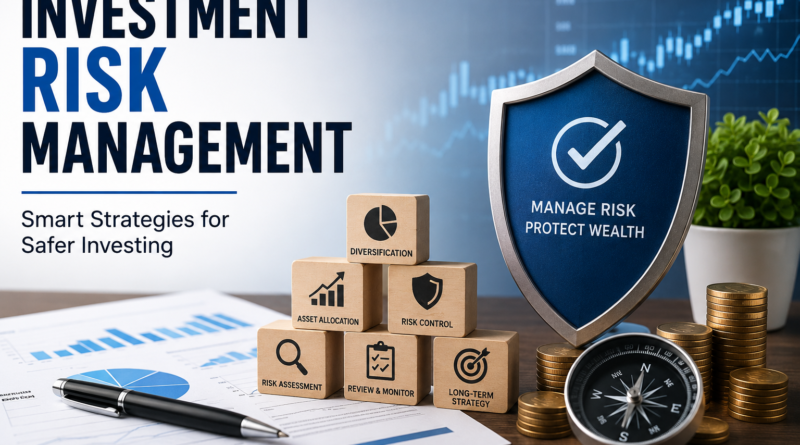
Investment Risk Management Smart Strategies for Safer Investing
Investment Risk Management: A Practical Guide to Protecting Your Portfolio
Investing can help you build wealth over time, but every investment comes with some level of uncertainty. Prices can rise and fall, economic conditions can change, and even carefully selected investments can lose value. This is why Investment Risk Management is an important part of building a successful long-term investment strategy.
Investment risk management is the process of identifying, understanding, and managing the risks associated with investing. It does not mean eliminating every possible loss. Instead, the goal is to make informed decisions, reduce unnecessary risks, and build a portfolio that matches your financial goals, time horizon, and risk tolerance.
Whether you are a beginner or an experienced investor, understanding investment risk management can help you make more disciplined decisions. By using diversification, asset allocation, regular portfolio reviews, and appropriate position sizes, investors can prepare for market uncertainty without abandoning their long-term objectives.
What Is Investment Risk Management?
Investment Risk Management refers to the methods investors use to identify and control potential risks in an investment portfolio.
Every investment has a different risk profile. Stocks may experience significant price fluctuations, bonds can be affected by interest rates and credit conditions, and real estate can be influenced by property values and economic cycles. Even investments that appear relatively stable can experience periods of decline.
Risk management begins with understanding what could cause an investment to lose value. After identifying those risks, an investor can decide how much risk is appropriate and what strategies can be used to manage it.
A good risk management approach usually considers:
- Financial goals
- Investment time horizon
- Risk tolerance
- Asset allocation
- Portfolio diversification
- Market volatility
- Investment concentration
- Liquidity needs
- Potential losses
- Investment costs
The purpose is not to predict every market movement. Instead, it is to create a plan that can continue working even when markets behave differently than expected.
Why Investment Risk Management Matters
Investing without considering risk can lead to decisions that may not fit an investor’s financial situation. For example, someone saving for a short-term goal may not want the same portfolio as someone investing for several decades.
Effective risk management can help investors avoid excessive concentration and emotional decision-making.
One of the biggest advantages is that it encourages investors to think about potential losses before they happen. When markets decline, investors who already understand their risk tolerance may be less likely to make impulsive decisions.
Risk management can also support long-term financial planning. A diversified portfolio with an appropriate mix of investments may be better positioned to handle different market conditions than a portfolio concentrated in a single company, industry, or asset class.
Understanding Different Types of Investment Risk
Before creating a risk management strategy, investors should understand the major types of investment risk.
Market Risk
Market risk is the possibility that an investment will decline because of changes in financial markets.
Stock markets can fall because of economic concerns, geopolitical events, changing interest rates, corporate earnings, or shifts in investor sentiment.
Market risk cannot be completely eliminated when investing in assets whose prices fluctuate. However, diversification and a suitable asset allocation can help manage its effect on a portfolio.
Inflation Risk
Inflation reduces the purchasing power of money over time.
If the return on an investment does not keep pace with inflation, the investor may have less purchasing power in the future.
This is particularly important for long-term financial planning. Investors should consider both the nominal return and the potential effect of inflation when evaluating investment choices.
Interest Rate Risk
Interest rate changes can affect different investments in different ways.
For example, bond prices generally move inversely to interest rates. When interest rates rise, existing bonds with lower interest payments may become less attractive, which can place downward pressure on their market prices.
Understanding interest rate risk is especially important for investors who hold bonds or bond funds.
Credit Risk
Credit risk is the possibility that a borrower may fail to make required payments.
This risk is particularly relevant to corporate bonds and other debt investments. Credit quality can vary considerably between issuers, so investors should understand the financial strength of the organization behind an investment.
Liquidity Risk
Liquidity risk occurs when an investor cannot easily sell an investment at a reasonable price.
Some publicly traded securities can generally be bought or sold relatively easily, while other assets may take longer to sell.
Investors should consider when they might need their money before committing funds to less liquid investments.
Concentration Risk
Concentration risk occurs when too much of a portfolio is invested in one company, sector, asset class, or geographic market.
For example, an investor whose portfolio consists almost entirely of technology stocks could experience significant losses if that sector performs poorly.
Diversification can help reduce concentration risk.
Assess Your Risk Tolerance
Risk tolerance is an important part of investment risk management.
It describes how much investment uncertainty and potential loss an investor is financially and emotionally prepared to accept.
Two people with identical incomes may have completely different risk tolerances. Personal circumstances, financial responsibilities, investment experience, and time horizons can all influence how much risk is appropriate.
Before investing, consider questions such as:
- How long do I plan to invest?
- When will I need this money?
- How much loss could I financially handle?
- Would a temporary market decline cause me to sell?
- Do I have sufficient savings for unexpected expenses?
- What are my major financial goals?
A longer investment horizon may allow an investor to tolerate more short-term volatility, while money needed in the near future may require a more conservative approach.
Risk tolerance should be reviewed periodically because financial circumstances can change.
Build an Appropriate Asset Allocation
Asset allocation is one of the most important tools in investment risk management.
It involves deciding how much of a portfolio should be allocated to different asset classes, such as:
- Stocks
- Bonds
- Cash
- Real estate
- Other investments
Different asset classes have different characteristics. Stocks may offer greater long-term growth potential but can experience substantial short-term volatility. Bonds may provide income and diversification but also have interest rate and credit risks. Cash can provide stability and liquidity but may have limited long-term growth potential.
There is no single asset allocation that is suitable for every investor.
A portfolio should reflect the investor’s financial goals, time horizon, risk tolerance, and personal circumstances.
Use Diversification to Manage Risk
Diversification is a fundamental principle of investment risk management.
Instead of relying heavily on one investment, diversification spreads money across different investments or asset classes.
For example, an investor may diversify across:
- Different companies
- Different industries
- Different asset classes
- Different geographic regions
- Different investment styles
The goal is to avoid having the entire portfolio depend on the performance of one area of the market.
Diversification does not guarantee profits and cannot eliminate investment losses. However, it may reduce the impact of a poor-performing investment or sector on the overall portfolio.
Avoid Over-Diversification
While diversification can be useful, owning too many investments can make a portfolio difficult to monitor.
The objective is not to own every possible investment. Instead, investors should aim for a sensible level of diversification that supports their financial plan.
Consider Position Size
Position sizing is another useful risk management technique.
Position size refers to how much of a portfolio is allocated to a particular investment.
If one investment represents a very large percentage of the portfolio, a significant decline in that investment can have a major effect on total portfolio value.
By keeping individual positions at appropriate sizes, investors can limit the potential impact of a single poor-performing investment.
The appropriate position size depends on the investor’s strategy, risk tolerance, portfolio structure, and investment objectives.
Understand Market Volatility
Market volatility refers to how much investment prices fluctuate over time.
Volatility is a normal part of investing. Prices can move significantly over short periods even when the long-term outlook for an investment has not fundamentally changed.
Investors sometimes make mistakes by treating short-term volatility as a reason to abandon a long-term investment plan.
A strong investment risk management strategy recognizes that volatility is unavoidable in many investments.
Instead of attempting to predict every price movement, investors can focus on:
- Maintaining diversification
- Investing according to a plan
- Matching investments with their time horizon
- Avoiding excessive concentration
- Reviewing risk periodically
Understanding volatility can make it easier to remain disciplined during uncertain markets.
Create an Investment Plan
A written investment plan can make risk management more consistent.
The plan should clearly define the investor’s objectives and the general approach they intend to follow.
An investment plan may include:
- Financial goals
- Investment time horizon
- Risk tolerance
- Target asset allocation
- Diversification guidelines
- Portfolio review schedule
- Rebalancing approach
- Rules for adding or reducing investments
Having a plan can help reduce emotional decisions during periods of market stress.
For example, instead of selling investments simply because prices have fallen, an investor can review whether the portfolio still matches the original investment strategy.
Rebalance Your Portfolio
Over time, market performance can cause a portfolio’s asset allocation to change.
Suppose an investor originally chooses an allocation of 60% stocks and 40% bonds. If stocks rise significantly, stocks may eventually represent a much larger portion of the portfolio.
This can increase the portfolio’s risk beyond the investor’s original plan.
Rebalancing involves adjusting the portfolio back toward its intended allocation.
How often an investor should rebalance depends on their strategy and circumstances. Some investors review their allocation at regular intervals, while others use predetermined thresholds.
Rebalancing should also take transaction costs, taxes, and account rules into consideration.
Use Dollar-Cost Averaging Carefully
Dollar-cost averaging involves investing a fixed amount of money at regular intervals rather than investing everything at once.
For example, an investor might contribute a set amount each month.
This approach can help create a consistent investing habit and reduce the pressure to determine the perfect time to enter the market.
However, dollar-cost averaging does not eliminate market risk and does not guarantee better returns. It is simply one approach investors may consider when developing a long-term investment plan.
Maintain an Emergency Fund
Investment risk management is not limited to the investment account itself.
Maintaining an appropriate emergency fund can also support better investment decisions.
Without accessible savings, an investor may be forced to sell investments during an unfavorable market period to cover an unexpected expense.
An emergency fund can provide a financial buffer for situations such as unexpected bills, temporary income disruptions, or urgent expenses.
The amount needed depends on individual circumstances, income stability, expenses, and financial obligations.
Be Careful With Leverage
Leverage involves using borrowed money to increase the size of an investment position.
While leverage can increase potential gains, it can also magnify losses.
This makes leveraged investing particularly important from a risk management perspective.
Investors who use borrowed funds should understand the costs, risks, margin requirements, and possibility of losses exceeding their initial investment in certain situations.
Beginners should be particularly cautious about strategies they do not fully understand.
Manage Investment Costs
Investment costs can affect long-term returns.
Depending on the investment and account, costs may include:
- Management fees
- Trading commissions
- Fund expense ratios
- Bid-ask spreads
- Account fees
- Taxes
Even relatively small recurring costs can affect portfolio growth over long periods.
Investors should understand the total cost of an investment before making a decision. Lower cost does not automatically mean a particular investment is better, but unnecessary costs can reduce the amount of money that remains invested.
Avoid Emotional Investing
Emotions can have a major influence on investment decisions.
Fear may cause investors to sell after a market decline, while excitement or greed may encourage investors to buy assets simply because prices have recently increased.
Both reactions can lead to decisions that do not match a carefully developed investment strategy.
Investment risk management encourages investors to make decisions based on financial goals, research, risk tolerance, and portfolio strategy rather than short-term emotions.
One useful approach is to establish investment rules before market conditions become stressful.
Review Your Portfolio Regularly
Risk management is not a one-time activity.
A portfolio should be reviewed periodically to make sure it continues to match the investor’s financial situation and objectives.
During a review, investors may consider:
- Current asset allocation
- Portfolio diversification
- Individual investment performance
- Investment fees
- Changes in financial goals
- Changes in risk tolerance
- Upcoming financial needs
Regular review does not mean constantly buying and selling investments. Excessive trading can increase costs and may interfere with a long-term strategy.
The purpose of a review is to determine whether the overall plan still makes sense.
Common Investment Risk Management Mistakes
Even investors who understand risk management can make mistakes.
Putting Too Much Money Into One Investment
Concentration can increase the impact of a single investment’s decline.
Chasing Past Performance
An investment that performed well in the past may not continue to perform at the same rate.
Ignoring Fees
Small recurring costs can reduce long-term investment returns.
Investing Without a Goal
Without a clear objective, it can be difficult to determine an appropriate level of risk.
Reacting to Every Market Movement
Constantly changing a portfolio because of short-term price movements can lead to unnecessary decisions.
Taking More Risk Than Necessary
Higher potential returns generally come with greater uncertainty. Investors should consider whether additional risk is actually necessary to reach their financial goals.
A Simple Investment Risk Management Checklist
Before making an investment decision, consider the following checklist:
Understand the investment: Know what you are buying and how it works.
Identify the risks: Consider market, liquidity, credit, inflation, and concentration risks where relevant.
Check your allocation: Make sure the investment fits within your overall portfolio.
Consider diversification: Avoid unnecessary dependence on a single investment or sector.
Evaluate costs: Understand fees and other expenses.
Review your time horizon: Make sure the investment matches when you expect to need the money.
Consider your risk tolerance: Do not choose an investment solely because it has high return potential.
Have a long-term plan: Avoid making decisions based only on short-term market movements.
Investment Risk Management for Beginners
Beginners do not need a complicated system to start managing investment risk.
A simple approach can begin with understanding personal financial goals and building a diversified portfolio appropriate for the investor’s circumstances.
New investors should learn the basics of stocks, bonds, ETFs, mutual funds, diversification, asset allocation, and compound growth before making significant investment decisions.
It is also important to avoid investments that are not understood simply because they promise high returns.
Starting with a manageable amount and gradually learning how different investments behave can help build confidence and financial knowledge.
The Role of Long-Term Thinking
Long-term thinking is closely connected to investment risk management.
Financial markets can experience periods of growth, decline, uncertainty, and recovery. Investors who focus exclusively on short-term performance may be more likely to make emotional decisions.
A long-term approach does not guarantee positive returns. Instead, it encourages investors to focus on financial objectives rather than attempting to predict every short-term movement.
The most appropriate strategy depends on each investor’s circumstances.
Final Thoughts on Investment Risk Management
Investment Risk Management is an essential part of responsible investing. While no strategy can eliminate investment risk, investors can take practical steps to understand and manage it.
Diversification, appropriate asset allocation, position sizing, portfolio reviews, emergency savings, and disciplined decision-making can all contribute to a stronger risk management approach.
The most important principle is to choose investments that fit your financial goals, time horizon, and ability to handle losses. Avoiding unnecessary risk can be just as important as seeking potential returns.
Investing is a long-term process, and successful risk management requires patience, education, and regular evaluation. By creating a thoughtful investment plan and staying disciplined during changing market conditions, investors can make more informed decisions and work toward their financial goals with greater confidence.
Disclaimer: This article is provided for educational and informational purposes only. It does not constitute financial, investment, tax, or legal advice. Investment values can rise or fall, and past performance does not guarantee future results. Consider your individual circumstances and consult a qualified financial professional before making investment decisions.
Read NEXt
Pingback: 9 Essential Stock Market for Beginners Tips for Smarter Investing