
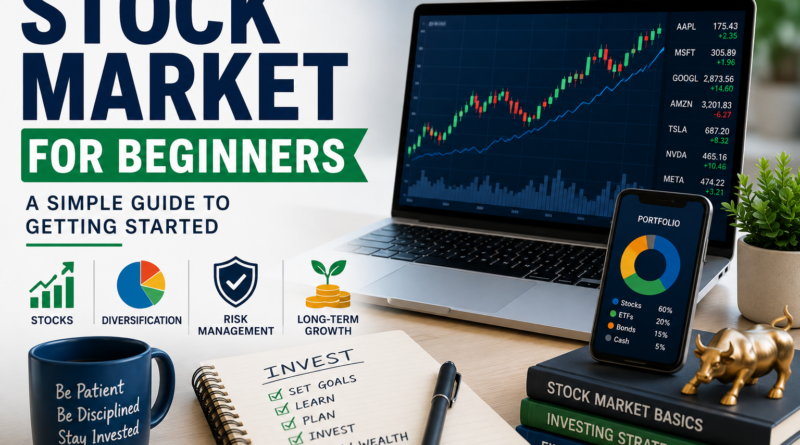
Stock Market for Beginners: A Simple Guide to Getting Started
Stock Market for Beginners: A Simple Guide to Getting Started
The Stock Market for Beginners can seem confusing at first. You may hear terms such as stocks, shares, dividends, indexes, brokers, market orders, and portfolios and wonder how everything fits together. The good news is that you do not need to understand every financial term before you begin learning about investing.
The stock market is a place where investors can buy and sell shares of publicly traded companies. When you purchase a stock, you generally become a partial owner of that company. The value of your investment can increase or decrease depending on the company’s performance, market conditions, investor expectations, and many other factors.
For beginners, the most important step is not trying to make quick profits. It is learning how the stock market works, understanding investment risk, setting financial goals, and developing a sensible long-term strategy.
This guide explains the basics of the Stock Market for Beginners, including how stocks work, how to start investing, different types of investments, common risks, diversification, and mistakes new investors should avoid.
What Is the Stock Market?
The stock market is a broad term for the collection of exchanges and marketplaces where shares of publicly traded companies are bought and sold.
Companies can issue shares to raise capital. Investors can purchase those shares because they believe the company may grow or generate value over time.
Once shares are publicly traded, their prices can change throughout the trading day. Prices are influenced by supply and demand as well as factors such as company earnings, economic conditions, interest rates, industry trends, news, and investor expectations.
For example, if investors become more optimistic about a company’s future, demand for its shares may increase. This can push the stock price higher. If expectations become negative, the price may decline.
Understanding this basic relationship between buyers, sellers, expectations, and prices is an important starting point for anyone learning about the stock market.
How Does the Stock Market Work?
The stock market works through buyers and sellers placing orders for shares.
Investors generally use a brokerage account to access the market. A broker provides the platform through which investors can research investments and place buy or sell orders.
When you place an order to purchase a stock, the order is matched with a seller according to the market’s trading system.
Stock prices can change quickly because millions of investors and institutions may be responding to new information.
Some common factors that influence stock prices include:
- Company earnings
- Revenue growth
- Economic conditions
- Interest rates
- Industry developments
- Consumer demand
- Government policies
- Investor sentiment
- Global events
This is why stock prices can move even when an investor has not personally changed anything about their investment.
What Is a Stock?
A stock represents an ownership interest in a company.
When you buy shares of a publicly traded company, you generally become one of its shareholders. The percentage of ownership depends on how many shares you own compared with the company’s total shares outstanding.
Companies issue stock for several reasons, including raising money to expand operations, develop products, hire employees, reduce debt, or pursue other business objectives.
Investors may benefit from stocks in two main ways.
The first is capital appreciation, which means the value of the shares increases and the investor sells them for more than the purchase price.
The second is dividend income, when a company distributes part of its profits to eligible shareholders.
However, neither outcome is guaranteed. Stock prices can decline, and companies can reduce or eliminate dividends.
Why Do People Invest in Stocks?
Many investors include stocks in their portfolios because stocks have historically provided opportunities for long-term growth, although past performance does not guarantee future results.
Stocks can provide exposure to businesses and industries that may grow over time.
For example, companies operating in areas such as technology, healthcare, financial services, consumer products, energy, and manufacturing may experience different growth patterns.
Stocks can also provide an opportunity to participate in the growth of businesses without owning or operating a company directly.
However, higher potential returns generally come with greater investment risk. Beginners should understand this relationship before investing.
Stock Market for Beginners: Understanding Risk
One of the most important lessons in the Stock Market for Beginners is that investing involves risk.
A stock can lose part or even most of its value. In extreme circumstances, investors can lose their entire investment in an individual company.
Common stock market risks include:
Market Risk
Market risk is the possibility that stock prices will decline because of broader market conditions.
Entire markets can fall during periods of economic uncertainty, recession concerns, financial stress, or changing investor expectations.
Business Risk
A company can experience declining sales, increasing costs, stronger competition, management problems, or other challenges.
Poor business performance can negatively affect its stock price.
Inflation Risk
Inflation can reduce purchasing power and affect companies differently. Investors should consider how inflation may influence their long-term financial objectives.
Liquidity Risk
Some stocks trade frequently while others have lower trading volume. A less liquid investment may be more difficult to sell quickly at a desired price.
Concentration Risk
Investing too much money in one company or industry can make a portfolio vulnerable to problems affecting that specific investment.
Understanding these risks is an essential part of responsible investing.
What Is a Stock Market Index?
A stock market index tracks the performance of a selected group of stocks.
Indexes can help investors understand how a particular segment of the market is performing.
For example, some indexes track large companies, while others focus on specific industries, regions, or market segments.
Indexes are also commonly used as benchmarks. An investor can compare the performance of a portfolio with an appropriate market index to understand how it has performed relative to that benchmark.
Index investing is popular because investors can use index funds or exchange-traded funds to gain exposure to a broad collection of companies.
Stocks vs. ETFs
Beginners often ask whether they should buy individual stocks or exchange-traded funds (ETFs).
An individual stock represents an investment in a particular company.
An ETF, on the other hand, can hold a collection of investments. Some ETFs track broad market indexes, while others focus on industries, countries, bonds, or specific investment strategies.
One potential advantage of an ETF is diversification. Instead of relying on the performance of one company, an investor may gain exposure to many companies through a single fund.
However, ETFs are not risk-free. Their value can also decline, and the level of risk depends on what the ETF holds.
How to Start Investing in the Stock Market
Learning how to start investing is an important part of the Stock Market for Beginners journey.
A basic process can look like this:
1. Define Your Financial Goals
Start by identifying why you want to invest.
Your goal might be long-term wealth building, retirement planning, education expenses, or another financial objective.
A clear goal can help determine how much you need to invest and how much investment risk may be appropriate.
2. Understand Your Time Horizon
Your time horizon is how long you expect to keep your money invested.
Someone investing for several decades may have a different strategy from someone who expects to need the money within a few years.
Time horizon is important because stock prices can fluctuate significantly over shorter periods.
3. Assess Your Risk Tolerance
Think about how you would react if your portfolio declined.
If a temporary decline would cause you to panic and sell, you may need to reconsider whether your investment choices are appropriate for your circumstances.
Risk tolerance involves both financial ability and emotional comfort with market fluctuations.
4. Learn Before You Invest
Take time to understand basic investment concepts.
Learn about stocks, ETFs, mutual funds, dividends, diversification, asset allocation, investment fees, and market risk.
You do not need to become a professional analyst, but you should understand what you are buying.
5. Choose a Brokerage Account
A brokerage account provides access to investments.
Before selecting a broker, consider factors such as:
- Account fees
- Available investments
- Trading costs
- Research tools
- Customer support
- Security features
- Educational resources
Availability and regulations vary by country, so investors should use a properly regulated provider appropriate for their location.
6. Start With an Amount You Can Afford
Do not invest money that you may immediately need for essential expenses.
Investing should fit into your broader financial plan.
If you are new to investing, starting with a manageable amount can help you learn how markets behave without taking unnecessary financial risks.
How Much Money Do You Need to Start?
There is no universal amount that every investor needs to begin.
Some brokerage platforms allow investors to purchase fractional shares, which can make certain investments more accessible.
The more important question is whether the money being invested is appropriate for your financial situation.
Before investing, consider maintaining adequate emergency savings and dealing with high-cost debt where appropriate.
Investing should generally be viewed as part of a broader financial plan rather than a replacement for basic financial stability.
Understanding Diversification
Diversification is one of the most useful concepts in the Stock Market for Beginners.
Diversification means spreading investments across different assets instead of putting all your money into one investment.
For example, a diversified portfolio may contain exposure to multiple companies, industries, asset classes, or geographic markets.
The purpose is to reduce concentration risk.
If one company performs poorly, its impact on a diversified portfolio may be smaller than it would be if the entire portfolio were invested in that company.
Diversification does not guarantee profits and cannot completely prevent losses. It is simply a method of managing risk.
What Is Asset Allocation?
Asset allocation refers to how an investor divides a portfolio among different asset classes.
A portfolio might contain stocks, bonds, cash, or other investments.
The appropriate allocation depends on factors such as:
- Financial goals
- Investment horizon
- Risk tolerance
- Income situation
- Liquidity requirements
- Personal circumstances
A younger investor with a long time horizon may have different needs from someone approaching retirement.
There is no single asset allocation that is appropriate for everyone.
Understanding Dividends
Some companies distribute a portion of their earnings to shareholders in the form of dividends.
Dividends can provide income to investors, although companies are generally not required to maintain the same dividend indefinitely.
A company may increase, reduce, suspend, or eliminate its dividend depending on its financial condition and business decisions.
Beginners should avoid choosing stocks solely because they offer a high dividend yield.
A high yield can sometimes reflect a falling share price or financial challenges. Investors should consider the overall business and financial condition of a company rather than focusing on one metric.
Long-Term Investing vs. Short-Term Trading
Beginners should understand the difference between investing and short-term trading.
Long-term investing generally involves holding investments for an extended period while focusing on broader financial goals.
Short-term trading involves buying and selling investments more frequently in an attempt to benefit from shorter-term price movements.
Short-term trading can require significant knowledge, discipline, time, and risk management.
New investors should not assume that frequent trading automatically leads to better returns.
For many people, a diversified long-term investment approach may be easier to manage than attempting to predict daily market movements.
Common Stock Market Mistakes for Beginners
New investors often make avoidable mistakes.
Investing Based on Hype
Buying a stock simply because it is trending on social media can expose investors to unnecessary risk.
Popularity does not guarantee that an investment is suitable or fairly valued.
Trying to Time the Market
Some investors attempt to predict the exact best time to buy and sell.
Consistently predicting short-term market movements is extremely difficult.
Ignoring Diversification
Putting most of your money into one stock can create substantial concentration risk.
Checking Prices Constantly
Watching stock prices every few minutes can encourage emotional decisions.
Investing Without Research
Buying something without understanding what it is can lead to unexpected risks.
Chasing Past Returns
A stock or fund that performed exceptionally well in the past may not continue doing so.
Past performance should not be treated as a guarantee of future results.
How Beginners Can Manage Investment Risk
Good risk management does not require predicting every market decline.
Instead, beginners can focus on practical habits.
Diversify your portfolio: Avoid unnecessary concentration.
Invest according to your goals: Your portfolio should support your financial objectives.
Understand what you buy: Never invest in something you do not understand.
Consider your time horizon: Match investments with when you expect to need the money.
Review your portfolio: Check periodically whether your allocation still matches your plan.
Avoid excessive leverage: Borrowing to invest can magnify losses.
Control unnecessary costs: Fees and expenses can reduce long-term results.
Stay disciplined: Avoid making major decisions based solely on fear or excitement.
How to Research a Stock
If you decide to research individual companies, start with basic information.
Look at the company’s business model and understand how it generates revenue.
You can also examine financial information such as:
- Revenue
- Earnings
- Cash flow
- Debt
- Profit margins
- Competitive position
- Industry conditions
Investors may also review company filings and official financial reports.
No single metric can tell you whether a stock is a good investment. Research should involve understanding the overall business and its risks.
How Compound Growth Can Help Investors
Compound growth occurs when investment earnings generate additional earnings over time.
For example, if an investment generates returns and those returns remain invested, future growth can occur on both the original amount and previous earnings.
Time can therefore be an important factor in long-term investing.
However, real investment returns are not guaranteed, and actual results can vary considerably from one period to another.
The concept of compounding demonstrates why consistent investing and a long time horizon can be valuable components of a financial plan.
When Should Beginners Buy Stocks?
There is no universally perfect time to buy stocks.
Markets are influenced by countless variables, and predicting short-term price movements is difficult.
Instead of focusing entirely on finding the perfect entry point, beginners may benefit from developing a consistent investment process.
For example, some investors contribute money regularly according to a predetermined plan.
This approach can reduce the temptation to make decisions based entirely on short-term market movements.
However, the right approach depends on an investor’s financial situation, goals, and strategy.
Frequently Asked Questions About the Stock Market for Beginners
Is the stock market safe for beginners?
The stock market involves risk, so it should not be considered completely safe. Stock prices can decline, sometimes significantly. Beginners should understand these risks before investing.
Can I start investing with a small amount?
Yes, depending on the brokerage platform and available investments. Some platforms support fractional shares, which can allow investors to begin with smaller amounts.
Should beginners buy individual stocks?
Some beginners may choose individual stocks, but they require research and involve company-specific risk. Diversified funds can provide another approach to gaining market exposure.
Can I lose all my money in stocks?
An individual stock can potentially lose most or all of its value if the company fails. Diversification can help reduce the impact of one company’s failure on a broader portfolio.
How long should I hold stocks?
There is no universal holding period. The appropriate time horizon depends on your investment goals, strategy, and financial circumstances.
Final Thoughts on the Stock Market for Beginners
Learning about the Stock Market for Beginners does not have to be complicated. The most important concepts are understanding what stocks are, how markets work, why prices fluctuate, and how investment risk affects your financial goals.
Beginners can create a stronger foundation by setting clear goals, understanding their risk tolerance, learning about diversification, choosing investments carefully, and maintaining a long-term perspective.
The stock market can provide opportunities for wealth building, but it also involves uncertainty and potential losses. There are no guaranteed returns, and past performance cannot predict future results.
The best approach is to keep learning, avoid decisions based purely on hype or emotion, and build an investment strategy that fits your individual circumstances.
Disclaimer: This article is for educational and informational purposes only. It is not financial, investment, tax, or legal advice. Investments involve risk, including the potential loss of money. Past performance does not guarantee future results. Consider your personal financial circumstances and, where appropriate, consult a qualified financial professional before making investment decisions.
Read Next
Pingback: 7 Proven Tips on How to Buy Stocks for Beginners