
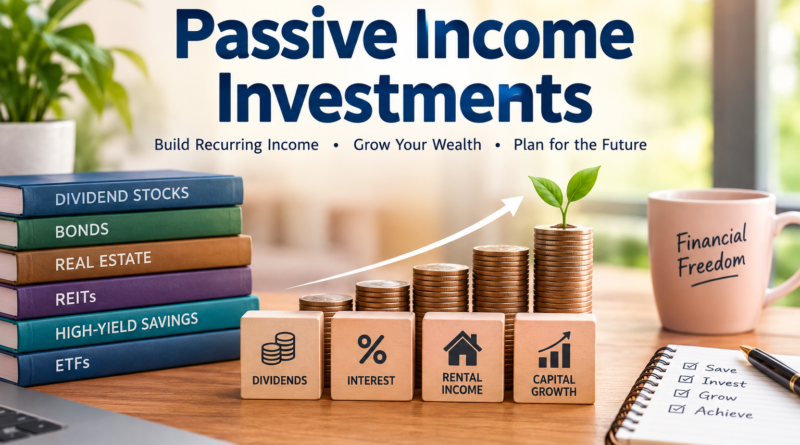
Passive Income Investments: A Complete Guide to Building Ongoing Income
Passive Income Investments can help you create additional income without requiring you to actively work for every dollar you earn. While no investment is completely effortless or risk-free, certain investments can generate recurring income through dividends, interest, rent, or other cash flows.
Building passive income usually requires an upfront investment of money, time, or both. The key is to choose investments that match your financial goals, risk tolerance, time horizon, and available capital.
This guide explains how passive income investments work, the main types to consider, their potential benefits and risks, and practical ways to build a diversified passive-income strategy.
What Are Passive Income Investments?
Passive income investments are assets that can potentially generate recurring income with limited day-to-day involvement from the investor.
Instead of earning money only by working a certain number of hours, you own an asset that produces cash flow. Examples include:
- Dividend-paying stocks
- Dividend ETFs
- Bonds
- Certificates of deposit
- Real estate
- Real estate investment trusts
- High-yield savings accounts
- Money market funds
- Peer-to-peer lending
- Certain annuities
The amount of income you receive depends on the investment, amount invested, interest or dividend rate, market conditions, taxes, fees, and other factors.
For example, if an investment generates a 4% annual yield and you invest $10,000, the initial annual income would be approximately $400 before taxes and fees if the yield remained unchanged.
However, investment returns are not guaranteed, and the value of an asset can rise or fall.
How Do Passive Income Investments Work?
Passive income investments generally work by allowing you to own an income-producing asset.
There are several common ways an investment can generate income.
Interest Income
Some investments pay interest to investors. Bonds, certificates of deposit, and savings products are common examples.
You provide money to a financial institution, government, or company, and in return, you may receive interest according to the terms of the investment.
Dividend Income
Companies can distribute part of their profits to shareholders through dividends.
For example, if you own 100 shares of a company paying $1 per share annually, you would receive $100 in dividends, assuming the company maintains that dividend.
Dividends can be increased, reduced, or eliminated.
Rental Income
Real estate can generate income through rent paid by tenants.
Property owners may receive monthly rental payments, but rental property is not completely passive because maintenance, vacancies, insurance, taxes, financing, and property management can require ongoing attention.
Capital Appreciation
Some investors also benefit when an asset increases in value.
For example, you could purchase an investment for $10,000 and later sell it for $13,000. The $3,000 difference represents a capital gain before considering fees and taxes.
Capital appreciation is different from recurring income because you generally need to sell an asset to realize the gain.
10 Passive Income Investments to Consider
There are many ways to potentially generate passive income. The right choice depends on your individual circumstances.
1. Dividend-Paying Stocks
Dividend stocks are among the most commonly discussed passive income investments.
When you purchase shares of a company that pays dividends, you may receive periodic payments without selling your shares.
Some established companies have histories of paying dividends over many years.
Advantages
- Potential recurring income
- Potential long-term capital growth
- Easy to buy through brokerage accounts
- Dividends may increase over time
Risks
- Stock prices can decline
- Dividends can be reduced or suspended
- Individual companies can experience financial problems
- Dividend income is not guaranteed
Investors should evaluate the company’s financial condition rather than choosing a stock simply because it has a high dividend yield.
2. Dividend ETFs
Dividend exchange-traded funds, commonly called dividend ETFs, hold a collection of stocks that meet specific criteria.
Instead of purchasing individual dividend stocks, an investor can purchase shares of a fund that owns multiple companies.
This can provide diversification across numerous holdings.
For example, instead of relying on the dividend from one company, a dividend-focused ETF may hold dozens or hundreds of companies.
Why Investors Consider Dividend ETFs
Dividend ETFs can provide:
- Diversification
- Regular distributions
- Professional fund management
- Easy trading
- Exposure to multiple companies
However, ETFs charge expenses, and their prices can fluctuate with the market.
3. Bonds
Bonds are another potential source of passive income.
When you purchase a bond, you are generally lending money to a government, municipality, or company. In return, the issuer may pay interest according to the bond’s terms.
Bonds can have different maturities, interest rates, and levels of credit risk.
Bond Risks
Important risks include:
- Interest-rate risk
- Credit/default risk
- Inflation risk
- Reinvestment risk
- Market-price risk
Generally, bonds with higher potential yields may involve greater risk.
4. Certificates of Deposit
Certificates of deposit, or CDs, are deposit products offered by banks and other financial institutions.
You generally agree to leave your money deposited for a specific period in exchange for an interest rate.
For example, a bank could offer a six-month, one-year, or two-year CD.
CDs can be useful for investors who prioritize predictable interest income and don’t need immediate access to the money.
However, early-withdrawal penalties may apply depending on the account terms.
5. High-Yield Savings Accounts
A high-yield savings account can generate interest while keeping your money relatively accessible.
Unlike many investments, savings accounts are designed primarily for cash management rather than long-term market growth.
They may be appropriate for:
- Emergency funds
- Short-term savings
- Cash reserves
- Money waiting to be invested
Interest rates can change, so the income generated by a savings account may not remain constant.
6. Real Estate Investment Trusts
Real estate investment trusts, or REITs, allow investors to gain exposure to real estate without directly purchasing and managing a property.
A REIT may own or operate properties such as:
- Apartment buildings
- Office buildings
- Shopping centers
- Warehouses
- Hotels
- Healthcare properties
Investors can potentially receive distributions from the income generated by the underlying real estate.
REITs can be traded through brokerage accounts, making them easier to access than buying physical property.
However, REIT prices can fluctuate, and their income can be affected by interest rates, property markets, vacancies, and economic conditions.
7. Rental Properties
Owning rental property can provide recurring rental income.
For example, an investor purchases a property and rents it to tenants. The rental payments can help cover expenses such as:
- Mortgage payments
- Property taxes
- Insurance
- Repairs
- Maintenance
- Property management
If rental income exceeds expenses, the remaining amount can become cash flow.
Rental property can generate significant income, but it is not completely passive.
Hiring a property manager can reduce the owner’s day-to-day workload, although management fees reduce the amount of income retained.
8. Money Market Funds
Money market funds invest in short-term, relatively liquid instruments.
They are often used by investors looking for a place to hold cash while potentially earning income.
Money market funds can be useful for short-term cash management, but they are not the same as bank savings accounts and may carry investment risks.
Investors should understand the specific fund’s holdings, expenses, and objectives before investing.
9. Annuities
Annuities are financial products that can provide income according to specific contractual terms.
Some annuities are designed to provide payments for a defined period or potentially for life.
They can be complicated because contracts may include:
- Fees
- Surrender periods
- Insurance costs
- Withdrawal restrictions
- Different payout structures
Because annuities vary considerably, investors should carefully review the contract before purchasing one.
10. Peer-to-Peer Lending
Peer-to-peer lending platforms connect borrowers with investors who provide funding.
Investors may earn interest when borrowers repay their loans.
The potential returns can be attractive, but so can the risks.
Borrowers may fail to repay their loans, and platform-specific risks can also exist.
Investors should never assume that a stated interest rate represents a guaranteed return.
How to Choose Passive Income Investments
Choosing an investment should involve more than simply looking for the highest yield.
A high yield can sometimes indicate higher risk.
Consider these factors before investing.
Risk Tolerance
Ask yourself how much investment loss you could tolerate.
A person who cannot tolerate significant price fluctuations may have different priorities from someone with a long investment horizon and a higher tolerance for market volatility.
Investment Time Horizon
Your investment timeline matters.
If you need the money within a few months, highly volatile investments may not be appropriate for that particular goal.
If your goal is decades away, you may have more time to tolerate short-term market fluctuations.
Income Requirements
Think about why you want passive income.
Are you trying to:
- Supplement your salary?
- Build retirement income?
- Pay recurring expenses?
- Reinvest income for growth?
- Build long-term wealth?
Your objective can influence the type of investments you consider.
Diversification
Avoid relying on a single investment for all of your income.
A diversified portfolio can spread exposure across different assets, sectors, companies, and income sources.
For example, an investor might combine stocks, bonds, cash, and real estate-related investments rather than relying entirely on one company.
Diversification does not eliminate investment risk, but it can reduce the impact of problems affecting a single investment.
How Much Money Do You Need for Passive Income?
There is no universal amount required to start building passive income.
You can begin with relatively small amounts through investments such as fractional shares, ETFs, or savings products, depending on the platform and country.
The amount required to generate meaningful income depends heavily on the expected yield.
For example:
| Investment Amount | 4% Annual Yield | Approx. Annual Income |
|---|---|---|
| $5,000 | 4% | $200 |
| $10,000 | 4% | $400 |
| $25,000 | 4% | $1,000 |
| $50,000 | 4% | $2,000 |
| $100,000 | 4% | $4,000 |
| $250,000 | 4% | $10,000 |
These figures are simple illustrations, not guaranteed returns. Actual income can vary, and taxes and investment expenses can reduce the amount received.
The table also demonstrates an important principle: the amount of capital matters when building passive income.
Should You Reinvest Passive Income?
Reinvesting income can help increase your investment balance over time.
Suppose you receive dividends or interest and use that money to purchase additional investments. Those additional assets can potentially generate more income in the future.
This creates a compounding effect.
For example:
Initial investment → income → reinvest income → larger investment balance → potentially more income
Investors focused on long-term wealth building may choose to reinvest distributions instead of spending them.
Investors who already need income may choose to use some or all of the payments for living expenses.
Passive Income vs. Active Income
Passive income and active income are different.
Active income generally requires direct participation, such as working a job or providing services.
Passive investment income can continue to arrive from assets you own, although the assets still require monitoring and can involve risk.
For example:
| Active Income | Passive Investment Income |
|---|---|
| Salary | Dividends |
| Freelance work | Interest |
| Consulting | Rental income |
| Business services | Fund distributions |
| Hourly work | Bond income |
Passive income does not mean “free money.” Most passive investments require capital, research, monitoring, and risk management.
Common Mistakes to Avoid
Building passive income sounds attractive, but investors can make expensive mistakes.
Chasing Extremely High Yields
A very high yield may look appealing, but it can indicate substantial risk.
Before investing, investigate why the yield is high and whether the underlying income is sustainable.
Ignoring Fees
Investment fees can reduce long-term returns.
Review:
- Expense ratios
- Trading fees
- Account fees
- Management fees
- Property expenses
- Early withdrawal penalties
Small fees can become significant over many years.
Putting Everything Into One Asset
Concentration creates additional risk.
If your entire passive income strategy depends on one company, property, or investment, a problem with that asset could significantly reduce your income.
Forgetting Taxes
Investment income can have tax consequences.
Dividends, interest, rental income, and capital gains may receive different tax treatment depending on your country and circumstances.
Always consider taxes when estimating your actual income.
Expecting Guaranteed Returns
Most investments involve some level of uncertainty.
A projected return, dividend yield, or interest rate should not automatically be treated as guaranteed income.
A Simple Passive Income Investment Strategy
A straightforward approach can help investors organize their goals.
Step 1: Build an Emergency Fund
Before focusing heavily on passive income investments, consider maintaining an emergency cash reserve appropriate for your circumstances.
This can help prevent you from selling investments unexpectedly when an emergency occurs.
Step 2: Pay Attention to Expensive Debt
High-interest debt can work against wealth-building efforts.
Paying down expensive debt may be an important part of your overall financial plan.
Step 3: Define Your Income Goal
Determine how much additional income you eventually want.
For example:
Goal: $500 per month
That equals:
$500 × 12 = $6,000 per year
You can then estimate how much invested capital would be required at different hypothetical yields.
Step 4: Choose a Diversified Mix
Instead of searching for one perfect investment, consider whether multiple asset classes fit your goals.
Step 5: Reinvest When Appropriate
If you do not need the income immediately, reinvesting distributions can help grow the investment base.
Step 6: Review Your Portfolio
Your financial circumstances and investment goals can change.
Review your portfolio periodically and make adjustments when appropriate.
Can Passive Income Replace a Salary?
Passive income can potentially become a significant part of someone’s financial resources, but replacing a full salary generally requires substantial capital or assets capable of producing substantial cash flow.
For example, someone targeting $40,000 per year would need significantly more capital than someone targeting $4,000 per year if both relied on the same hypothetical yield.
This is why building passive income is often a long-term process.
Rather than expecting immediate financial independence, investors can focus on gradually increasing their assets and income-producing investments.
Benefits of Passive Income Investments
Passive income investments can offer several potential benefits.
Recurring Cash Flow
Certain investments can provide regular interest, dividends, distributions, or rental payments.
Potential Wealth Growth
Some investments can generate income while also appreciating over time.
Diversification of Income
Investment income can provide another potential source of money besides employment.
Long-Term Compounding
Reinvesting income can potentially accelerate portfolio growth over long periods.
Greater Financial Flexibility
A growing investment income stream may provide additional flexibility for future financial goals.
Risks of Passive Income Investments
Passive income investments are not risk-free.
Important risks include:
- Market volatility
- Loss of principal
- Inflation
- Interest-rate changes
- Company-specific risk
- Credit risk
- Liquidity risk
- Real estate vacancies
- Changes in dividend payments
- Taxes and fees
Understanding these risks is just as important as understanding potential income.
Frequently Asked Questions
What are the best passive income investments?
There is no single investment that is best for everyone. Dividend stocks, ETFs, bonds, CDs, savings products, REITs, and rental properties all have different risk, income, liquidity, and growth characteristics.
How can I start passive income investments with little money?
You can start by researching low-cost diversified investments, savings products, or fractional investment options available in your country. Even small contributions can build over time.
Is passive income really passive?
Not completely. Investments may require research, monitoring, tax planning, maintenance, or portfolio adjustments. Rental properties, in particular, can require significant management unless professional help is used.
Can passive income make you financially independent?
It can contribute to financial independence, but the result depends on your income needs, investment returns, savings rate, expenses, taxes, and amount of invested capital.
Is dividend income guaranteed?
No. Companies can reduce, suspend, or eliminate dividends. Investors should evaluate the financial strength and dividend history of a company rather than assuming payments will continue.
How much should I invest for passive income?
There is no universal amount. Start by defining your income goal, timeline, risk tolerance, and financial situation. Then estimate how much capital may be required under realistic return assumptions.
Final Thoughts
Passive Income Investments can be an important part of a long-term financial strategy. Dividend stocks, ETFs, bonds, CDs, REITs, rental properties, and other income-producing assets can potentially create recurring cash flow.
However, passive income should not be viewed as guaranteed or effortless money. Every investment has different risks, costs, tax considerations, and potential returns.
A practical approach is to start with clear financial goals, maintain appropriate cash reserves, diversify your investments, control unnecessary costs, and focus on long-term consistency rather than chasing unusually high yields.
Over time, regularly investing and reinvesting income can help increase the amount of capital working for you. The goal is not simply to find an investment that pays income today, but to build a sustainable financial system that supports your future goals.
REad Next