
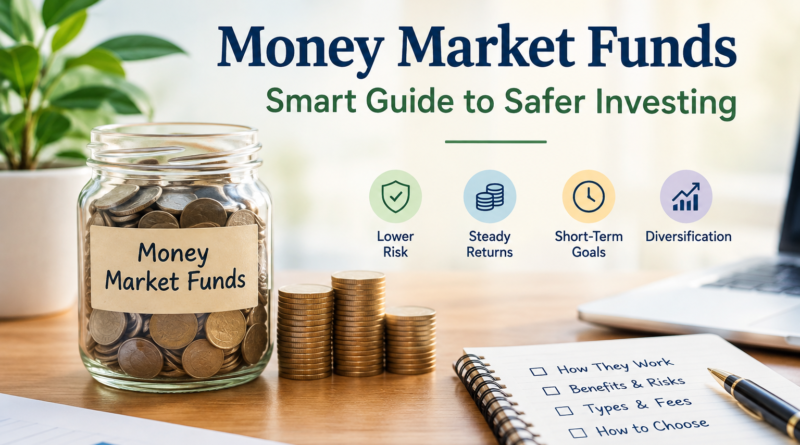
Money Market Funds: A Complete Guide for Investors
Money market funds are investment funds designed to provide investors with a relatively stable place to hold cash while earning income from short-term, high-quality investments. They are commonly used by individuals, businesses, and institutions that want liquidity without keeping all their money in a traditional bank account.
Understanding money market funds can help investors decide whether they fit into a short-term savings strategy, emergency fund, investment portfolio, or cash-management plan. Although these funds are generally considered lower-risk investments compared with stocks, they are not completely risk-free.
In this guide, we will explain what money market funds are, how they work, the different types, their benefits and risks, how they compare with savings accounts and other investments, and what investors should consider before investing.
What Are Money Market Funds?
A money market fund is a type of mutual fund that invests primarily in short-term debt and cash-equivalent securities. The investments may include Treasury securities, government obligations, certificates of deposit, commercial paper, and other short-term instruments, depending on the specific fund.
The primary goal is usually to provide:
- Capital preservation
- Liquidity
- Short-term income
- Lower volatility than many other investments
Unlike a regular savings account, a money market fund is an investment product. When you purchase shares of a money market fund, your money is pooled with money from other investors and managed according to the fund’s investment strategy.
The fund earns income from the securities it holds and generally distributes that income to shareholders.
How Do Money Market Funds Work?
Money market funds collect money from many investors and use that money to purchase short-term securities.
For example, imagine an investor puts $10,000 into a money market fund. Instead of simply holding the $10,000 as cash, the fund manager may invest the pooled money in short-term government securities and other eligible instruments.
Those securities generate interest or other income. After expenses, the fund generally passes much of that income to its investors.
A simplified process looks like this:
Investor → Money Market Fund → Short-Term Securities → Income → Investor
The fund manager is responsible for selecting investments that meet the fund’s objectives and applicable requirements.
Why Do Investors Use Money Market Funds?
Money market funds are often used for money that investors may need relatively soon.
For example, an investor might use a money market fund to hold:
- Emergency savings
- Money waiting to be invested
- A house down payment
- Short-term financial reserves
- Business cash
- Retirement account cash awaiting investment
- Proceeds from selling another investment
The appropriate use depends on the investor’s circumstances, time horizon, risk tolerance, taxes, and the specific fund.
Types of Money Market Funds
Not all money market funds invest in exactly the same securities. Their strategies can differ significantly.
1. Government Money Market Funds
Government money market funds primarily invest in government securities and related instruments.
Examples may include:
- U.S. Treasury bills
- Government agency securities
- Repurchase agreements backed by government securities
These funds are generally designed to focus on high-quality government-related instruments.
However, government money market funds can still involve investment risks and are not identical to directly holding government securities.
2. Prime Money Market Funds
Prime money market funds generally invest in a broader range of short-term securities issued by financial institutions, corporations, and other eligible borrowers.
Because their investment universe can be broader than government funds, their yields may sometimes differ from those of government-focused funds.
Investors should review the fund’s prospectus to understand exactly what it owns.
3. Municipal Money Market Funds
Municipal money market funds invest primarily in short-term municipal securities.
Some investors may consider these funds because certain income may receive favorable tax treatment depending on the investor’s location and circumstances.
Tax treatment can vary, so investors should not assume that all income from a municipal money market fund is tax-free.
Money Market Funds vs. Money Market Accounts
The names sound similar, but money market funds and money market deposit accounts are different products.
A money market fund is an investment fund.
A money market deposit account is a bank or credit-union deposit account.
The distinction matters because their protections, structures, interest calculations, and risks can be different.
For example:
| Feature | Money Market Fund | Money Market Deposit Account |
|---|---|---|
| Product type | Investment fund | Bank/credit-union deposit |
| Main purpose | Cash investment | Cash savings |
| Returns | Based on fund investments | Interest paid by institution |
| Investment risk | Yes | Deposit account risks |
| Government deposit insurance | Generally no | May apply when eligible |
| Liquidity | Generally high | Generally high |
| Value | Can have investment-related changes | Deposit balance generally does not fluctuate like a fund |
Always check the specific product and applicable protections rather than relying on the name alone.
Money Market Funds vs. Savings Accounts
A savings account is generally designed for depositing and accessing cash, while a money market fund invests in short-term securities.
A savings account may be useful for money that needs strong liquidity and applicable deposit protection.
A money market fund may appeal to investors who want their cash invested in short-term securities while receiving investment income.
The right choice depends on factors such as:
- Interest rate or current yield
- Fees
- Deposit insurance
- Liquidity requirements
- Taxes
- Investment objectives
- Risk tolerance
Money Market Funds vs. Certificates of Deposit
Certificates of deposit, or CDs, generally require an investor to leave money deposited for a specified period in exchange for an agreed interest rate.
Money market funds generally offer greater flexibility because shares can usually be bought or sold according to the fund’s rules.
However, a CD and a money market fund have different structures and risks.
A CD may provide a predictable interest rate for its term, while a money market fund’s yield can change as market interest rates change.
Money Market Funds vs. Bond Funds
Money market funds invest in very short-term securities, while bond funds can hold bonds with much longer maturities.
Bond funds may therefore experience larger price changes when interest rates move.
For investors who need relatively stable cash management, the shorter maturity profile of money market funds can be an important characteristic.
However, lower volatility generally also means lower potential long-term returns compared with investments such as diversified stock funds.
Benefits of Money Market Funds
1. Liquidity
One of the main reasons investors use money market funds is liquidity.
Shares can generally be purchased or redeemed according to the fund’s rules, making them useful for managing short-term cash.
2. Lower Volatility
Money market funds generally invest in short-term, high-quality securities.
Their prices may therefore be less volatile than many stock or longer-term bond investments.
That does not mean their value or income can never change.
3. Diversification
Instead of investing directly in one short-term security, investors can gain exposure to a portfolio of securities through one fund.
This can help spread exposure across multiple issuers and instruments.
4. Professional Management
Money market funds are managed by professional investment managers who monitor the fund’s portfolio and investment requirements.
This can be convenient for investors who do not want to select individual short-term securities themselves.
5. Useful for Temporary Cash
Suppose an investor sells a stock but is not ready to purchase another investment.
Instead of leaving the money unused, the investor might place it in a suitable cash-management vehicle while deciding what to do next.
Money market funds can serve this type of temporary role.
Risks of Money Market Funds
Although money market funds are often viewed as conservative investments, they are not risk-free.
1. Investment Risk
The securities held by the fund can experience problems related to credit quality, liquidity, interest rates, or market conditions.
A fund’s performance can therefore differ from expectations.
2. No Guaranteed Return
The income generated by a money market fund can change.
If short-term interest rates fall, the fund’s yield may also decline.
Investors should not assume that today’s yield will remain unchanged.
3. Inflation Risk
One of the most important long-term risks is inflation.
Suppose a money market fund earns 4% while inflation is 3%.
The nominal return is positive, but the investor’s purchasing power increases by much less after considering inflation.
If inflation becomes higher than the fund’s return, the investor’s real purchasing power can decline.
4. Fees and Expenses
Money market funds charge operating expenses.
Even a relatively small expense ratio can reduce the amount of income an investor ultimately receives.
When comparing funds, investors should examine both the stated yield and the fund’s expenses.
5. Liquidity Risk
Under stressed market conditions, some short-term securities can become harder to sell.
Money market funds have specific rules and safeguards designed around liquidity, but investors should still understand that financial markets can become stressed.
6. Tax Considerations
Income from money market funds may be taxable depending on the type of fund and the investor’s jurisdiction.
Municipal money market funds may have different tax characteristics.
Investors should review applicable tax rules before making decisions.
Are Money Market Funds Safe?
Money market funds are generally considered lower-risk investments, but “lower risk” does not mean “risk-free.”
Their focus on short-term, high-quality securities is intended to reduce volatility and credit exposure. However, the fund remains an investment product.
Investors should distinguish between:
Lower risk: The investment has historically or structurally lower volatility or credit exposure.
No risk: The investor is guaranteed not to lose money.
These are not the same thing.
Before investing, read the fund’s prospectus, investment strategy, risks, fees, and applicable investor protections.
What Determines Money Market Fund Returns?
Several factors influence the income generated by a money market fund.
Interest Rates
Short-term interest rates have a major effect on money market fund yields.
When short-term rates rise, newly purchased securities may offer higher yields.
When rates decline, the fund’s income may eventually decline as older securities mature and are replaced with lower-yielding investments.
Fund Expenses
A fund with higher expenses may provide a lower net return than another fund with similar investments.
This is why investors should compare net yield, not simply the headline yield.
Portfolio Holdings
Different money market funds can hold different securities.
Government-focused funds, prime funds, and municipal funds may have different yield and risk characteristics.
How to Choose a Money Market Fund
There is no single money market fund that is appropriate for every investor.
Before choosing one, consider the following factors.
1. Investment Objective
Ask why you are investing.
Are you:
- Protecting short-term cash?
- Waiting for another investment opportunity?
- Saving for a near-term purchase?
- Managing business cash?
- Seeking current income?
Your objective should guide the type of fund you consider.
2. Yield
Compare the fund’s current yield with other suitable cash-management options.
Remember that yields can change.
A higher current yield does not automatically mean the fund is appropriate for your situation.
3. Expense Ratio
Check the fund’s annual operating expenses.
Two funds with similar investments can produce different results if their costs are different.
4. Portfolio Quality
Review the types of securities held by the fund.
Consider the credit quality, maturity profile, and concentration of the portfolio.
5. Liquidity
Check the fund’s redemption policies and settlement procedures.
Make sure they match your cash-access needs.
6. Minimum Investment
Some funds may require a minimum initial investment, while others may have lower or no minimums.
7. Tax Treatment
Understand how distributions may be taxed.
This can be particularly important when comparing taxable and municipal money market funds.
Example of Using a Money Market Fund
Imagine Sarah receives $20,000 from selling an investment.
She does not want to immediately purchase another long-term investment because she expects to need part of the money within several months.
She could consider placing some of the cash into an appropriate money market fund while she evaluates her next investment.
The fund may generate income during that period.
However, Sarah should still consider the fund’s expenses, liquidity, taxes, and risks before investing.
This example illustrates one common use: temporary cash management rather than long-term wealth building.
Are Money Market Funds Good for Long-Term Investing?
Money market funds can play a useful role in a long-term financial plan, but they are generally not designed to provide the same long-term growth potential as investments such as diversified stock funds.
For example, someone saving for retirement over several decades may need investments capable of growing faster than inflation over the long run.
Keeping all long-term retirement money in cash-like investments can create inflation and opportunity-cost concerns.
On the other hand, an investor approaching a near-term financial goal may value liquidity and stability more than long-term growth.
The appropriate allocation depends on the investor’s goals, time horizon, and risk tolerance.
Money Market Funds and Emergency Funds
Emergency funds are designed to cover unexpected expenses such as:
- Medical bills
- Car repairs
- Home repairs
- Temporary loss of income
- Unexpected family expenses
Because emergency money may be needed quickly, liquidity is important.
Some people use savings accounts, money market deposit accounts, or money market funds for this purpose.
The key is to understand the differences between these products, especially regarding access, fees, and applicable protections.
Common Mistakes to Avoid
Chasing the Highest Yield
A higher yield can be attractive, but investors should examine the entire fund.
Look at:
- Risk
- Expenses
- Portfolio composition
- Liquidity
- Tax treatment
- Fund policies
Ignoring Fees
Even small fees can reduce investment income over time.
Always check the expense ratio and other applicable charges.
Treating a Money Market Fund Like a Bank Account
A money market fund is an investment product.
Do not automatically assume that it has the same protections as a bank deposit.
Ignoring Inflation
A stable-looking return may still fail to preserve purchasing power if inflation remains high.
Using It for Every Financial Goal
Money market funds may be useful for short-term objectives, but long-term investors should consider whether their overall portfolio has enough exposure to assets designed for long-term growth.
Frequently Asked Questions
What is a money market fund?
A money market fund is an investment fund that generally invests in short-term, high-quality securities and is designed to provide liquidity and current income with relatively low volatility.
Can you lose money in a money market fund?
Yes. Money market funds are investments and are not completely risk-free. Their risks can include credit, liquidity, interest-rate, and market-related risks.
Do money market funds pay interest?
They generally earn income from the securities in their portfolios and distribute income to shareholders, often in the form of dividends.
Are money market funds FDIC insured?
Money market funds are generally not FDIC-insured bank deposits. Investors should distinguish them from money market deposit accounts offered by banks.
Are money market funds good for beginners?
They can be useful for investors who understand their purpose and risks, particularly for short-term cash management. Beginners should review the fund’s prospectus and fees before investing.
Can money market funds lose value?
Yes. Although they are designed to maintain relatively stable values, they are not guaranteed investments.
Are money market funds good for retirement?
They can have a role in a retirement portfolio, particularly for short-term cash needs or conservative allocations. However, a retirement strategy covering many years may require a broader mix of investments.
How long should you keep money in a money market fund?
There is no universal holding period. The appropriate period depends on your financial objective. Money market funds are generally more suitable for short-term cash management than for maximizing long-term growth.
Final Thoughts
Money market funds can be useful tools for investors who want to manage short-term cash while potentially earning income from a portfolio of short-term securities. Their liquidity, relatively low volatility, and professional management make them an important part of the broader investment landscape.
However, they are not the same as bank deposits and should not automatically be considered risk-free. Investors should examine the fund’s holdings, expenses, yield, liquidity, tax treatment, and risks before investing.
For short-term goals, emergency reserves, or cash waiting to be invested, a money market fund may be worth considering alongside other cash-management options. For long-term wealth building, investors should also evaluate whether their broader portfolio is appropriately diversified for their time horizon and goals.
Read Next