
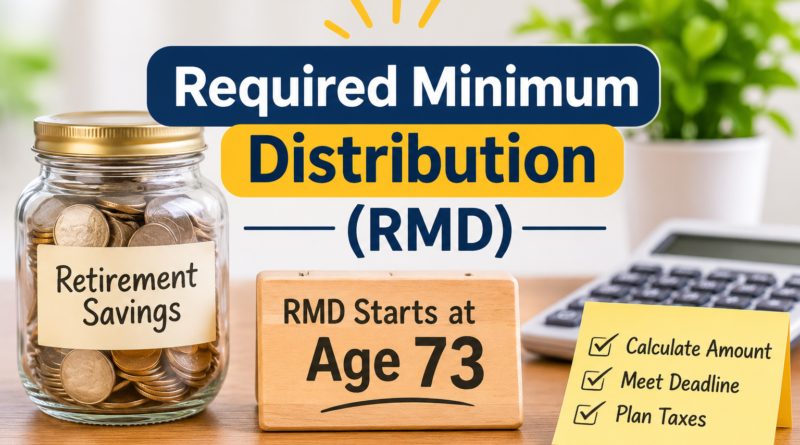
Required Minimum Distribution (RMD): Complete Guide to Rules, Age, Calculations, and Taxes
Retirement planning is an important part of managing your financial future. While saving money in retirement accounts helps you build long-term financial security, understanding when and how to withdraw that money is equally important. One important retirement rule that account holders need to understand is the Required Minimum Distribution (RMD).
A Required Minimum Distribution is the minimum amount of money that certain retirement account owners must withdraw from their retirement savings each year after reaching a specific age. These rules are designed to ensure that retirement funds do not remain tax-deferred indefinitely.
For many retirees, RMDs can affect annual income, tax planning, investment decisions, and retirement budgets. Failing to withdraw the required amount on time may also result in significant tax penalties.
Whether you have a traditional IRA, 401(k), or another retirement account, understanding RMD rules can help you avoid unnecessary taxes and manage your retirement savings more effectively.
In this guide, we will explain what a Required Minimum Distribution is, when withdrawals begin, how to calculate the amount, which accounts are subject to RMD rules, and how to avoid common mistakes.
What Is a Required Minimum Distribution?
A Required Minimum Distribution (RMD) is the minimum amount that an individual must withdraw annually from certain tax-advantaged retirement accounts after reaching the required starting age.
Many retirement accounts allow individuals to contribute money during their working years while receiving certain tax advantages. For example, traditional IRA and traditional 401(k) contributions may receive tax-deferred treatment. This means account holders generally do not pay income tax on the money and investment growth until they withdraw it.
However, the government eventually requires individuals to begin taking withdrawals. These mandatory withdrawals are known as Required Minimum Distributions.
The amount you must withdraw depends on several factors, including:
- Your age.
- Your retirement account balance.
- The IRS life expectancy factor.
- Whether you have a spouse who is your sole beneficiary and more than 10 years younger.
RMDs are generally treated as ordinary taxable income when withdrawn from traditional tax-deferred retirement accounts. However, the tax treatment can vary depending on the account type and the source of the money.
Example:
Suppose you have $400,000 in a traditional IRA and your applicable IRS distribution period is 25.5.
Your estimated RMD would be:
\[ \$400,000 \div 25.5 = \$15,686.27 \]
You would generally need to withdraw approximately $15,686 for that year.
This amount is a simplified example. Your actual distribution period must be determined using the applicable IRS rules and tables.
Why Are Required Minimum Distributions Important?
Understanding Required Minimum Distributions is important because retirement accounts are designed to provide financial support during retirement, not to avoid taxes permanently.
If you have accumulated substantial savings in tax-deferred accounts, RMD rules determine when you must begin withdrawing those funds.
There are several reasons why these distributions matter.
1. Avoiding Tax Penalties
One of the biggest reasons to understand RMD rules is to avoid penalties. If you withdraw less than the required amount, the IRS may impose an excise tax on the shortfall.
Although certain correction rules and penalty reductions may apply, failing to take your distribution can still create an unnecessary tax expense.
2. Managing Retirement Income
RMDs can become an important source of retirement income. They provide a predictable withdrawal requirement that can help retirees plan their annual budgets.
However, you should remember that the required withdrawal may be higher or lower than your actual spending needs.
3. Planning Annual Taxes
Traditional retirement account withdrawals are generally included in taxable income. Taking an RMD may therefore increase your total annual income and affect your tax bracket.
It may also influence other income-related calculations, such as the taxation of Social Security benefits and Medicare income-related monthly adjustment amounts.
4. Maintaining Retirement Account Compliance
RMD rules apply to specific retirement accounts. Understanding which accounts are covered and when withdrawals must begin helps you remain compliant with IRS requirements.
At What Age Do Required Minimum Distributions Begin?
The age at which you must begin taking Required Minimum Distributions depends on your birth year and the applicable retirement distribution rules.
Under current U.S. federal rules:
- Age 70½: This was the starting age under older rules for individuals who reached this age before January 1, 2020.
- Age 72: This applied to certain individuals under the SECURE Act of 2019.
- Age 73: Generally applies to individuals who reach age 72 after December 31, 2022.
- Age 75: Applies to individuals born in 1960 or later under the SECURE 2.0 Act, beginning when they reach that age.
For people currently approaching retirement, age 73 is an important milestone. Those born in 1960 or later will generally have a later starting age of 75.
When Is Your First RMD Due?
Your first Required Minimum Distribution is generally due by April 1 of the year following the year you reach your applicable RMD starting age.
For example, if you turn 73 in 2026, you can generally delay your first RMD until April 1, 2027.
However, delaying your first withdrawal means you may need to take two distributions during 2027:
- Your first RMD by April 1, 2027.
- Your second RMD by December 31, 2027.
Both distributions may be included in your taxable income for 2027.
For this reason, some retirees choose to take their first RMD during the year they reach the required age instead of delaying it.
Which Retirement Accounts Require Minimum Distributions?
Not every retirement account follows the same RMD rules. Some accounts require annual withdrawals during the original owner’s lifetime, while others are exempt.
Here are the major retirement accounts covered by RMD regulations.
1. Traditional IRA
Traditional Individual Retirement Accounts generally require minimum distributions starting at the applicable RMD age.
Money contributed to a traditional IRA may receive tax-deferred treatment. Once withdrawals begin, distributions are generally taxable as ordinary income, except for any nontaxable basis.
2. 401(k) Plans
Traditional 401(k) accounts are also subject to RMD requirements.
Employees who retire and have money in an employer-sponsored 401(k) may need to begin withdrawals after reaching the applicable starting age.
However, an important exception may apply if you continue working for the employer sponsoring the plan. Certain employees can delay RMDs from that current employer’s plan until retirement, provided they are not 5% owners and the plan permits the exception.
3. 403(b) Plans
A 403(b) plan is commonly offered to employees of public schools, nonprofit organizations, and certain other institutions.
These accounts generally follow RMD rules similar to other tax-deferred retirement plans.
4. SEP and SIMPLE IRAs
Simplified Employee Pension (SEP) IRAs and Savings Incentive Match Plan for Employees (SIMPLE) IRAs are retirement savings accounts used by small businesses and self-employed individuals.
Both account types are generally subject to RMD requirements.
5. Roth IRA
One important difference is that original Roth IRA owners do not have to take Required Minimum Distributions during their lifetimes.
This allows Roth IRA funds to remain invested for as long as the account owner chooses.
However, beneficiaries who inherit Roth IRAs may be subject to distribution requirements.
6. Roth 401(k)
Under current rules, designated Roth accounts in employer retirement plans are no longer subject to lifetime RMDs for the original account owner beginning in 2024.
Inherited Roth 401(k) accounts may still have distribution requirements.
| Retirement account | Lifetime RMD requirement |
|---|---|
| Traditional IRA | Yes |
| Traditional 401(k) | Yes |
| 403(b) | Yes |
| SEP IRA | Yes |
| SIMPLE IRA | Yes |
| Roth IRA | No |
| Designated Roth 401(k) | No, beginning in 2024 |
How to Calculate Required Minimum Distribution
Calculating your Required Minimum Distribution is relatively straightforward when you have your previous year-end account balance and the correct IRS life expectancy factor.
The general formula is:
\[ \text{RMD} = \frac{\text{Previous Year-End Balance}} {\text{IRS Distribution Period}} \]
The previous year-end balance refers to the value of your retirement account on December 31 of the preceding year.
The distribution period comes from the appropriate IRS life expectancy table.
Step 1: Find Your Retirement Account Balance
Start by checking your retirement account statement.
You generally need the account balance as of December 31 of the previous year.
For example, when calculating your 2026 RMD, you generally use your December 31, 2025 account balance.
Step 2: Determine Your Age
Your age during the distribution year helps determine the applicable life expectancy factor.
For example, if you turn 75 during 2026, you generally use age 75 when selecting your factor.
Step 3: Find the Correct IRS Life Expectancy Table
The IRS provides three main life expectancy tables:
- Uniform Lifetime Table: Generally used by retirement account owners.
- Joint and Last Survivor Table: Used when the account owner’s spouse is the sole beneficiary and more than 10 years younger.
- Single Life Expectancy Table: Generally used for certain beneficiaries of inherited retirement accounts.
Choosing the correct table is important because it directly affects the amount you must withdraw.
Step 4: Divide Your Account Balance
Once you have your account balance and applicable distribution period, divide the balance by the factor.
Example:
Suppose your traditional IRA had a balance of $300,000 on December 31, 2025, and you turn 75 during 2026.
According to the IRS Uniform Lifetime Table, the distribution period at age 75 is 24.6.
Your calculation would be:
\[ \$300,000 \div 24.6 = \$12,195.12 \]
Your estimated Required Minimum Distribution for 2026 would be approximately $12,195.
The calculation assumes the standard Uniform Lifetime Table applies and excludes any special account adjustments.
IRS Uniform Lifetime Table for Required Minimum Distributions
The IRS Uniform Lifetime Table helps retirement account owners calculate the minimum amount they must withdraw each year.
Here are some commonly used distribution factors:
| Age | Distribution period |
|---|---|
| 73 | 26.5 |
| 74 | 25.5 |
| 75 | 24.6 |
| 76 | 23.7 |
| 77 | 22.9 |
| 78 | 22.0 |
| 79 | 21.1 |
| 80 | 20.2 |
| 81 | 19.4 |
| 82 | 18.5 |
| 83 | 17.7 |
| 84 | 16.8 |
| 85 | 16.0 |
As individuals get older, their distribution periods become shorter. This generally means they must withdraw a larger percentage of their retirement account balance each year.
Always check the latest IRS Publication 590-B for the complete table and applicable rules.
When Must You Take Your Required Minimum Distribution?
After your first RMD, subsequent annual distributions generally must be completed by December 31 of each calendar year.
For example, if you already started taking RMDs in 2025, your 2026 distribution must generally be completed by December 31, 2026.
The deadline is important because missing it may result in an excise tax.
If you have several retirement accounts, remember that the deadline and aggregation rules can differ depending on the account type.
Traditional IRA owners can generally combine the calculated RMD amounts from their IRAs and withdraw the total from one or more of those IRAs.
However, 401(k) and other employer-plan RMDs generally must be satisfied separately from each applicable plan account.
For 403(b) accounts, special aggregation rules may also apply.
What Happens If You Do Not Take Your Required Minimum Distribution?
Failing to take your Required Minimum Distribution can create an additional tax expense.
The IRS generally imposes a 25% excise tax on the amount that should have been withdrawn but was not distributed on time.
However, the penalty may be reduced to 10% if the account owner corrects the shortfall within the applicable correction window.
Example:
Suppose your required RMD is $10,000, but you withdraw only $6,000.
Your shortfall is:
\[ \$10,000-\$6,000=\$4,000 \]
At the standard 25% excise tax rate, the potential tax would be:
\[ \$4,000 \times 25\% = \$1,000 \]
If you qualify for the reduced 10% rate by correcting the mistake within the applicable period, the tax could be $400 instead.
You may also request a waiver if the shortfall resulted from a reasonable error and you are taking reasonable steps to correct it. This generally requires filing IRS Form 5329 and explaining the circumstances.
Keeping accurate withdrawal records and checking deadlines can help you avoid these problems.
Are Required Minimum Distributions Taxable?
In most cases, Required Minimum Distributions from traditional retirement accounts are taxable as ordinary income.
This means the amount you withdraw is generally added to your taxable income for the year.
For example, if you receive $50,000 from Social Security and withdraw $15,000 from a traditional IRA, your total income may increase to $65,000 before considering applicable tax adjustments and exclusions.
However, the exact tax treatment depends on the retirement account and the source of contributions.
Traditional Retirement Accounts
Withdrawals from traditional IRAs and traditional 401(k) accounts are generally taxable at ordinary income tax rates.
If you made nondeductible contributions to a traditional IRA, part of your distribution may be tax-free because you have already paid taxes on that portion.
Roth Retirement Accounts
Original Roth IRA owners generally do not have lifetime RMDs. Qualified Roth IRA withdrawals are generally tax-free.
Designated Roth 401(k) accounts also do not require lifetime RMDs for original owners under the rules effective from 2024.
Can RMDs Affect Social Security Taxes?
Yes. Withdrawals from traditional retirement accounts can increase your combined income, which may cause a larger portion of your Social Security benefits to become taxable.
This is why retirees should consider their retirement withdrawals when planning their annual taxes.
Strategies to Manage Required Minimum Distributions
Although RMDs are mandatory, there are several ways to manage them more effectively.
1. Plan Withdrawals Before Retirement
Planning ahead can help you understand how much money you may need to withdraw after reaching the required age.
Review your retirement balances and estimate future distributions so you can prepare for potential tax consequences.
2. Consider Roth Conversions
A Roth conversion involves moving eligible money from a traditional retirement account into a Roth IRA.
The converted amount is generally taxable in the year of conversion, but qualified Roth IRA withdrawals can be tax-free.
Roth conversions may reduce future traditional account balances and therefore future RMDs. However, conversion taxes and timing should be carefully evaluated.
3. Consider Qualified Charitable Distributions
A Qualified Charitable Distribution (QCD) allows eligible IRA owners aged 70½ or older to transfer money directly from an IRA to an eligible charitable organization.
A qualifying QCD can count toward your RMD while being excluded from taxable income, subject to IRS limits and requirements.
This strategy may be useful for retirees who already donate to charity.
Importantly, QCD rules generally apply to eligible IRAs rather than ordinary distributions from employer-sponsored 401(k) plans.
4. Review Your Investment Portfolio
RMDs can affect your investment strategy because you may need to sell investments or withdraw cash to meet the annual requirement.
Review your portfolio regularly and maintain an appropriate amount of liquid assets to help cover upcoming distributions.
5. Work With a Tax Professional
Retirement distributions can affect several areas of your financial situation.
A qualified tax professional can help you calculate your RMD, review tax consequences, and identify opportunities to manage your retirement income.
Common Required Minimum Distribution Mistakes to Avoid
Even experienced retirement savers can make mistakes when handling RMDs.
Here are some common problems to watch for.
1. Missing the annual deadline: Failing to withdraw the required amount by the applicable deadline may result in an excise tax.
2. Using the wrong account balance: RMD calculations generally use the previous December 31 account balance, not the current account value.
3. Selecting the wrong IRS table: Using an incorrect life expectancy factor can result in an inaccurate withdrawal.
4. Forgetting multiple accounts: You must calculate RMDs separately for applicable accounts, even when aggregation is permitted for withdrawals.
5. Ignoring inherited retirement accounts: Beneficiaries may have different distribution requirements depending on their relationship to the original account owner and when the owner died.
6. Assuming every Roth account is exempt: Although original owners generally have no lifetime RMDs from Roth IRAs and designated Roth employer accounts, inherited Roth accounts can have distribution requirements.
Avoiding these mistakes can make retirement planning easier and reduce unnecessary tax complications.
Frequently Asked Questions (FAQs)
1. What does Required Minimum Distribution mean?
A Required Minimum Distribution is the minimum amount an individual must withdraw annually from certain tax-advantaged retirement accounts after reaching the applicable starting age. These withdrawals help ensure retirement savings are eventually distributed and taxed when applicable.
2. At what age do RMDs start?
For most individuals reaching the RMD starting age under current rules, distributions begin at age 73. Individuals born in 1960 or later generally have a starting age of 75.
3. How do I calculate my Required Minimum Distribution?
Divide your retirement account balance from December 31 of the previous year by the applicable IRS life expectancy factor. The correct factor depends on your age and circumstances.
4. Are Required Minimum Distributions taxable?
Yes, distributions from traditional IRAs and traditional 401(k) accounts are generally taxable as ordinary income. Roth IRA owners generally do not have lifetime RMDs, and qualified Roth withdrawals are usually tax-free.
5. What happens if I miss my RMD deadline?
The IRS may impose a 25% excise tax on the amount not withdrawn. This may be reduced to 10% if you correct the shortfall within the applicable correction period. You may also qualify for a waiver in certain circumstances.
6. Can I withdraw more than my Required Minimum Distribution?
Yes. You can withdraw more than the minimum required amount. However, additional withdrawals from traditional tax-deferred accounts may increase your taxable income.
7. Do Roth IRAs have Required Minimum Distributions?
No. Original Roth IRA owners are not required to take minimum distributions during their lifetimes. However, inherited Roth IRAs are subject to beneficiary distribution rules.
8. Can I donate my RMD to charity?
Eligible IRA owners can use a Qualified Charitable Distribution to transfer funds directly to qualifying charities. A properly completed QCD can count toward the annual RMD and may be excluded from taxable income, subject to applicable requirements.
9. Can I delay my first RMD?
Generally, yes. You can delay your first distribution until April 1 of the year following the year you reach your applicable RMD starting age. However, you will generally need to take another RMD by December 31 of that same year.
10. Do I need to take an RMD if I am still working?
You may be able to delay RMDs from your current employer’s retirement plan if you continue working, are not a 5% owner, and the plan permits the exception. This exception generally does not apply to traditional IRAs.
Conclusion
Required Minimum Distribution rules are an important part of retirement planning. They determine when individuals must begin withdrawing money from certain retirement accounts and how much they need to distribute each year.
Understanding the applicable starting age, IRS life expectancy tables, withdrawal deadlines, and tax consequences can help you manage retirement savings more effectively.
Whether you have a traditional IRA, 401(k), 403(b), or another tax-deferred retirement account, planning your RMDs in advance can help you avoid penalties and unexpected tax expenses.
The best approach is to review your retirement accounts regularly, calculate your annual distribution correctly, and consult a qualified financial or tax professional when necessary.
Disclaimer: This article is for educational and informational purposes only. Retirement distribution rules and tax consequences depend on individual circumstances. Consult a qualified tax professional or financial adviser before making retirement distribution decisions.
SEO Details for Rank Math
Focus Keyword: Required Minimum Distribution
SEO Title: 7 Powerful Required Minimum Distribution Rules You Must Know
Meta Title: Required Minimum Distribution Guide
Meta Description: Understand Required Minimum Distribution rules, age limits, calculations, taxes, deadlines, and ways to avoid costly retirement withdrawal penalties.
Permalink / Slug: required-minimum-distribution
Category: Retirement Planning
Tags:
- Required Minimum Distribution
- RMD Rules
- Retirement Accounts
- IRA Withdrawals
- 401(k) Retirement
- Retirement Taxes
- RMD Calculation
Featured Image Alt Text: Required Minimum Distribution retirement planning guide
Image Title: Required Minimum Distribution Guide
Image Caption: Understanding retirement withdrawal rules and RMD calculations.
Image Description: A professional illustration representing Required Minimum Distribution rules, retirement savings, annual withdrawals, and financial planning.
REad Next
These official IRS resources can support your article’s accuracy and provide readers with additional information.