
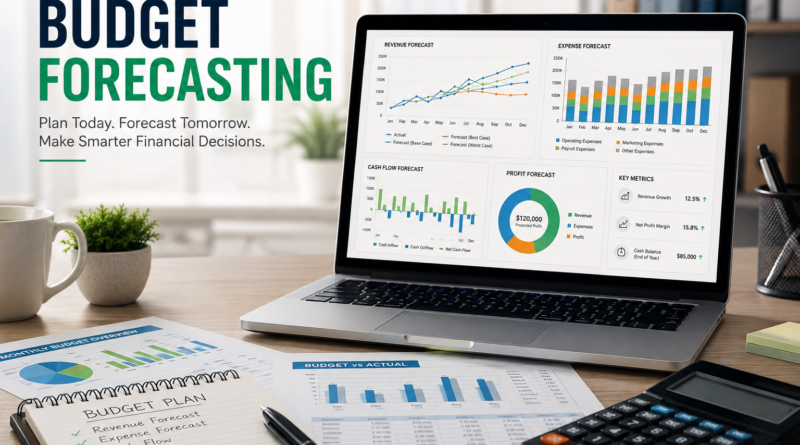
Budget Forecasting: A Practical Guide to Methods Process and Examples
1. Meta Title
Budget Forecasting: Methods, Process & Examples
What Is Budget Forecasting?
Budget forecasting is the process of estimating a company’s future financial performance by using historical data, current financial data, business assumptions, market trends, and expected changes in revenue and expenses. It helps businesses create financial projections for a specific forecast period and prepare for different financial outcomes.
A budget forecast is not simply a guess about how much money a business may earn or spend. A useful forecast model is based on available information. This can include previous sales, operating expenses, fixed costs, variable costs, cash flow, growth projections, and economic conditions.
For example, a small business may review the previous 12 months of sales and discover that revenue usually increases during certain seasons. The business can use this historical financial data, along with expected price changes and planned marketing activities, to estimate future revenue.
Budget forecasting helps turn financial planning into an ongoing process. Instead of making one annual estimate and forgetting about it, businesses can monitor financial performance, compare actual results with projected results, and update the forecast when circumstances change.
Budget Forecasting Definition
In simple terms, budget forecasting is a forward-looking financial planning process. A business estimates what may happen financially during a future period and uses those estimates to support business decisions.
The forecast may cover:
- Expected revenue
- Sales projections
- Operating expenses
- Fixed costs
- Variable costs
- Cash flow
- Profit forecast
- Net income
- Resource allocation
- Growth projections
A company can prepare a monthly budget forecast, quarterly forecast, or annual budget forecast depending on its financial goals and planning needs.
How Budget Forecasting Works
The process usually begins with financial data. A business gathers historical performance information and analyzes how revenue, expenses, and profitability have changed over time.
Next, the finance team identifies business drivers that may affect future performance. For example, customer growth, pricing, employee headcount, production volume, or advertising spending may all influence financial outcomes.
The business then creates forecast assumptions. These assumptions may include expected sales growth, inflation, changes in supplier costs, or market conditions.
Finally, the forecast is compared with actual results. If performance differs significantly from expectations, variance analysis can help explain why.
Practical example: If a company forecasted monthly revenue of $100,000 but actual results were $85,000, management can investigate the difference. Perhaps sales volume declined, a customer delayed an order, or market conditions changed. The company can then adjust projections rather than continuing to rely on outdated assumptions.
Why Is Budget Forecasting Important?
Budget forecasting gives businesses a clearer view of possible future financial outcomes. No forecast can predict the future perfectly, but a structured forecasting process can reduce uncertainty and help decision-makers prepare for change.
Improves Financial Planning
Financial planning is stronger when it is based on realistic estimates rather than assumptions alone. A budget forecast allows businesses to estimate future revenue and project future expenses before making major commitments.
For example, before hiring five new employees, a company can create a forecast that includes salaries, benefits, equipment, and expected additional revenue. This helps management decide whether the expansion supports its financial objectives.
Helps Manage Cash Flow
Profitability and cash flow are not always the same. A business can report a profit while still experiencing cash flow problems if customers pay late or large expenses are due before revenue is collected.
Cash flow forecasting helps businesses estimate when money will enter and leave the company.
Example: A business may forecast $200,000 in quarterly revenue. However, if customers pay invoices 60 days later while suppliers must be paid within 30 days, the business could face a temporary cash shortage. A cash flow forecast can identify this risk early.
Supports Better Business Decisions
Financial decision-making improves when leaders understand the possible financial impact of their choices.
A forecast can help answer questions such as:
- Can we afford to expand?
- Should we increase marketing spending?
- How much inventory should we purchase?
- Can we hire additional employees?
- What happens if sales decline by 10%?
This makes budget forecasting a valuable part of strategic planning and business strategy.
Identifies Financial Risks
Forecasting also supports risk management. Businesses can use scenario analysis and what-if analysis to test potential problems before they happen.
For example, management could prepare three scenarios:
- Sales grow by 15%.
- Sales remain stable.
- Sales decline by 10%.
Each scenario may produce different revenue projections, expense forecasts, and cash flow results. This helps a business prepare contingency plans instead of reacting at the last minute.
How to Do Budget Forecasting Step by Step
A reliable budget forecasting process does not need to be overly complicated. The most important requirement is a logical method that uses relevant data and is updated regularly.
Define Your Financial Goals and Forecast Period
Start by deciding what you want the forecast to achieve.
Your financial goals may include:
- Increasing revenue
- Improving profitability
- Reducing operating expenses
- Maintaining positive cash flow
- Funding business growth
- Managing financial risk
Next, define the forecast period. A monthly forecast may be useful for businesses that need close financial control, while an annual forecast may support longer-term strategic planning.
Example: A growing business may create a 12-month financial forecast and review it every month. Each month, it updates the next 12 months using the latest actual performance.
Gather Historical Financial Data
Historical data provides a starting point for forecasting.
Review:
- Previous revenue
- Sales trends
- Operating expenses
- Fixed and variable costs
- Cash flow
- Gross profit
- Net income
- Previous budget vs actual results
Historical financial data can reveal patterns, such as seasonal sales changes or recurring expense increases.
However, historical forecasting should not assume that the future will automatically look exactly like the past. Market conditions and business circumstances can change.
Analyze Revenue and Expenses
Break down your financial data into meaningful categories.
For revenue, consider:
- Product sales
- Service revenue
- Customer growth
- Pricing changes
- Seasonal demand
For expenses, consider:
- Payroll
- Rent
- Utilities
- Marketing
- Software
- Inventory
- Supplier costs
This creates a more detailed expense forecast and revenue forecast.
Identify Key Business Drivers
Business drivers are factors that directly influence financial performance.
Examples include:
- Number of customers
- Average selling price
- Sales conversion rate
- Number of employees
- Production volume
- Customer retention
A driver-based forecasting approach connects financial projections to operational activity.
Example: Instead of estimating next year’s sales as simply “10% higher,” a business might forecast 1,000 new customers multiplied by an average annual customer value of $500. This creates a more transparent forecast model.
Create Forecast Assumptions
Every financial forecast includes assumptions. The goal is to make those assumptions clear and reasonable.
Examples include:
- Revenue will grow by 8%.
- Supplier costs will increase by 3%.
- Headcount will increase by five employees.
- Customer retention will remain stable.
- Marketing expenses will increase during the holiday season.
Documenting assumptions makes it easier to review assumptions later and adjust projections when circumstances change.
Choose a Budget Forecasting Method
The best method depends on the business and available data.
A startup with limited historical financial data may rely more heavily on market research and qualitative forecasting. An established business with several years of data may use historical analysis, moving averages, or driver-based forecasting.
Build Your Forecast Model
Your forecast model should organize projected financial information clearly.
At a minimum, it may include:
| Forecast Component | What It Estimates | Example |
|---|---|---|
| Revenue forecast | Future income | $500,000 annual sales |
| Expense forecast | Future costs | $350,000 operating expenses |
| Profit forecast | Expected earnings | $150,000 before other adjustments |
| Cash flow forecast | Cash movement | Monthly cash inflows and outflows |
| Growth projections | Expected expansion | 10% customer growth |
A simple spreadsheet forecasting model may be sufficient for a small business. Larger organizations may use FP&A software and automated forecasting tools.
Create Best-Case, Base-Case, and Worst-Case Scenarios
Scenario planning is especially useful when there is uncertainty.
A base-case scenario represents the most likely outcome. A best-case scenario reflects stronger-than-expected performance. A worst-case scenario estimates what could happen if major risks occur.
Example: If projected revenue is $1 million:
- Best case: $1.2 million
- Base case: $1 million
- Worst case: $800,000
The business can then review whether its expenses and cash reserves are appropriate under each scenario.
Compare Actual Results With Your Forecast
Once the forecast period begins, compare actual results with projected results.
Budget vs actual analysis helps identify variance.
If actual expenses are higher than the expense forecast, management should investigate the reason. The difference may result from higher prices, unexpected costs, or incorrect assumptions.
Review, Adjust, and Update Your Forecast
Forecasting should be a continuous process.
Update the forecast when:
- New financial data becomes available
- Sales trends change
- Market conditions shift
- Costs increase
- Business strategy changes
Regular updates can improve forecast accuracy because future projections are based on more current information.
Common Budget Forecasting Methods
Different businesses use different forecasting techniques. The following methods are among the most useful.
Historical Data Forecasting
This method uses previous financial performance to estimate future results.
Example: If revenue grew by 5%, 7%, and 6% over the past three years, a business might use this information to estimate future growth.
The advantage is simplicity. The limitation is that past performance may not reflect future economic conditions.
Straight-Line Forecasting
Straight-line forecasting applies a consistent growth or decline rate.
For example, if revenue was $100,000 and management expects 10% growth, the next forecast might be $110,000.
This method is easy to use but may be too simple for businesses with significant seasonal changes.
Rolling Forecasting
A rolling forecast is continuously updated.
Instead of creating one forecast for January through December and leaving it unchanged, a company may always maintain a forecast for the next 12 months.
Example: At the end of March, the business removes March and adds the following March. The forecast period remains continuous.
Rolling forecasting can improve financial agility.
Driver-Based Forecasting
Driver-based forecasting uses operational metrics to create financial estimates.
For example:
Revenue = Number of customers × Average customer spending
This method can produce useful financial projections because it explains the underlying drivers of revenue.
Scenario-Based Forecasting
Scenario analysis examines multiple possible outcomes.
This is useful when a business faces uncertainty related to:
- Market demand
- Inflation
- Competition
- Pricing
- Economic conditions
Incremental Budgeting
Incremental budgeting starts with an existing budget and adjusts it.
For example, a department with a $100,000 budget may receive a 5% increase for the next period.
This method is simple but can carry previous inefficiencies forward.
Zero-Based Budgeting
Zero-based budgeting requires expenses to be justified from the beginning rather than automatically continuing previous spending levels.
A department may need to explain why it requires each major cost.
This approach can improve budget allocation but may require more time and data analysis.
Qualitative and Quantitative Forecasting
Quantitative forecasting relies mainly on numerical data and statistical methods.
Qualitative forecasting uses professional judgment, market knowledge, expert opinions, and other non-numerical information.
Many businesses combine both approaches for a more balanced financial forecast.
Key Components of a Budget Forecast
Revenue Projections
Revenue projections estimate future income.
Consider:
- Sales volume
- Pricing
- Customer growth
- New products
- Market trends
Expense Projections
An expense forecast estimates expected costs.
Separate expenses into fixed costs and variable costs when possible.
Fixed costs may include rent and certain salaries. Variable costs may change based on sales or production.
Cash Flow Forecasting
Cash flow forecasting tracks the timing of expected inflows and outflows.
This is especially important for businesses with delayed customer payments or seasonal revenue.
Fixed and Variable Costs
Understanding cost behavior improves forecast accuracy.
For example, rent may remain stable while shipping costs increase as sales volume rises.
Financial Assumptions and Market Trends
A forecast should consider assumptions outside the company’s direct control.
These may include inflation, interest rates, customer demand, supplier prices, and broader economic conditions.
Types of Budget Forecasts
Sales Forecast
A sales forecast estimates future sales based on historical performance, customer demand, and sales pipeline information.
Expense Forecast
This estimates future operating expenses and other business costs.
Cash Flow Forecast
This focuses specifically on the movement of cash.
Operating Budget Forecast
An operating budget forecast combines expected revenue and operating expenses to support day-to-day financial planning.
Annual and Monthly Budget Forecasting
An annual forecast supports strategic planning, while monthly forecasting provides more detailed financial control.
Many businesses use both.
Budget Forecasting Example for a Small Business
Consider a small online business preparing a three-month budget forecast.
The company expects:
- January revenue: $50,000
- February revenue: $55,000
- March revenue: $60,000
It estimates operating expenses of:
- January: $35,000
- February: $38,000
- March: $40,000
The simple profit forecast would be:
| Month | Revenue Forecast | Expense Forecast | Projected Difference |
|---|---|---|---|
| January | $50,000 | $35,000 | $15,000 |
| February | $55,000 | $38,000 | $17,000 |
| March | $60,000 | $40,000 | $20,000 |
This is only a starting point. The business should also review when customers actually pay and when major expenses are due.
Comparing Forecast Results With Actual Performance
Suppose actual February revenue is only $48,000 instead of the forecasted $55,000.
The variance is:
$55,000 − $48,000 = $7,000 unfavorable revenue variance
Management should investigate the cause. If the lower sales level is likely to continue, the business may need to update the March forecast and adjust resource allocation.
This shows why reforecasting is a core part of effective financial forecasting.
Budgeting vs Forecasting: What Is the Difference?
Budgeting and forecasting are closely connected, but they serve different purposes.
Budget vs Forecast Comparison
| Budget | Forecast |
|---|---|
| Sets a financial plan | Estimates likely future results |
| Often prepared for a fixed period | Updated as new information becomes available |
| Supports targets and resource allocation | Supports ongoing decision-making |
| May remain relatively stable | Usually more flexible |
| Focuses on planned financial performance | Focuses on expected financial performance |
When Should You Use a Budget?
Use a budget when setting financial goals, allocating resources, and establishing spending plans.
When Should You Use a Financial Forecast?
Use a forecast when you need to understand the likely impact of changing conditions and make informed decisions based on current data.
The two processes work best together. The budget provides direction, while the forecast provides an updated view of what may actually happen.
Benefits of Budget Forecasting
Better Financial Decision-Making
Forecasts help leaders evaluate the financial consequences of potential decisions.
Improved Resource Allocation
Businesses can allocate money, staff, and other resources more effectively.
More Accurate Financial Planning
Regular updates make financial planning more responsive.
Better Risk Management
Scenario planning helps identify financial risk before it becomes a major problem.
Stronger Business Growth Planning
Growth projections help businesses determine whether they have sufficient revenue, cash flow, and resources to expand.
Common Budget Forecasting Challenges
Inaccurate Financial Data
Poor data can create unreliable financial projections.
Solution: Improve data quality and review the source of important numbers.
Unexpected Market Changes
Market trends can shift quickly.
Solution: Use scenario analysis and rolling forecasts.
Poor Forecast Assumptions
Unrealistic assumptions reduce forecast accuracy.
Solution: Review assumptions regularly and compare them with actual performance.
Lack of Regular Updates
An outdated forecast can lead to poor decisions.
Solution: Establish a regular forecasting schedule.
Overreliance on a Single Scenario
Planning only for the most optimistic outcome can increase financial risk.
Solution: Create best-case, base-case, and worst-case scenarios.
Budget Forecasting Best Practices
Use Accurate Historical Data
Reliable financial data is the foundation of useful forecasting.
Update Your Forecast Regularly
Monthly or quarterly reviews can keep projections relevant.
Track Budget vs Actual Results
Variance analysis helps identify where performance differs from expectations.
Use Multiple Financial Scenarios
Scenario planning improves preparedness.
Review Your Forecast Assumptions
Business conditions change, so assumptions should not remain fixed forever.
Involve Department Leaders and Key Stakeholders
Department leaders may have information that the finance team does not see directly. Cross-functional collaboration can improve forecast inputs.
Practical example: A sales manager may know that a major customer plans to reduce orders. Including this information early can improve the revenue forecast.
Budget Forecasting Tools and Software
Spreadsheet and Excel Forecasting
Spreadsheet forecasting is flexible and accessible, particularly for small businesses.
A simple Excel forecasting model can track:
- Revenue
- Expenses
- Cash flow
- Actual vs forecast
- Monthly trends
Financial Forecasting Software
As a business grows, manual spreadsheets may become difficult to manage.
Budget forecasting software can support:
- Data integration
- Real-time reporting
- Automated forecasting
- Scenario analysis
- Collaboration
FP&A and Forecast Automation
FP&A processes connect financial planning with analysis and strategic decision-making.
Forecast automation can reduce repetitive manual work and make it easier to update financial models.
AI Forecasting and Predictive Analytics
Artificial intelligence and predictive analytics may help identify patterns in large amounts of financial data.
However, AI forecasting still depends on data quality and sensible business judgment. Automated predictions should support decision-making rather than replace human review.
Frequently Asked Questions About Budget Forecasting
What Is Budget Forecasting?
Budget forecasting is the process of estimating future financial performance using historical data, current financial data, assumptions, and expected business conditions.
What Is the Difference Between Budgeting and Forecasting?
A budget sets financial targets and spending plans, while a forecast estimates what the business is likely to achieve based on current and expected conditions.
What Are the Main Budget Forecasting Methods?
Common methods include historical data forecasting, straight-line forecasting, rolling forecasts, driver-based forecasting, scenario analysis, incremental budgeting, and zero-based budgeting.
How Often Should a Budget Forecast Be Updated?
The right schedule depends on the business. Many organizations review forecasts monthly or quarterly, while fast-changing businesses may update them more frequently.
What Is an Example of Budget Forecasting?
A business may use previous sales data and expected customer growth to estimate next quarter’s revenue, then subtract projected operating expenses to estimate profitability and cash flow needs.
What Data Is Needed for Budget Forecasting?
Useful inputs can include historical revenue, sales data, operating expenses, fixed and variable costs, cash flow information, market trends, growth assumptions, and key performance indicators.
Final Thoughts on Budget Forecasting
Budget forecasting gives businesses a practical way to look ahead, test financial assumptions, manage risk, and make better decisions. Start with reliable data, choose a forecasting method that fits your business, compare actual results with projections, and update your forecast regularly. The goal is not to predict the future perfectly—it is to be better prepared for it.
Read Next
Pingback: Tax-Loss Harvesting: 7 Rules, Benefits & Guide