
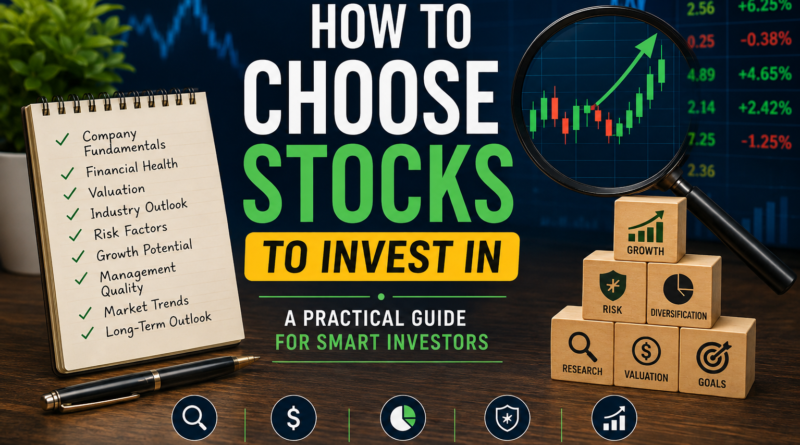
How to Choose Stocks to Invest In: Investor Guide
How to Choose Stocks to Invest In: A Complete Beginner’s Guide
Learning how to choose stocks to invest in is one of the most important skills for anyone interested in building a long-term investment portfolio. Buying shares of a publicly traded company means becoming a partial owner of that business, so stock selection should involve more than simply choosing a company that is popular or frequently mentioned in financial news.
Good stock selection combines financial research, valuation, risk management, business analysis, and an understanding of your own financial goals. You do not need to predict which stock will rise tomorrow. Instead, you need a repeatable process for finding businesses that fit your objectives, evaluating their fundamentals, considering their valuation, and deciding how much risk you can reasonably accept.
This guide explains how to pick stocks, how to research companies, how to analyze stock fundamentals, how to compare valuations, and how to build a disciplined stock-selection process.
What Does It Mean to Choose a Stock?
Choosing a stock means deciding which company’s shares fit your investment objectives, risk tolerance, time horizon, and portfolio strategy.
When you buy individual stocks, your investment is linked to the company’s future performance. If the company increases revenue, improves profitability, strengthens its competitive position, and creates value for shareholders, its stock may benefit over time. However, there is no guarantee that a company’s share price will rise.
Stock selection therefore involves asking questions such as:
- What does the company do?
- How does it make money?
- Is its business model understandable?
- Are revenue and earnings growing?
- Does the company generate cash?
- How much debt does it have?
- Is the stock price reasonable?
- What risks could damage the business?
- Does the stock fit my portfolio?
Practical example: Suppose two companies operate in the same industry. One has faster revenue growth but high debt, while the other grows more slowly but produces consistent free cash flow. Choosing between them requires more than looking at their stock prices. You need to understand the businesses and determine which one better matches your objectives.
Why Is Choosing the Right Stock Important?
Individual stocks can experience significant price fluctuations. A company can report disappointing earnings, lose market share, face regulatory problems, or struggle during changing economic conditions.
Choosing stocks carefully can help you avoid making decisions based solely on hype or short-term market movements.
A strong stock selection process considers both potential return and downside risk. It also recognizes that even excellent companies can become poor investments if purchased at an unreasonable valuation.
Practical example: A high-quality company trading at an extremely expensive valuation may offer less attractive future returns than a similarly strong company trading at a more reasonable price.
The goal is not to find a perfect stock. The goal is to find investment opportunities that offer an attractive balance between business quality, valuation, risk, and expected long-term returns.
Start With Your Investment Goals
Before learning how to pick stocks, define what you want your investments to accomplish.
Define Your Financial Goals
Your financial goals determine the type of portfolio you should build.
Common goals include:
- Wealth building
- Capital growth
- Retirement investing
- Income generation
- Wealth preservation
- Funding future expenses
- Building long-term financial security
A person saving for retirement decades away may have different portfolio objectives from someone who expects to use their money within three years.
Practical example: An investor with a 25-year investment horizon may be more comfortable with growth-oriented stocks than someone who needs the money soon.
Consider Your Investment Objectives
Investment objectives describe what you expect from your portfolio.
Some investors prioritize capital appreciation. Others want investment income through dividends. Some want a combination of growth and income.
Your objective can influence stock selection.
For example, an income investor may investigate dividend stocks and dividend sustainability, while a growth investor may focus more heavily on revenue growth, earnings growth, and future market opportunities.
Match Stocks With Your Time Horizon
Your investment time horizon is the period you expect to hold an investment.
Long-term investing allows an investor to tolerate temporary market volatility more easily because there is more time for businesses to grow and recover from normal price fluctuations.
Practical example: If your investment horizon is 20 years, a temporary 15% decline may be less significant than it would be for someone who needs the money next year.
Understand Your Risk Tolerance
Risk tolerance is your ability and willingness to handle investment losses and market volatility.
Assess Investment Risk
Every stock carries investment risk. Even companies with strong financial fundamentals can experience falling stock prices.
Consider:
- Business risk
- Industry risk
- Financial risk
- Market risk
- Concentrated risk
- Economic risk
A company operating in a highly competitive industry may have different risks from a stable company serving an essential market.
Understand Risk and Return
Generally, investments with greater uncertainty can have greater potential returns, but higher potential returns are never guaranteed.
Risk and return should therefore be evaluated together.
A stock with exceptional growth potential may also have high volatility. A mature company may have slower growth but more stable financial performance.
Practical example: An aggressive investor might accept greater exposure to emerging companies, while a conservative investor may prefer established blue chip stocks.
Avoid Taking More Risk Than You Can Handle
Investors often underestimate their reaction to losses.
Before selecting stocks, consider how you would respond if a stock fell 20%, 30%, or more.
If a temporary decline would cause you to sell immediately, a highly volatile investment may not fit your strategy.
How to Choose Stocks to Invest In
The central question is how to choose stocks to invest in without relying on guesswork.
A practical approach is to move from broad objectives toward detailed company research.
Decide What You Want From Your Investment
Start by deciding whether you primarily want:
- Growth
- Income
- Stability
- Value
- A combination of these characteristics
This narrows the universe of potential stocks.
Choose Between Growth, Value, and Dividend Stocks
Growth stocks generally emphasize future expansion. Value stocks may trade at prices that appear low relative to certain financial measures. Dividend stocks distribute part of their earnings to shareholders.
None of these categories is automatically superior.
The right choice depends on valuation, company quality, risk, and your financial goals.
Consider Your Investment Time Horizon
Long-term stock investing often requires patience.
Instead of asking whether a stock can rise next month, consider whether the company’s business could become more valuable over several years.
Practical example: If a company is expanding into a growing market and consistently reinvesting cash into profitable opportunities, its long-term prospects may matter more than short-term price movements.
Learn the Different Types of Stocks
Understanding stock categories makes stock picking more organized.
Growth Stocks
Growth stocks are companies expected to increase revenue, earnings, or cash flow at attractive rates.
They can offer substantial capital appreciation but may also have higher valuations and greater volatility.
Example: A rapidly expanding company in a growing technology market may be considered a growth stock.
Value Stocks
Value stocks are generally associated with companies whose market prices appear inexpensive relative to their financial fundamentals or estimated intrinsic value.
A value investor may examine valuation multiples, cash flow, assets, and earnings before deciding whether the market is undervaluing the company.
Dividend Stocks
Dividend stocks provide shareholders with dividend payments.
Investors should not focus only on dividend yield. They should also examine earnings, cash flow, payout sustainability, and the company’s ability to maintain or grow distributions.
Blue Chip Stocks
Blue chip stocks generally refer to established companies with significant market positions, established operations, and long operating histories.
They may appeal to investors seeking relatively established businesses, although they still carry investment risk.
Large-Cap and Small-Cap Stocks
Large-cap companies generally have much larger market capitalizations than small-cap companies.
Small-cap stocks can provide exposure to emerging companies and potentially faster growth, but they may also experience greater volatility and business uncertainty.
Quick reference:
| Stock Type | Common Focus | Potential Consideration |
|---|---|---|
| Growth | Revenue and earnings expansion | Higher valuation risk |
| Value | Price relative to fundamentals | Business or turnaround risk |
| Dividend | Income generation | Dividend sustainability |
| Blue chip | Established businesses | Slower growth possible |
| Small-cap | Emerging companies | Higher volatility |
Research the Company’s Business Model
Before buying a stock, understand the underlying business.
Understand How the Company Makes Money
A simple business model is easier to evaluate.
Ask:
- What products or services does it sell?
- Who are its customers?
- How does it generate revenue?
- What are its major expenses?
- What drives profitability?
- Is revenue recurring or dependent on one-time purchases?
Practical example: If you cannot explain how a company makes money in a few sentences, you may need more company research before investing.
Evaluate the Company’s Competitive Advantage
A competitive advantage can help a company maintain its market position.
Possible advantages include:
- Strong brand recognition
- Low-cost operations
- Proprietary technology
- Network effects
- Switching costs
- Distribution advantages
- Scale
A strong competitive advantage can support sustainable growth.
Study Management and Leadership
Company leadership influences capital allocation, strategic decisions, and business execution.
Review the management team’s track record and examine how leadership discusses growth, profitability, debt, acquisitions, and shareholder returns.
Analyze Company Fundamentals
Fundamental analysis is central to evaluating stocks.
Check Revenue and Earnings Growth
Revenue shows how much money a company generates from its operations, while earnings indicate profitability after expenses.
Look for trends rather than relying on one reporting period.
Practical example: A company with steadily increasing revenue and earnings over several years may deserve more research than one whose results are highly inconsistent.
Review Earnings Per Share
Earnings per share, or EPS, shows the portion of company earnings attributable to each share.
When analyzing EPS, consider whether earnings growth is supported by genuine business expansion or influenced by changes in the number of shares outstanding.
Examine Profit Margins
Profit margins help show how effectively a company converts revenue into profit.
Compare margins over time and against competitors.
A rising margin can indicate improving efficiency or pricing power, while declining margins may require further investigation.
Analyze Cash Flow
Profit and cash generation are not identical.
Review operating cash flow and free cash flow to understand whether the business generates cash after necessary capital expenditures.
Practical example: A company reporting accounting profits but consistently weak cash flow deserves closer examination.
Review the Balance Sheet
The balance sheet provides information about assets, liabilities, and shareholders’ equity.
A stronger balance sheet can provide financial flexibility during difficult economic periods.
Check Debt Levels
Debt can help companies expand, but excessive debt can increase financial risk.
Consider total debt alongside cash, earnings, interest expenses, and cash flow.
Do not judge debt using one number alone. Compare it with the company’s ability to service its obligations.
Evaluate Stock Valuation
A great company is not necessarily a great investment at every price.
Understand the P/E Ratio
The price-to-earnings ratio compares a company’s stock price with its earnings per share.
A higher P/E may reflect strong growth expectations, while a lower P/E may indicate lower expectations or potential undervaluation.
However, P/E should always be compared with similar companies and the company’s historical valuation.
Compare Price-to-Sales and Price-to-Book Ratios
The P/S ratio compares market value with revenue.
The P/B ratio compares market value with book value.
These measures can be useful in specific industries, but they should not be treated as standalone indicators.
Consider Dividend Yield
Dividend yield measures annual dividends relative to the stock price.
A very high dividend yield may appear attractive, but it can sometimes result from a falling stock price or an unsustainable payout.
Estimate Fair or Intrinsic Value
Fair value is an estimate of what a stock may reasonably be worth based on its business fundamentals and future prospects.
Different valuation methods can produce different estimates.
The goal is not to calculate a perfectly precise number. It is to determine whether the current stock price appears reasonable relative to your assumptions.
Identify Overvalued and Undervalued Stocks
An undervalued stock may trade below what an investor believes its underlying business is worth.
An overvalued stock may trade at a price that assumes unrealistic future growth.
Practical example: If two businesses have similar growth and profitability but one trades at a dramatically higher valuation, the investor should investigate why the market assigns that premium.
Analyze the Industry and Market
A company does not operate in isolation.
Study Industry Trends
Consider whether the industry is expanding, stagnating, or declining.
Industry growth can create opportunities, but rapid growth can also attract new competitors.
Evaluate the Competitive Landscape
Identify the company’s major competitors and compare their market position.
Look at pricing, product quality, customer loyalty, innovation, and operating efficiency.
Consider Economic Conditions
Economic conditions can influence consumer demand, corporate spending, financing costs, and profitability.
Interest rates, inflation, monetary policy, and economic cycles can affect different sectors in different ways.
Follow Market Trends and Market Sentiment
Market sentiment can move stock prices significantly in the short term.
However, sentiment is not the same as fundamental value.
Practical example: A company may experience a sharp decline because of negative market sentiment even though its long-term business fundamentals remain relatively stable. That does not automatically make the stock a bargain, but it can justify further research.
Compare a Stock With Its Competitors
One of the best ways to analyze company performance is to compare it with similar businesses.
Compare Growth and Profitability
Compare:
- Revenue growth
- Earnings growth
- Profit margins
- Free cash flow
- Return measures
A company growing faster than competitors deserves investigation, but determine whether that growth is sustainable.
Compare Valuation Metrics
Compare P/E, P/S, P/B, and other relevant valuation multiples.
A lower multiple does not automatically mean a stock is undervalued.
Compare Competitive Position
Examine market share, products, customer relationships, brand strength, and management quality.
Practical example: Company A may have a lower P/E than Company B, but Company B may have stronger growth, higher margins, and a better competitive advantage. Valuation should therefore be considered alongside quality.
Use a Stock Screener to Find Potential Investments
A stock screener can help investors narrow thousands of companies into a manageable research list.
Set Basic Screening Criteria
Possible criteria include:
- Market capitalization
- Revenue growth
- EPS growth
- Profit margins
- Debt levels
- P/E ratio
- Dividend yield
- Free cash flow
Screen for Growth, Value, or Income
A growth investor may prioritize revenue and earnings growth.
A value investor may emphasize valuation multiples.
An income investor may focus on dividend yield and dividend sustainability.
Narrow the List Before Doing Deeper Research
A screener should create a watchlist, not make the final investment decision.
Practical example: A screener might reduce 3,000 companies to 30 candidates. You can then perform detailed company research on those candidates.
Read Annual Reports and Investor Presentations
Company reports provide valuable information that is often more useful than headlines.
Review Financial Statements
Read the income statement, balance sheet, and cash flow statement.
Look for long-term trends and changes that require explanation.
Look for Business Risks
Annual reports often identify risks involving competition, regulation, suppliers, customers, debt, technology, or economic conditions.
Investors should actively search for reasons an investment could fail.
Understand Management’s Strategy
Investor presentations can help explain management’s strategy, priorities, growth plans, and expectations.
Practical example: If management expects significant future investment spending, determine how that spending could affect cash flow and future profitability.
Build an Investment Thesis
An investment thesis is the core reason you believe a stock may be a suitable investment.
Identify the Main Reason to Invest
Your thesis might be based on:
- Sustainable earnings growth
- Attractive valuation
- Competitive advantage
- Strong cash flow
- Industry expansion
- Improving profitability
- Dividend growth
Identify Potential Risks
Every thesis should include reasons it could be wrong.
For example, an investor expecting strong earnings growth should identify what could prevent that growth.
Decide What Would Change Your Thesis
Before investing, determine which developments would cause you to reconsider the position.
Practical example: If your thesis depends on revenue growth above a certain level, repeated deterioration in growth may be a reason to reassess the investment.
Consider Market Volatility
Stock prices do not move in a straight line.
Understand Stock Price Fluctuations
Daily price changes can result from earnings announcements, economic data, interest rates, market news, global events, or investor sentiment.
Short-term volatility does not necessarily mean the business has deteriorated.
Avoid Emotional Investment Decisions
Fear and excitement can lead investors to buy at elevated prices or sell during temporary declines.
A written investment thesis can help reduce emotional decisions.
Focus on Long-Term Fundamentals
Long-term investors can benefit from focusing on business performance rather than checking stock prices constantly.
Practical example: If the stock falls 10% but revenue, margins, cash flow, and competitive position remain healthy, the decline alone may not invalidate the original thesis.
Diversify Your Stock Portfolio
Diversification reduces the impact of any single investment on the overall portfolio.
Diversify Across Companies
Owning several companies can reduce company-specific risk.
However, simply owning many companies does not guarantee proper diversification.
Diversify Across Sectors
Consider exposure across different industries when appropriate.
Sector diversification can reduce dependence on a single part of the economy.
Consider Stocks, ETFs, and Index Funds
ETFs and index funds can provide broad exposure to many companies.
A diversified portfolio may combine individual stocks with ETFs, index funds, bonds, and cash depending on the investor’s objectives.
Practical example: Instead of allocating an entire portfolio to one technology company, an investor could combine several investments across sectors and use a broad-market fund for additional diversification.
Individual Stocks vs ETFs and Index Funds
Choosing between individual stocks and diversified funds depends on your skills, time, objectives, and risk tolerance.
When Individual Stocks May Make Sense
Individual stocks may appeal to investors who enjoy company research and are willing to monitor their holdings.
They allow investors to make targeted decisions about specific businesses.
When ETFs May Be Better
ETFs can provide diversification through a single investment.
They may be appropriate for investors who want broad market exposure without researching individual companies.
When Index Funds Can Simplify Investing
Index funds are designed to track a particular market index or benchmark.
They can simplify portfolio construction and reduce the need for individual stock picking.
Practical example: A beginner who does not have time to analyze financial statements may find a diversified index fund easier to manage than a portfolio of individually selected stocks.
Consider Fees, Taxes, and Investment Costs
Investment performance is affected by costs.
Trading Costs
Depending on the brokerage and market, investors may encounter commissions, spreads, or other transaction-related costs.
Even small costs can matter over many transactions.
Expense Ratios
ETFs and mutual funds typically charge expense ratios.
Compare expenses when evaluating similar funds.
Taxes and Investment Returns
Taxes can affect realized investment returns.
Tax treatment varies by country, account type, investment, and individual circumstances, so investors should understand the applicable rules before making decisions.
Choose Stocks Based on Your Investing Style
Your investing style can determine which stocks receive the most attention.
Growth Investing
Growth investors focus on companies with strong expansion potential.
They may accept higher valuations if they believe future earnings can justify the price.
Value Investing
Value investors search for situations where the market price appears lower than their estimate of intrinsic value.
Patience is often required because the market may take time to recognize a company’s potential.
Dividend Investing
Dividend investing focuses on companies that return cash to shareholders.
A strong dividend strategy considers business quality, cash flow, payout ratios, and long-term dividend sustainability.
Active vs Passive Investing
Active investors select individual investments and attempt to outperform a benchmark.
Passive investors generally seek broad market exposure through index funds or ETFs.
Neither approach is automatically right for every investor.
Create a Simple Stock-Selection Process
A repeatable process can make stock selection more disciplined.
Step 1 — Define Your Goals
Determine your financial goals, risk tolerance, and investment horizon.
Step 2 — Create a Watchlist
Use a stock screener, industry research, company reports, and other reliable sources to identify potential stocks.
Step 3 — Research the Companies
Understand the business model, customers, competitors, industry, and management.
Step 4 — Analyze Fundamentals
Review revenue, earnings, EPS, margins, cash flow, assets, liabilities, and debt.
Step 5 — Check Valuation
Use appropriate valuation metrics and compare the company with competitors.
Step 6 — Assess Risk
Identify company-specific, industry, economic, and portfolio risks.
Step 7 — Decide on Position Size
Even a strong stock can create excessive portfolio risk if it represents too large a percentage of your investments.
Step 8 — Monitor the Investment
Track company fundamentals and reassess your thesis when new information becomes available.
Practical example: An investor could use this eight-step process to evaluate ten companies, eliminate those with weak fundamentals, research the remaining candidates, and select only investments that fit the portfolio’s objectives.
Common Mistakes to Avoid When Picking Stocks
Buying Based on Hype
Popular stocks can attract enormous attention.
Popularity alone does not establish fair value or business quality.
Ignoring Valuation
A strong company can still be overpriced.
Always consider what you are paying relative to expected business performance.
Chasing Past Performance
A stock that performed exceptionally well in the past may not repeat the same performance.
Past returns should be a starting point for research rather than a guarantee of future results.
Failing to Diversify
Putting too much money into one company or sector creates concentrated risk.
Making Decisions Based on Emotion
Fear, greed, and market excitement can interfere with disciplined stock picking.
Practical example: Buying a stock after it rises sharply because everyone is discussing it may be very different from buying after completing independent stock research.
Should Beginners Pick Individual Stocks?
Beginners can learn how individual stock investing works, but stock picking requires research and discipline.
Benefits of Individual Stock Investing
Individual stocks provide:
- Direct ownership exposure
- Greater control over portfolio construction
- Potential for capital appreciation
- Potential dividend income
- Opportunities to invest in specific businesses
Risks for Beginner Investors
The major risks include:
- Insufficient diversification
- Poor company analysis
- Overpaying for stocks
- Emotional decisions
- Excessive trading
- Concentrated portfolio risk
When ETFs or Index Funds May Be More Appropriate
ETFs and index funds may be better suited to investors who prefer simplicity and broad diversification.
A beginner does not need to pick individual companies to become a successful long-term investor.
How Many Stocks Should You Own?
There is no universal number of stocks that every investor should own.
Avoid Excessive Concentration
If one stock represents an unusually large portion of your portfolio, a major decline in that company can have a significant impact on your overall wealth.
Balance Diversification With Simplicity
Owning too many individual stocks can also make portfolio management difficult.
The objective is to create an investment mix that provides reasonable diversification while remaining manageable.
Practical example: An investor with limited research time may prefer fewer carefully researched holdings combined with diversified funds rather than dozens of individual stocks.
How to Monitor Stocks After Buying
Buying a stock is not the end of the research process.
Track Company Fundamentals
Monitor important changes in:
- Revenue
- Earnings
- Margins
- Cash flow
- Debt
- Competitive position
- Management strategy
Review Earnings Reports
Quarterly reports can reveal whether the company is progressing according to your expectations.
Avoid reacting to every short-term difference between actual and expected results without understanding the bigger picture.
Reassess Your Investment Thesis
Your original investment thesis should remain relevant.
If the fundamental reason for owning the stock changes, reassess the investment.
When Should You Sell a Stock?
Selling should generally be based on your investment strategy rather than short-term market noise.
When the Investment Thesis Changes
If the fundamental reason you bought the stock is no longer valid, selling may deserve consideration.
When Valuation Becomes Excessive
A stock can become significantly more expensive than your estimate of fair value.
That may reduce its expected future return.
When Your Financial Goals Change
Your portfolio should evolve as your financial circumstances and objectives change.
Practical example: An investor approaching retirement may gradually adjust asset allocation and reduce exposure to investments that no longer match their changing risk tolerance.
Final Checklist for Choosing Stocks
Before buying a stock, ask yourself:
- Do I understand the business?
- What does the company sell?
- How does it make money?
- Is revenue growing?
- Are earnings improving?
- Is EPS growing?
- Are profit margins healthy?
- Does the company generate free cash flow?
- Is debt manageable?
- Does the company have a competitive advantage?
- How strong is the management team?
- What are the industry’s long-term prospects?
- How does the company compare with competitors?
- Is the stock reasonably valued?
- What is my investment thesis?
- What are the biggest risks?
- Does this investment match my risk tolerance?
- Does it fit my investment horizon?
- Is my portfolio diversified?
- What would make me change my mind?
If you cannot answer these questions, more research may be appropriate before making an investment decision.
Frequently Asked Questions About Choosing Stocks
How do I choose stocks for beginners?
Beginners should start by defining their financial goals, risk tolerance, and investment horizon. Then research businesses they understand, review company fundamentals, compare valuation, assess risk, and consider diversification.
A beginner should not feel pressured to select individual stocks. ETFs and index funds can provide diversified exposure without requiring extensive company-by-company research.
What should I look for when buying stocks?
When buying stocks, examine the company’s business model, revenue growth, earnings, EPS, profit margins, cash flow, debt, competitive advantage, management, industry outlook, valuation, and major risks.
The right combination depends on your investing style and objectives.
How do I analyze a stock before buying?
Start with fundamental analysis.
Review the company’s financial statements, revenue, earnings, cash flow, balance sheet, debt, competitive position, industry trends, and valuation.
Then write a simple investment thesis explaining why the stock may be attractive and what risks could invalidate that thesis.
How do I know if a stock is undervalued?
A stock may be considered undervalued when its current market price appears lower than a reasonable estimate of its intrinsic or fair value.
Investors can use valuation multiples, discounted cash flow analysis, comparable companies, and other methods.
However, valuation is based on assumptions, so an apparently cheap stock may remain cheap for valid reasons.
How many stocks should a beginner own?
There is no universal number.
The appropriate amount depends on portfolio size, diversification needs, research ability, risk tolerance, and whether the investor also owns ETFs or index funds.
The main goal is to avoid excessive concentration while keeping the portfolio manageable.
Are individual stocks better than ETFs?
Neither is automatically better.
Individual stocks offer greater control and the potential to outperform, but they require more research and carry company-specific risk.
ETFs can provide diversification and simplicity. The appropriate choice depends on the investor’s goals, knowledge, time, and risk tolerance.
How do I choose stocks for long-term investing?
For long-term investing, focus on durable businesses, sustainable competitive advantages, financial strength, reasonable valuations, and long-term growth potential.
Avoid choosing stocks solely because of short-term market trends.
A long-term investor should regularly monitor company fundamentals while avoiding unnecessary reactions to normal stock market volatility.
Final Thoughts
Knowing how to choose stocks to invest in is less about finding a guaranteed winner and more about developing a disciplined research process. Start with your goals, understand your risk tolerance, study the business, analyze fundamentals, compare valuation, assess industry conditions, and diversify your portfolio.
The strongest stock-selection process is one you can repeat consistently. Instead of chasing market hype or trying to predict every price movement, focus on business quality, valuation, risk, and long-term fundamentals. That approach can help both beginner investors and experienced DIY investors make more thoughtful investment decisions.
Read Next
Pingback: 7 Investment Strategies: Powerful Guide for Beginners