
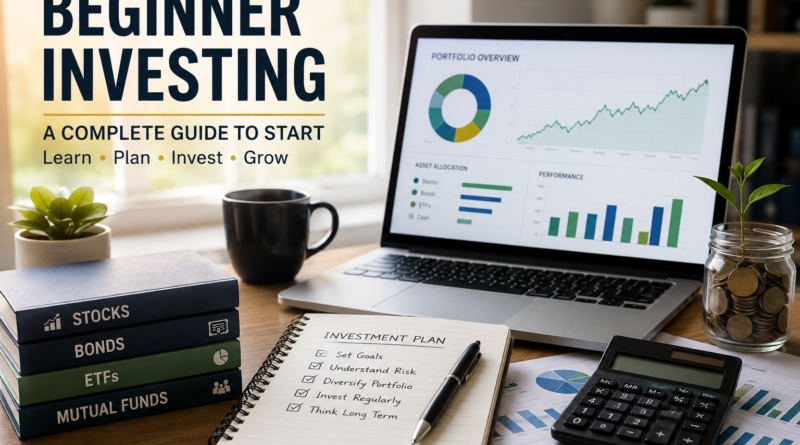
Investing for Beginners: Build Wealth Wisely
Investing for Beginners: A Complete Guide to Getting Started
Beginner investment guide can make investing easier to understand when you are just getting started. Instead of trying to predict the market or choosing investments at random, beginners can start by learning investing basics, setting financial goals, understanding risk, and creating a simple investment plan.The good news is that investing for beginners does not have to be overwhelming. You can start by understanding a few fundamental concepts, defining your financial goals, choosing investments that fit your risk tolerance, and developing a realistic investment plan.
Investing is primarily about putting money to work with the expectation that it can grow or generate income over time. Unlike keeping all your money in cash, investing gives you the opportunity to participate in the growth of businesses and financial markets. However, investments can lose value, so successful investing requires an understanding of risk as well as potential returns.
This guide explains investing basics in a practical way. You will learn how investing works, which investment types beginners should understand, how to build a diversified portfolio, how to invest with little money, and which common mistakes to avoid.
Investing for Beginners: What You Need to Know
What Is Investing?
Investing means putting money into an asset or financial product with the goal of achieving future growth, income, or both.
Common investments include stocks, bonds, ETFs, mutual funds, and index funds. Each has different characteristics, levels of risk, potential returns, and time horizons.
For example, when you buy shares of a public company, you generally acquire a small ownership interest in that business. If the company performs well and investors value it more highly, its share price may increase. Some companies may also distribute part of their profits to shareholders through dividends.
Investing therefore differs from simply saving money. Saving generally emphasizes preserving money and keeping it available, while investing involves accepting some level of uncertainty in exchange for the possibility of higher long-term growth.
Saving vs. Investing
Saving and investing can both have a place in a financial plan.
| Saving | Investing |
|---|---|
| Usually focuses on stability and access | Focuses on long-term growth or income |
| Often suitable for short-term needs | Often more suitable for longer time horizons |
| Generally lower investment risk | Can involve significant market risk |
| Useful for emergency funds | Useful for long-term wealth building |
| Less exposure to market fluctuations | Values can rise and fall |
Practical example: Imagine you expect to need money for an unexpected expense soon. Keeping an emergency fund in an appropriate savings vehicle may make more sense than putting that money into an individual stock. Money intended for a distant financial goal may have a longer investment horizon and therefore potentially tolerate more market fluctuation.
How Investing Works
The basic investing process is straightforward:
- Define a financial goal.
- Determine how much money you can invest.
- Understand your risk tolerance.
- Select an investment account.
- Choose appropriate investments.
- Build a diversified portfolio.
- Make regular contributions when possible.
- Monitor and review your strategy.
The objective is not to predict every market movement. A sound investment strategy focuses on matching your investments to your goals, time horizon, and ability to tolerate losses.
Beginner Investment Guide How to Start Investing Set Your Financial Goals Before You Invest
A common beginner mistake is opening an investment account before deciding what the money is supposed to accomplish.
Your financial goals should come first.
Goals could include building long-term wealth, preparing for retirement, generating future income, funding education, or reaching financial independence. Different goals may require different investment strategies
Beginner Investing Tips for Smart InvestorsShort-Term and Long-Term Goals
Your time horizon is the amount of time you expect to have before you need the money.
A short-term goal generally provides less time to recover from a major market decline. A long-term goal can potentially provide more time for investment growth and recovery from temporary market fluctuations.
Worked example: Suppose two investors each have $10,000.
Investor A expects to need the money relatively soon for a major planned expense. Investor B does not expect to use the money for several decades.
Even though they have the same starting amount, their investment decisions may reasonably differ because their time horizons and ability to tolerate market fluctuations are different.
Creating an Investment Plan
A basic investment plan should answer several questions:
- What am I investing for?
- When will I need the money?
- How much can I invest initially?
- How much can I contribute regularly?
- What level of loss can I realistically tolerate?
- Which investment types fit my goals?
- How often will I review my portfolio?
A written plan can help prevent emotional decisions when markets become volatile.
Understand Investment Risk and Risk Tolerance
Every investment carries some degree of risk. Understanding that risk is one of the most important parts of investing for beginners.
Risk refers to the possibility that an investment may lose value or produce a different result from what you expected.
The Relationship Between Risk and Return
Generally, investments with greater potential returns can also involve greater potential losses. This relationship is often described as the risk-and-return trade-off.
Stocks can experience substantial price fluctuations. Bonds may have different forms of credit and interest-rate risk. Funds can also decline when the assets they hold fall in value.
There is no investment that guarantees high returns without risk.
Practical example: Consider an investor choosing between a highly volatile individual stock and a diversified fund. The individual stock may produce a very large gain if the company performs exceptionally well, but it can also experience a significant decline. A diversified fund spreads money across multiple holdings, which may reduce the impact of one company’s poor performance, although it does not eliminate market risk.
Conservative, Moderate, and High-Risk Investing
Investors are often broadly described as conservative, moderate, or aggressive based on their willingness and ability to accept investment risk.
A conservative investor may prioritize stability and may have a shorter time horizon.
A moderate investor may accept a combination of market fluctuations and stability in pursuit of long-term growth.
A more aggressive investor may be willing to accept substantial short-term fluctuations because of a long investment horizon and greater tolerance for potential losses.
Your risk tolerance should not be based only on how much risk you think you can handle. Consider how you would actually react if your portfolio declined significantly.
How to Manage Investment Risk
Risk management can include:
- Diversifying investments
- Matching investments to your time horizon
- Avoiding excessive concentration
- Understanding what you own
- Keeping an emergency fund separate from investments
- Avoiding investments you do not understand
- Reviewing your asset allocation periodically
Diversification does not guarantee profits or prevent losses, but it can reduce the effect that a single investment has on your overall portfolio.
Learn the Main Types of Investments
Before choosing investments, beginners should understand the major categories available.
Stocks
Stocks represent ownership interests in companies.
Investors may earn returns through increases in share prices and, when companies distribute them, dividends.
Stocks can provide significant long-term growth potential, but their prices can fluctuate considerably.
Bonds
Bonds are debt investments. Investors generally lend money to an issuer, such as a government or company, under defined terms.
Government bonds and corporate bonds can have different levels of credit risk, maturity periods, and interest-rate sensitivity.
Bonds are often included in portfolios to provide diversification and income characteristics, although they are not risk-free.
ETFs and Index Funds
Exchange-traded funds, commonly called ETFs, hold collections of assets and trade on an exchange during market hours.
Index funds aim to track a particular market index rather than attempting to select investments individually.
These approaches can make diversification easier for investors who do not want to research and manage a large collection of individual securities.
Mutual Funds
Mutual funds pool money from many investors and invest according to a stated strategy.
Some mutual funds focus on stocks, others on bonds, and others on combinations of assets.
Investors should review a fund’s strategy, costs, holdings, and risks before investing.
Money Market Funds
Money market funds generally invest in short-term, relatively liquid instruments. They are often used for purposes where investors prioritize liquidity and comparatively lower volatility, although they are still investment products and are not identical to bank savings accounts.
Dividend and Growth Investments
Dividend stocks are shares of companies that distribute dividends to shareholders.
Growth stocks are generally associated with companies where investors expect relatively strong future growth.
Value stocks are often associated with companies considered relatively inexpensive compared with measures of their underlying business value.
These categories can overlap, and an investor should evaluate the actual company or fund rather than relying solely on a label.
Investing for Beginners: How to Start Step by Step
Getting started with investing can be broken into manageable steps.
Decide How Much You Can Invest
Start with an amount that fits your financial situation.
Do not allow investing contributions to interfere with essential expenses or financial obligations.
Your investment budget can be based on a fixed monthly amount or a percentage of disposable income.
The goal is consistency rather than starting with a huge amount.
Build an Emergency Fund
Before taking significant investment risk, consider establishing an emergency fund appropriate for your circumstances.
An emergency fund can help cover unexpected expenses without forcing you to sell investments during an unfavorable market period.
Worked example: Suppose your portfolio falls 20% while you suddenly need cash for an emergency. If you have no separate savings, you might have to sell investments after a decline. Having accessible emergency savings can give your long-term portfolio more room to remain invested.
Pay Attention to High-Interest Debt
High-interest debt can make it difficult to build wealth.
Before aggressively investing, evaluate expensive debt and determine whether paying it down should be a priority.
This does not mean everyone should follow exactly the same sequence. Your interest rates, financial goals, cash flow, and other circumstances matter.
Open a Brokerage Account
A brokerage account allows investors to purchase and sell many types of investments.
When comparing an online broker or investment platform, examine:
- Available investments
- Account fees
- Trading costs
- Research tools
- Fractional shares
- Customer support
- Minimum investment requirements
- Security features
Fees that appear small can become meaningful over a long investment horizon.
Fund Your Investment Account
After opening an account, transfer money according to the platform’s instructions.
Avoid investing money that you may immediately need for rent, essential bills, or emergency expenses.
Choose Your Investments
Beginners should avoid choosing an investment simply because its price recently increased.
Instead, consider:
- Your financial goals
- Time horizon
- Risk tolerance
- Diversification
- Costs
- Investment strategy
- Historical behavior
- What the investment actually owns
Research is particularly important when purchasing individual stocks.
Make Your First Investment
Once you understand the investment and it fits your plan, you can make your purchase through your brokerage platform.
Your first investment does not need to be complicated.
For many investors, a diversified approach can be easier to manage than building a portfolio entirely from individual stocks.
How to Build a Diversified Investment Portfolio
A portfolio is the collection of investments you own.
Portfolio management involves deciding how those investments should be combined and maintained.
What Is Asset Allocation?
Asset allocation refers to how your investment money is distributed among different asset categories.
For example, a portfolio might contain stocks, bonds, and other investments.
The appropriate allocation depends on factors such as:
- Risk tolerance
- Investment horizon
- Financial goals
- Income needs
- Financial circumstances
There is no universal allocation that is appropriate for every investor.
Stocks and Bonds
Stocks may provide growth potential but can fluctuate significantly.
Bonds can provide different risk and income characteristics.
Combining asset classes can create a more balanced investment mix than concentrating everything in one category.
Why Diversification Matters
Diversification means spreading investments across different assets rather than depending heavily on one company, industry, or security.
Imagine an investor puts 100% of their money into one company’s stock. If that company experiences serious financial problems, the investor’s entire portfolio could be heavily affected.
Now consider an investor whose money is distributed among many companies and asset classes. A decline in one holding may have a smaller impact on the overall portfolio.
Diversification cannot remove market risk, but it can reduce concentration risk.
Example of a Beginner Portfolio
Consider a hypothetical investor with a long time horizon.
Instead of selecting dozens of individual companies, the investor could research diversified funds that provide exposure to a broad range of companies and potentially combine them with other asset classes based on their personal risk profile.
The exact percentages should not be treated as a universal recommendation. Portfolio allocation should reflect the investor’s individual circumstances.
How to Invest With Little Money
You do not necessarily need a large amount of money to begin learning about investing.
Start With Small Investments
Small investments can help a beginner develop consistent financial habits.
For example, investing a manageable amount every month can gradually increase total contributions.
The key advantage is that regular contributions can make investing a routine rather than something you attempt only when you have extra cash.
Use Fractional Shares
Some brokerage platforms allow fractional shares, meaning an investor can purchase less than one whole share.
This can make certain investments more accessible when a full share has a high price.
Availability, fees, and eligibility vary by platform.
Invest Regularly
Monthly investing and recurring contributions can help investors maintain consistency.
Instead of waiting for the “perfect” time to invest, an investor can follow a predetermined contribution schedule.
Dollar-Cost Averaging
Dollar-cost averaging involves investing a fixed amount at regular intervals.
When prices are higher, the fixed amount purchases fewer shares. When prices are lower, it purchases more shares.
Worked example: Suppose an investor contributes $200 each month to an investment. They continue buying according to their schedule rather than changing the contribution every time the market moves.
This does not guarantee profits or protect against losses, but it can provide a disciplined approach to regular investing.
Stock Market Investing for Beginners
The stock market can appear intimidating, but the basic concept is relatively simple.
What Is a Stock?
A stock represents ownership in a company.
Public companies issue shares that can be bought and sold by investors through financial markets.
The market price of a stock changes because buyers and sellers continuously reassess the value and future prospects of the company.
How Investors Make Money From Stocks
There are two primary ways stock investors may receive returns:
- Capital appreciation: The share price increases and the investor sells at a higher price.
- Dividends: The company distributes cash or another form of dividend to eligible shareholders.
Neither outcome is guaranteed.
Example: An investor purchases shares at $50 per share. If the price later rises to $65 and the investor sells, the investment has experienced a $15 per-share increase before considering costs and taxes. If the company also paid dividends during the holding period, those distributions could contribute to the investor’s total return.
Researching Stocks Before Buying
Researching stocks means going beyond headlines.
Beginners can examine:
- Company revenue
- Earnings
- Debt
- Cash flow
- Competitive position
- Business model
- Industry conditions
- Valuation
- Management
- Dividend history when relevant
An investor should understand why they are buying a stock and what could cause their original investment thesis to become invalid.
Long-Term Investing and Compound Growth
One of the most powerful concepts in investing is compounding.
How Compounding Works
Compound growth occurs when investment returns generate additional returns over time.
Suppose an investment grows and those gains remain invested. Future growth can then occur on both the original contribution and previous gains.
Simple hypothetical example: Imagine investing $1,000 and earning a hypothetical 8% return for one year. The account would become $1,080 before considering taxes, fees, or changes in market value. If that entire amount remained invested and earned another hypothetical 8%, the second year’s gain would be calculated on $1,080 rather than only the original $1,000.
Actual investment returns are not guaranteed and will not necessarily arrive at a constant rate.
Reinvesting Dividends
Investors who receive dividends may choose to reinvest them rather than taking the income as cash.
Reinvested dividends can purchase additional shares, which may then potentially generate future dividends or capital growth.
Why Time Matters
Time can be a major advantage for long-term investors because it provides more opportunity for contributions and potential compound growth.
This is one reason retirement investing often emphasizes starting early and maintaining consistent contributions rather than trying to make one perfect investment decision.
Common Investing Mistakes Beginners Should Avoid
Investing Without a Plan
Buying investments without understanding the goal can lead to inconsistent decisions.
Create an investment plan before putting significant money into the market.
Emotional Investing and Panic Selling
Markets can decline quickly.
Seeing your portfolio fall can trigger fear, but selling solely because prices dropped may conflict with a long-term strategy.
Before making a decision, ask whether your financial circumstances or investment thesis actually changed.
Chasing Returns
Investors sometimes buy assets simply because they recently performed extremely well.
Past performance does not guarantee future results.
A strong recent return can attract attention, but it should not replace fundamental research.
Market Timing
Trying to consistently predict the best time to buy and sell is extremely difficult.
Investors who repeatedly move in and out of the market may miss periods of recovery or growth.
Ignoring Fees
Investment fees, brokerage fees, account charges, and fund expenses can reduce long-term returns.
Always understand the costs associated with an investment before buying it.
Example: A fee that looks insignificant on one transaction can become much more meaningful when applied repeatedly to a large portfolio over many years.
Taking Excessive Risk
An investment may have attractive potential returns but still be inappropriate for your circumstances.
Taking more risk than you can financially or emotionally tolerate can result in poor decisions during market downturns.
Overtrading
Frequent buying and selling can increase costs and encourage short-term thinking.
For many long-term investors, a simple strategy with periodic portfolio reviews can be easier to maintain than constant trading.
How to Monitor and Review Your Investments
Investing does not necessarily mean checking your portfolio every hour.
Monitoring should be purposeful.
Tracking Portfolio Performance
Review whether your portfolio continues to match your objectives.
You can evaluate:
- Overall performance
- Asset allocation
- Investment costs
- Diversification
- Individual holdings
- Contributions
- Progress toward financial goals
Do not judge your entire investment strategy based on a single day’s market movement.
When to Adjust Your Investments
Your portfolio may need adjustment when your financial circumstances, goals, or time horizon change.
For example, an investor approaching a major financial goal may have different priorities from someone investing for several decades.
Rebalancing may also be considered when an asset allocation moves significantly away from the intended mix.
Keeping Emotions Under Control
A disciplined investment strategy can help reduce emotional decision-making.
Instead of reacting to every market headline, focus on your financial plan and the reasons behind your investment choices.
Investing Tips for Beginners
Keep Your Strategy Simple
You do not need a complicated portfolio to become a successful investor.
Understand the investments you own and make decisions that fit your goals.
Diversify
Avoid putting too much money into one company, sector, or asset type.
A diversified portfolio can help reduce concentration risk.
Invest Consistently
Regular investing can help turn wealth building into a habit.
Even small contributions can accumulate over time.
Understand What You Own
Never invest solely because someone online says an investment will increase.
Research the asset, understand its risks, and determine whether it fits your investment strategy.
Focus on the Long Term
Long-term investing can reduce the pressure to react to temporary market fluctuations.
That does not mean ignoring your portfolio. It means evaluating short-term volatility within the context of your broader financial goals.
Frequently Asked Questions About Investing for Beginners
How much money do I need to start investing?
There is no universal amount required to become an investor. Some platforms offer low or no account minimums, and certain brokers provide fractional shares. What matters most is investing an amount that fits your budget and financial situation.
Is investing risky for beginners?
Investing involves risk, and beginners can lose money. Risk varies substantially between investment types. Understanding risk tolerance, diversification, and time horizon can help you choose investments more appropriately.
What is the best investment for a beginner?
There is no single best investment for everyone. A suitable choice depends on your goals, time horizon, risk tolerance, financial situation, and investment knowledge. Diversified investments can be easier for some beginners to manage than selecting individual stocks.
Should beginners invest in stocks?
Stocks can be part of a long-term investment strategy, but beginners should understand that stock prices can fluctuate substantially. Research, diversification, and appropriate asset allocation are important.
How can I start investing with little money?
You can start by setting aside a manageable amount, making regular contributions, and considering investments that allow small purchases or fractional shares when available.
What is diversification?
Diversification means spreading investments across different assets, companies, industries, or markets. Its purpose is to reduce the effect of any single investment on the overall portfolio.
What is compound growth?
Compound growth occurs when investment gains remain invested and generate potential additional gains over time. The longer money remains invested, the more opportunity there may be for compounding to affect wealth accumulation.
Should I invest or pay off debt first?
The answer depends on the type and cost of debt, your financial situation, emergency savings, and investment goals. High-interest debt can be particularly expensive, so it deserves careful consideration before aggressively increasing investment contributions.
How often should I check my investment portfolio?
There is no universal schedule. Long-term investors may benefit from periodic reviews rather than constantly reacting to daily market movements. The appropriate frequency depends on your strategy and circumstances.
Can I lose all my money investing?
Some individual investments can lose most or all of their value. Diversification can reduce concentration risk, but it cannot eliminate the possibility of losses. Understanding what you own is therefore essential.
Final Thoughts on Investing for Beginners
Investing for beginners becomes much easier when you focus on fundamentals instead of trying to predict every market move. Start with clear financial goals, establish an appropriate emergency fund, understand your risk tolerance, choose investments carefully, and build a diversified portfolio.
You do not need to start with a large amount of money or a complicated strategy. Consistent investing, sensible diversification, careful research, controlled costs, and a long-term perspective can provide a stronger foundation for wealth building.
The best first step is not finding a perfect investment. It is creating a realistic plan and following it with discipline.
Read Next
Pingback: How to Choose Stocks to Invest In: 10 Proven Tips