
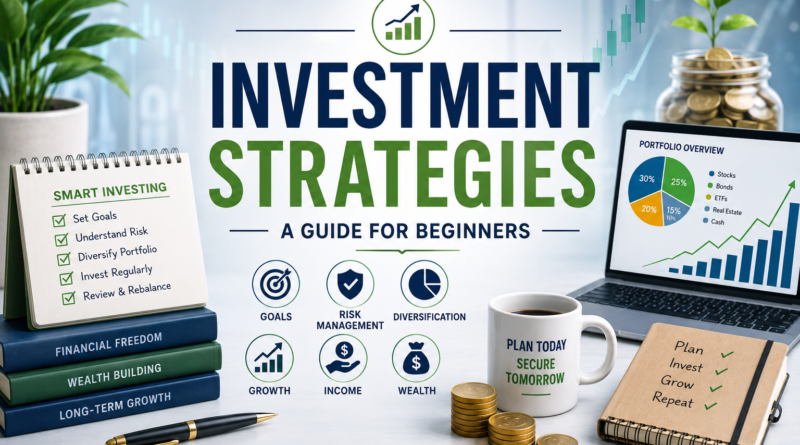
Investment Strategies: A Guide for Beginners
Investment Strategies: A Guide for Beginners
Building wealth through investing is less about finding one perfect asset and more about choosing an approach that fits your goals, time horizon, risk tolerance, and financial situation. The right Investment Strategies can help you decide what to buy, how much to invest, how often to contribute, and how to respond when markets move.
There is no universal strategy that works equally well for every investor. Someone saving for retirement several decades away may have a very different investment plan from someone saving for a house within five years. Likewise, a person comfortable with market fluctuations may choose a different portfolio from an investor focused primarily on capital preservation.
Understanding the major strategies gives you a framework for making better investment decisions. It can also help you avoid emotional reactions, unnecessary trading, excessive costs, and portfolios that do not match your objectives.
What Are Investment Strategies?
An investment strategy is a structured approach for deciding how to invest money and manage an investment portfolio. It typically considers financial goals, risk tolerance, time horizon, asset allocation, diversification, expected returns, and the types of securities an investor is comfortable owning.
Some investors prefer passive investing, where they seek broad market exposure through index funds or ETFs. Others use active investing and research individual companies in an attempt to outperform a benchmark.
There are also strategies built around specific characteristics. Value investing focuses on companies that appear inexpensive relative to their fundamentals. Growth investing emphasizes companies expected to expand earnings or revenue. Dividend investing focuses on companies that distribute part of their profits to shareholders.
Practical Example
Imagine two investors who each have $10,000.
Investor A is saving for retirement 25 years from now and can tolerate temporary declines. Investor B expects to use the money for a major purchase in three years.
Even though they have the same starting amount, their investment approach may be completely different. Investor A may have greater exposure to growth-oriented assets, while Investor B may emphasize stability and capital preservation.
The strategy should follow the goal rather than the other way around.
Why Investment Strategies Matter
Without a defined investment strategy, it is easy to make decisions based on headlines, social media trends, fear, or excitement. A market decline can cause an unprepared investor to sell at an unfavorable time, while a rapidly rising stock can tempt someone to invest too much without understanding the risk.
A written investment plan creates a framework for decision-making.
It can answer questions such as:
- What am I investing for?
- How much can I invest regularly?
- What level of risk can I tolerate?
- Which asset classes should I own?
- How diversified should my portfolio be?
- When should I review my investments?
- What fees am I paying?
- What circumstances would justify changing my plan?
A strategy also provides discipline. Instead of reacting to every market movement, you can evaluate changes against your original objectives.
Practical Example
Suppose the stock market falls 15%. An investor without a plan may immediately sell because of fear.
An investor following a long-term strategy may first ask whether their financial goals, risk tolerance, and investment horizon have changed. If nothing fundamental has changed, the market decline may not require a complete change in strategy.
This does not mean ignoring risk. It means making decisions deliberately rather than emotionally.
How to Choose the Right Investment Strategy
Choosing among different investing strategies begins with your personal financial circumstances.
There is a major difference between selecting an investment because it is popular and selecting it because it fits a specific objective.
Start With Your Financial Goals
Begin by identifying what you want your investments to accomplish.
Common financial goals include:
- retirement
- buying a home
- education expenses
- building long-term wealth
- creating potential investment income
- preserving capital
- funding a future business
- building an emergency reserve
The goal determines many other decisions.
Understand Your Risk Tolerance
Risk tolerance describes how much uncertainty and potential loss you can reasonably accept.
An investor with a high risk tolerance may be comfortable with significant fluctuations in stocks. Someone with a lower tolerance may prefer a more balanced mix of stocks, bonds, and cash.
Risk tolerance is not simply about what you think you can tolerate. Your financial situation matters too.
An investor may psychologically accept volatility but still have a short time horizon that makes large losses particularly problematic.
Consider Your Time Horizon
Your time horizon is the period before you expect to need the money.
A long time horizon can provide more opportunity to withstand temporary market declines. A short horizon generally requires greater attention to liquidity and downside risk.
For example, retirement money needed decades from now can usually be approached differently from money needed for a tuition payment next year.
Set an Investment Budget
Your investment budget should fit comfortably within your broader financial plan.
Before committing substantial money to investments, consider essential expenses, high-interest debt, emergency savings, and other financial obligations.
Practical Example
Suppose you earn $4,000 per month and decide to invest $400 regularly.
Instead of trying to predict which stock will rise next, you could establish a regular contribution schedule and divide your money according to a predetermined investment mix.
The goal is consistency and suitability rather than speculation.
Best Investment Strategies for Beginners
Beginners do not need to use complicated systems. Simple investment strategies can be effective when they are appropriate for the investor and applied consistently.
Passive Investing
Passive investing seeks to track a market index or broad segment rather than repeatedly selecting individual securities.
Index funds and ETFs are commonly used for this approach. Instead of trying to identify the next winning company, an investor can gain exposure to a broader group of investments.
Potential advantages include simplicity, diversification, and relatively low costs.
A limitation is that passive investors generally accept market performance rather than attempting to outperform it.
Practical Example
Instead of researching 30 individual companies, a beginner could use a diversified index fund that provides exposure to many companies.
This reduces the importance of choosing one particular stock correctly.
Value Investing
Value investing involves looking for securities that appear undervalued relative to their underlying business fundamentals.
Investors may examine measures such as earnings, cash flow, assets, debt, and valuation ratios.
The central idea is that the market price may not fully reflect the company’s long-term value.
However, a stock can remain undervalued for a long time, and sometimes a low price reflects genuine business problems.
Growth Investing
Growth investing focuses on companies expected to grow revenue, earnings, market share, or other business metrics faster than average.
Growth stocks can offer substantial upside when expectations are achieved, but they may also experience significant volatility when growth forecasts disappoint.
Dividend Investing
Dividend investing focuses on companies that distribute cash to shareholders.
Dividend stocks can appeal to investors seeking potential income as well as long-term appreciation. However, a high dividend yield should not automatically be interpreted as a safe investment.
Investors should consider the company’s earnings, cash flow, balance sheet, dividend history, and ability to maintain distributions.
Dollar-Cost Averaging
Dollar-cost averaging involves investing a predetermined amount at regular intervals rather than attempting to predict the best entry point.
For example, an investor might contribute $300 every month.
When prices are higher, the fixed amount buys fewer shares. When prices are lower, it buys more shares.
This approach can reduce the temptation to make emotional market-timing decisions.
It does not eliminate investment risk, and it does not guarantee better returns than investing a lump sum immediately.
Buy-and-Hold Investing
Buy-and-hold investing involves purchasing investments with the intention of holding them for an extended period.
The strategy focuses on long-term potential rather than frequent buying and selling.
It can reduce trading activity and help investors avoid reacting to short-term market noise.
Income Investing
Income investing focuses on generating cash flow from investments.
Depending on the investor’s objectives and risk profile, income may come from dividends, bond interest, or other investment sources.
The key is to evaluate both the income potential and the risk of the underlying investment.
Long-Term vs Short-Term Investment Strategies
Time horizon is one of the most important distinctions among investment approaches.
Long-Term Investing
Long-term investing generally emphasizes holding investments for years rather than trying to profit from short-term price movements.
Long-term investors may use diversified stocks, bonds, ETFs, mutual funds, or combinations of these assets depending on their goals.
The benefit of a longer horizon is that temporary market volatility may have less influence on the ultimate outcome.
Short-Term Investing and Trading
Short-term investing and trading involve more frequent decisions and can include swing trading or other active approaches.
Traders may analyze price movements, company news, market conditions, technical indicators, or fundamental information.
Short-term approaches can require more time, knowledge, discipline, and risk management.
When Each Approach May Fit
Consider a person saving for retirement in 25 years. A long-term strategy may make more sense because the investor has time to tolerate market cycles.
Now consider someone who expects to use the money within 12 months. Taking substantial market risk could create a serious problem if prices decline immediately before the money is needed.
Practical Example
An investor with a 20-year horizon might accept a temporary 20% portfolio decline if the portfolio’s risk level remains consistent with their plan.
A person needing the same money next year may not have that flexibility.
The difference is not simply investment preference. It is the relationship between risk and the timing of the financial goal.
Active vs Passive Investing
Active and passive investing represent two broad approaches to portfolio management.
How Passive Investing Works
Passive investors generally seek to match a benchmark or market segment.
They often use index funds or ETFs and avoid frequent security selection.
The approach emphasizes broad exposure, lower turnover, and consistency.
How Active Investing Works
Active investors attempt to make decisions that differ from the broader market.
They may research individual companies, sectors, industries, economic trends, or valuation opportunities.
Active management can provide flexibility, but it may also involve higher costs, more research, and the possibility of underperforming the market.
Choosing Between Active and Passive Approaches
The decision should consider your knowledge, available time, costs, risk tolerance, and objectives.
Some investors combine both approaches.
Practical Example
An investor could use a broad index fund as the core of a portfolio and allocate a smaller portion to carefully researched individual stocks.
This creates a distinction between the portfolio’s core strategy and its more active component.
Building a Portfolio With Asset Allocation and Diversification
A successful investment strategy is not only about what you buy. It is also about how different investments work together.
Stocks, Bonds, ETFs, and Mutual Funds
Stocks represent ownership in companies and generally carry greater price volatility than cash or many high-quality bonds.
Bonds represent debt issued by governments, corporations, or other entities. Their risks include interest-rate risk, credit risk, and inflation risk.
ETFs and mutual funds can hold collections of securities, making it possible to obtain broad exposure through one investment vehicle.
How Asset Allocation Works
Asset allocation refers to how your portfolio is divided among asset classes.
A simplified portfolio might contain:
| Asset Class | General Role | Main Consideration |
|---|---|---|
| Stocks | Growth potential | Higher volatility |
| Bonds | Income and diversification | Interest-rate and credit risk |
| Cash | Liquidity and stability | Inflation risk |
| ETFs | Diversified exposure | Depends on underlying assets |
| Mutual Funds | Professional or index-based exposure | Fees and strategy |
The appropriate mix depends on goals, risk tolerance, and time horizon.
Why Diversification Matters
Diversification means spreading investments across different securities, sectors, industries, or asset classes.
The goal is not to eliminate losses. Rather, diversification can reduce the effect that one investment has on the overall portfolio.
Owning 20 stocks from the same industry is less diversified than owning investments across multiple sectors and asset classes.
Portfolio Rebalancing
Over time, market movements can change your portfolio allocation.
Suppose you originally wanted 70% stocks and 30% bonds. If stocks rise significantly, the portfolio could become 80% stocks.
Rebalancing involves adjusting the portfolio back toward the intended allocation.
Practical Example
Imagine a $50,000 portfolio designed to contain:
- $35,000 in stocks
- $15,000 in bonds
After a strong stock-market period, it becomes:
- $42,000 in stocks
- $13,000 in bonds
The portfolio now has more stock exposure than originally planned.
A disciplined investor can review the allocation and determine whether rebalancing is appropriate.
Investment Strategies and Risk Management
Risk management is a central part of responsible investing.
Every investment has some form of risk. The goal is not necessarily to remove risk but to understand and manage it.
Understanding Investment Risk
Investment risk can include:
- market risk
- company-specific risk
- interest-rate risk
- inflation risk
- liquidity risk
- credit risk
- currency risk
Different assets carry different combinations of these risks.
Managing Market Volatility
Market volatility refers to changes in investment prices over time.
Volatility is normal in financial markets, particularly with stocks.
A diversified portfolio and an appropriate time horizon can help an investor manage temporary fluctuations.
Reducing Downside Risk
Risk can be managed through diversification, appropriate asset allocation, position sizing, research, and maintaining a suitable cash reserve.
Risk management should begin before purchasing an investment rather than after a loss occurs.
Avoiding Emotional Investment Decisions
Fear and greed can influence investor behavior.
Common emotional reactions include selling after a sharp decline or buying after a large price increase because everyone appears to be making money.
A written investment plan can create rules that reduce the influence of short-term emotions.
Practical Example
Suppose a stock you own falls 25%.
Instead of immediately selling, review why you bought it.
If the original investment thesis has failed, selling may be reasonable. If the decline is simply market-wide and your original assumptions remain valid, the correct response may be different.
The key is evaluating evidence rather than reacting automatically.
Investing vs Trading: What Is the Difference?
Investing and trading are related but different activities.
Investing generally focuses on building wealth over longer periods. Trading usually focuses more heavily on shorter-term price movements.
Investment Strategies for Investors
Long-term investors may emphasize:
- diversification
- asset allocation
- fundamental research
- regular contributions
- low costs
- portfolio rebalancing
- long-term goals
Stock Trading Strategies
Traders may use:
- swing trading
- technical analysis
- price patterns
- momentum
- market trends
- stop-loss orders
- limit orders
- position sizing
Trading can involve greater frequency and requires strict risk management.
Technical and Fundamental Analysis
Technical analysis examines price and trading activity to identify potential patterns or trends.
Fundamental analysis evaluates factors such as revenue, earnings, debt, cash flow, competitive position, and valuation.
Neither approach removes uncertainty.
Common Trading Orders
A market order generally seeks immediate execution at available market prices.
A limit order specifies the maximum price a buyer is willing to pay or minimum price a seller is willing to accept.
A stop-loss order can be used as part of a risk-management plan to trigger an order when a security reaches a specified level, although actual execution and price can vary depending on market conditions and order type.
Practical Example
A long-term investor may buy a diversified fund and expect to hold it for many years.
A short-term trader may buy a stock because of a specific price pattern and plan an exit if the trade moves against them.
Both are making investment decisions, but their time horizons, research methods, and risk-management requirements are different.
Comparing Popular Investment Strategies
Different strategies solve different problems. Comparing them can make the choice clearer.
| Strategy | Main Focus | Potential Strength | Main Limitation |
|---|---|---|---|
| Passive investing | Market exposure | Simple and diversified | Does not seek to outperform |
| Value investing | Undervalued companies | Focus on valuation | May take time to work |
| Growth investing | Business growth | Higher growth potential | Can be volatile |
| Dividend investing | Income | Potential cash flow | Dividends can be reduced |
| Dollar-cost averaging | Regular investing | Reduces timing pressure | Does not eliminate losses |
| Buy and hold | Long-term ownership | Low turnover | Requires patience |
| Active trading | Short-term opportunities | Flexibility | Higher complexity and risk |
Value Investing vs Growth Investing
Value investors typically look for investments they believe are priced below their intrinsic value.
Growth investors focus more heavily on future expansion.
A company can sometimes exhibit both value and growth characteristics, so these categories are not always completely separate.
Market Timing vs Dollar-Cost Averaging
Market timing attempts to make investment decisions based on expected future market movements.
Dollar-cost averaging removes much of the timing decision by investing at predetermined intervals.
Market timing can be difficult because markets respond to constantly changing information.
Stocks vs Bonds
Stocks generally provide greater long-term growth potential but can experience larger price fluctuations.
Bonds can provide income and diversification, but they carry risks such as interest-rate changes and issuer default.
The appropriate balance depends on the investor’s objectives.
ETFs vs Mutual Funds
Both ETFs and mutual funds can provide diversified exposure to multiple securities.
The differences can include how they trade, fee structures, tax considerations, minimum investments, and management style.
Investors should examine the specific fund rather than assuming every ETF or mutual fund has the same characteristics.
Common Investment Strategy Mistakes to Avoid
A strong strategy can still fail if investors repeatedly make poor behavioral or planning decisions.
Chasing Past Performance
An investment that performed extremely well in the past may not repeat that performance.
Past returns should be evaluated alongside valuation, risk, fees, business fundamentals, and the broader economic environment.
Ignoring Investment Fees
Small fees can reduce long-term investment growth.
Common costs include expense ratios, brokerage fees, advisory fees, and trading costs.
For long-term investors, comparing costs can be an important part of investment planning.
Overtrading
Frequent trading can increase costs and create more opportunities for emotional decisions.
Trading should have a clear purpose rather than being driven by boredom or short-term market noise.
Lack of Diversification
Putting too much money into one company, industry, or asset class can create unnecessary portfolio risk.
Diversification cannot guarantee profits or prevent losses, but it can reduce dependence on any single investment.
Investing Without a Plan
Buying investments without defining goals, risk tolerance, or time horizon can lead to inconsistent decisions.
A simple investment plan is often better than a complicated strategy that an investor cannot follow.
Practical Example
Consider two investors who receive a $10,000 bonus.
One immediately buys a trending stock after seeing several positive posts online.
The other reviews their portfolio, checks their asset allocation, considers their goals, and invests the money according to their existing plan.
The second investor is not guaranteed better returns, but the decision is based on a repeatable process rather than excitement.
How to Create an Investment Strategy Step by Step
Creating a practical investment strategy does not have to be complicated.
Step 1: Define Your Goals
Write down exactly what the money is for and when you expect to need it.
A goal such as “build wealth” is broad. A more useful goal might be “save and invest for retirement over the next 25 years.”
Step 2: Assess Your Risk Tolerance
Consider both your financial capacity and emotional ability to withstand losses.
Ask how you might react if your portfolio temporarily declined by 10%, 20%, or more.
Step 3: Choose an Asset Allocation
Decide how much exposure you want to stocks, bonds, cash, and other appropriate assets.
Your allocation should reflect your goals and risk profile.
Step 4: Select Investments
Choose individual securities, ETFs, mutual funds, index funds, or other investments that fit your strategy.
Examine costs, diversification, liquidity, risk, and the investment’s purpose.
Step 5: Invest Consistently
Regular contributions can make investing a repeatable financial habit.
For many investors, consistency matters more than constantly trying to predict market movements.
Step 6: Review and Rebalance
Review your portfolio periodically rather than reacting to every daily price movement.
If your financial goals, income, risk tolerance, or time horizon change, your investment strategy may need to change too.
Practical Example
Suppose a 30-year-old investor wants to invest for retirement.
They establish a long-term goal, determine their risk tolerance, choose a diversified portfolio, automate monthly contributions, and schedule periodic reviews.
If the market falls, they evaluate the portfolio against the original plan rather than automatically abandoning it.
If their circumstances change substantially, they reassess the strategy.
That is the essence of strategic investing: having a process that can adapt without becoming reactive.
Frequently Asked Questions About Investment Strategies
What is the best investment strategy for beginners?
There is no single best strategy for every beginner.
A simple, diversified approach using low-cost investments and regular contributions may be easier to maintain than frequent trading. The appropriate strategy still depends on financial goals, risk tolerance, and time horizon.
What are the most common investment strategies?
Common approaches include passive investing, value investing, growth investing, dividend investing, dollar-cost averaging, buy-and-hold investing, income investing, and active investing.
Each has different objectives, risks, and levels of complexity.
How do I choose an investment strategy?
Start with your financial goals, time horizon, risk tolerance, available investment budget, and knowledge level.
Then choose an asset allocation and investments that support those factors.
Is passive investing better than active investing?
Neither is automatically better for everyone.
Passive investing can offer simplicity, diversification, and potentially lower costs. Active investing offers more flexibility but requires greater research and can involve higher costs and risks.
What is the safest investment strategy?
No investment strategy is completely risk-free.
Strategies emphasizing diversification, appropriate asset allocation, liquidity, and risk management can help manage risk, but every investment decision involves trade-offs.
How much money do I need to start investing?
The amount depends on the investment platform and products available to you.
Some brokers and funds allow relatively small initial investments, while fractional shares can make certain investments more accessible.
The more important factor is establishing an amount that fits sustainably within your budget.
What is dollar-cost averaging?
Dollar-cost averaging means investing a predetermined amount at regular intervals.
It can reduce the pressure of trying to identify the perfect time to enter the market, but it does not guarantee profits or protect against losses.
Is long-term investing better than short-term trading?
“Better” depends on the investor.
Long-term investing can be simpler and may require less frequent decision-making. Short-term trading can offer opportunities but generally requires more active management and risk control.
How can I reduce investment risk?
Risk can be managed through diversification, appropriate asset allocation, research, position sizing, maintaining a suitable cash reserve, and avoiding unnecessary concentration.
Your investment strategy should also match your time horizon.
How should beginners diversify a portfolio?
Beginners can consider diversification across multiple securities, sectors, and appropriate asset classes rather than concentrating their money in one investment.
Broad-market ETFs or index funds can provide diversification through a single investment, although investors should still understand what those funds actually hold.
Final Thoughts
The strongest investment strategy is not necessarily the most complicated one. It is the strategy that fits your goals, risk tolerance, time horizon, budget, and ability to stay disciplined.
Whether you prefer passive investing, value investing, growth investing, dividend investing, or a combination of approaches, the foundation remains the same: understand risk, diversify thoughtfully, control costs, invest consistently, and review your plan when your circumstances change.
Good investing is less about predicting every market move and more about following a sensible process for the long term.
REad Next
Pingback: How to Manage Money: 7 Powerful Tips for Better Finances