
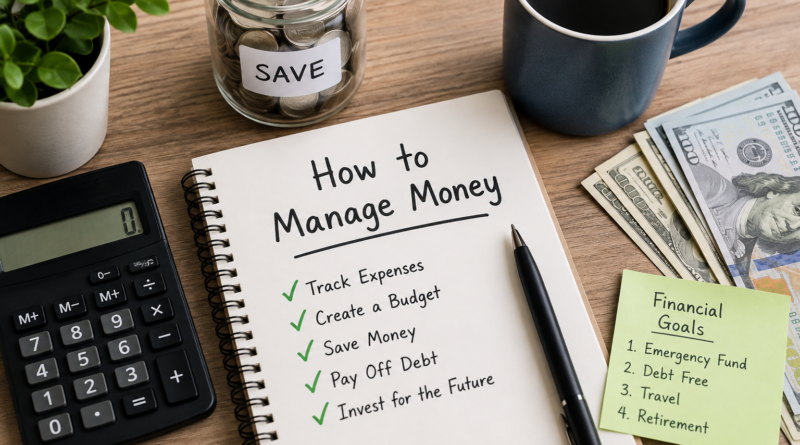
How to Manage Money Simple Finance Tips
How to Manage Money A Simple Guide to Better Finances
Money management tips can make it easier to take control of your finances and make smarter decisions with your money. Whether you want to create a monthly budget, reduce unnecessary spending, build an emergency fund, pay off debt, or start saving for future goals, simple money management habits can make a meaningful difference. The key is to understand where your money goes and create a practical plan that works with your income and financial goals
Good money management combines budgeting, saving, responsible spending, debt control, emergency planning, and long-term investing. You do not have to change everything overnight. Small improvements, repeated consistently, can make a meaningful difference over time.
Best Money Management Tips for Beginners
Whether you are a student, employee, freelancer, business owner, or someone trying to organize household finances, the basic principles are similar. You need a clear picture of your income and expenses, realistic financial goals, and a system that makes good decisions easier.
This guide explains practical ways to manage your money, avoid common mistakes, build financial security, and work toward long-term financial independence.
What Is Money Management?
Money management is the process of planning, tracking, saving, spending, and investing your income so that it supports your current needs and future financial goals.
It involves more than simply creating a budget. Effective personal finance management means understanding your cash flow, controlling unnecessary expenses, preparing for unexpected costs, managing debt, and putting some money toward future objectives.
A simple money-management system can answer five questions:
- How much money comes in?
- Where does the money go?
- How much should be saved?
- Which debts should be prioritized?
- What should be done with money left after essential expenses?
For example, imagine someone earns $3,000 per month. If they spend the entire amount without tracking expenses, they may feel financially stressed even though their income is reasonable. By tracking expenses and creating a spending plan, they may discover that hundreds of dollars are going toward subscriptions, dining out, impulse purchases, or other discretionary spending.
The goal is not to eliminate every enjoyable expense. The goal is to make spending intentional.
Why Is Money Management Important?
Money affects many areas of everyday life. Poor financial habits can make unexpected expenses stressful, while good habits can provide greater flexibility and confidence.
Effective financial management can help you:
- Keep spending below income
- Build savings
- Prepare for emergencies
- Reduce expensive debt
- Improve financial stability
- Work toward major financial goals
- Prepare for retirement
- Invest for long-term wealth building
- Reduce financial stress
Consider two people with the same monthly income. One regularly spends without a plan and uses credit cards whenever money runs short. The other tracks expenses, maintains an emergency fund, and saves automatically.
Their incomes are identical, but their financial situations can become very different over time.
Money management therefore depends not only on how much you earn, but also on what you do with what you earn.
How to Manage Money in 10 Simple Steps
Learning how to manage your money becomes easier when you break the process into practical steps. You do not need a complicated financial system. A simple routine that you actually follow is often more useful than a perfect plan that you abandon after a few weeks.
1. Track Your Income and Expenses
The first step is understanding your current financial position.
Write down all reliable sources of income, such as salary, freelance earnings, business income, or other regular payments. Then record your expenses.
Divide spending into categories such as:
- Housing
- Utilities
- Food
- Transportation
- Insurance
- Debt payments
- Entertainment
- Subscriptions
- Shopping
- Savings
- Investments
You can use a spreadsheet, budgeting app, notebook, or bank statement. The tool matters less than consistency.
Practical example
Suppose your monthly income is $3,500.
Your basic expenses might be:
| Category | Monthly Amount |
|---|---|
| Housing | $1,100 |
| Food | $450 |
| Transportation | $300 |
| Utilities | $250 |
| Debt payments | $300 |
| Insurance | $150 |
| Entertainment | $200 |
| Savings | $400 |
| Other | $250 |
| Total | $3,400 |
The remaining $100 gives you a small margin. Without tracking, you might not realize how little flexibility you actually have.
Once you know your numbers, you can make better decisions.
2. Create a Monthly Budget
A budget is a plan for how you intend to use your income before you spend it.
Start with your monthly take-home income. Then list essential expenses, financial obligations, savings, and discretionary spending.
A useful budget does not have to be restrictive. It should give every major portion of your income a purpose.
One popular framework is the 50/30/20 approach:
- Around 50% for needs
- Around 30% for wants
- Around 20% for savings and debt repayment
However, these percentages are guidelines rather than universal rules. Someone living in an expensive city may need to spend more on housing, while someone with significant debt may temporarily allocate more toward repayment.
Practical scenario
If you take home $4,000 per month, you might initially plan approximately:
- $2,000 for essential needs
- $1,200 for wants and flexible spending
- $800 for savings and financial priorities
If your actual housing costs are high, you can adjust those proportions. A good budget should reflect your real circumstances rather than forcing you into an unrealistic formula.
3. Separate Needs From Wants
One of the simplest ways to improve spending habits is to distinguish between needs and wants.
Needs generally include expenses required for basic living, such as housing, food, utilities, transportation, and essential healthcare.
Wants are expenses that improve comfort or enjoyment but are not essential, such as expensive entertainment, frequent restaurant meals, premium subscriptions, or impulse shopping.
The distinction is not about labeling wants as bad. Enjoyment is part of a healthy financial life. The problem occurs when discretionary spending prevents you from paying bills or reaching important goals.
A simple test
Before making a purchase, ask:
Do I need this now, or do I simply want it now?
If it is a want, consider waiting 24 hours before purchasing. This can reduce impulse purchases without requiring you to eliminate discretionary spending completely.
4. Save Money Before You Spend It
Many people save whatever happens to remain at the end of the month. Unfortunately, there may be nothing left.
A more reliable approach is to treat savings as a planned expense.
When you receive your income, transfer a predetermined amount into savings. This approach is sometimes called “pay yourself first.”
Even a small amount can help establish the habit.
For example, saving $100 every month produces $1,200 in contributions over a year, before considering any interest or investment returns.
As your income increases, consider increasing your savings rate instead of automatically increasing your lifestyle expenses.
5. Build an Emergency Fund
An emergency fund is money reserved for unexpected expenses.
Possible emergencies include:
- Job loss
- Medical costs
- Major repairs
- Urgent travel
- Unexpected household expenses
- Temporary income reduction
Without emergency savings, an unexpected bill may force you to rely on expensive credit.
Start with a manageable target. Building one month of essential expenses can be a useful early milestone. Over time, many people aim for several months of essential expenses depending on their income stability and personal circumstances.
Keep emergency savings somewhere accessible and relatively low risk rather than putting all of it into investments that may fluctuate in value.
Practical example
If your essential monthly expenses are $2,000, an initial emergency-fund target could be $1,000. After reaching that milestone, you could work toward $2,000, then gradually increase the reserve.
The important part is progress.
6. Pay Off High-Interest Debt
Debt can make money management difficult because interest consumes part of your future income.
Credit card balances and other high-interest debt deserve particular attention.
Start by listing:
- Current balance
- Interest rate
- Minimum payment
- Due date
Then choose a repayment strategy.
The debt avalanche method prioritizes the debt with the highest interest rate. The debt snowball method focuses on the smallest balance first to create quick psychological wins.
Neither approach is automatically right for everyone. The best method is one you can follow consistently.
Practical scenario
Suppose you have:
- Credit Card A: $2,000 at 25% interest
- Credit Card B: $5,000 at 18% interest
- Personal Loan: $7,000 at 10% interest
An interest-focused strategy would generally prioritize Credit Card A because it has the highest rate.
Once that balance is cleared, redirect the payment toward the next debt rather than increasing lifestyle spending.
7. Set Financial Goals
Money management becomes easier when you know what you are working toward.
Your goals can be divided into short-term and long-term objectives.
Short-term goals might include:
- Building an emergency fund
- Paying a credit card
- Saving for a vacation
- Replacing an old laptop
- Covering an upcoming annual bill
Long-term goals might include:
- Buying a home
- Retirement planning
- Funding education
- Building an investment portfolio
- Achieving financial independence
Make goals specific.
Instead of saying, “I want to save more,” try:
“I want to save $3,000 for an emergency fund within 12 months.”
That gives you a measurable target of $250 per month.
8. Start Investing for the Future
Saving protects money for near-term needs, while investing can help grow wealth over longer periods.
Common investment options include stocks, bonds, ETFs, mutual funds, and index funds. The appropriate choice depends on your financial goals, time horizon, risk tolerance, and circumstances.
Before investing, establish basic financial stability. High-interest debt and the absence of emergency savings can make aggressive investing less appropriate for some people.
Compound growth is one reason starting early can be powerful. When investment returns remain invested, future returns can potentially build on earlier gains.
However, investing always involves risk. Markets can fall, and investments can lose value. Diversification can help spread risk, but it cannot eliminate it.
Practical example
Imagine two investors each contribute $200 monthly for many years. The investor who starts earlier has more time for contributions and potential returns to compound.
The lesson is not that investing guarantees wealth. It is that time can be a valuable part of a long-term investment strategy.
9. Protect Your Finances With Insurance
Financial planning should also consider what could go wrong.
Insurance can help protect against certain large financial losses. Depending on your circumstances, relevant coverage may include health, life, property, auto, disability, or other forms of insurance.
The purpose is not to buy every policy available. It is to identify risks that could seriously damage your finances and determine whether appropriate protection makes sense.
For example, someone with dependents may have a stronger need for life insurance than someone with no dependents.
Similarly, someone who relies entirely on their ability to work may need to think carefully about income protection.
10. Review and Improve Your Money Habits
A budget is not a document you create once and forget.
Review your finances regularly. Look at your income, expenses, savings progress, debt balances, and upcoming financial obligations.
A monthly review can answer questions such as:
- Did I stay within my spending plan?
- Which categories increased?
- Did I save the amount I planned?
- Did my debt decrease?
- Are my goals still realistic?
- What needs to change next month?
Practical scenario
At the end of the month, you discover that your food spending was $100 higher than planned. Instead of abandoning the budget, investigate why.
Perhaps grocery prices increased, or you ate out more frequently. Once you understand the reason, you can adjust the next month’s plan.
A flexible budget is usually more sustainable than a rigid one.
How to Manage Money Without Overspending
Overspending is often caused by convenience, emotion, social pressure, or poor planning rather than a lack of knowledge.
One useful strategy is to create spending limits for categories where you tend to lose control.
You can also:
- Remove unnecessary subscriptions
- Compare prices before major purchases
- Use a shopping list
- Delay non-essential purchases
- Avoid shopping when emotional
- Review recurring charges
- Set a weekly discretionary-spending limit
- Use cash or a separate account for certain spending categories
Another effective strategy is to make saving automatic.
If money moves into savings shortly after payday, you are less likely to accidentally spend it.
Practical example
Suppose you regularly spend $250 per month on impulse shopping. Reducing that amount to $150 would free $100 every month.
That $100 could instead contribute to emergency savings, debt repayment, or long-term investing.
You do not necessarily need a dramatic lifestyle change. Small recurring improvements can have a large cumulative effect.
How to Manage Money on a Low Income
Managing money can be especially challenging when income is limited because most of it may already be committed to essential expenses.
Start by separating expenses into three categories:
Essential: housing, food, utilities, transportation, healthcare.
Important but adjustable: phone plans, groceries, insurance options, transportation choices.
Optional: entertainment, subscriptions, non-essential shopping.
Focus first on expenses that can realistically be changed.
Increasing income can also be part of the solution. Depending on your situation, this could involve freelance work, additional hours, selling unused items, developing a new skill, or pursuing better employment opportunities.
Avoid assuming that every financial problem can be solved by cutting expenses. When essential costs already consume most income, earning more may have a greater impact.
Practical scenario
Someone earning $2,000 per month may discover that essential expenses already total $1,750.
There is only $250 of flexibility.
Instead of trying to eliminate every small pleasure, they could look for larger opportunities such as reducing a major recurring bill, refinancing expensive debt where appropriate, increasing income, or finding a better-paying opportunity.
Money management should focus on the biggest financial levers first.
How to Manage Money as a Beginner
If you are completely new to personal finance, avoid trying to implement ten complicated strategies at once.
Start with a simple sequence:
- Know your monthly income.
- Track every major expense.
- Create a realistic budget.
- Build a small emergency reserve.
- Reduce high-interest debt.
- Set clear financial goals.
- Automate savings.
- Learn basic investing.
- Review your finances monthly.
This order creates a foundation before you take on more complex financial decisions.
Beginner example
Imagine a recent graduate earning their first full-time salary.
Instead of immediately upgrading their car, increasing subscriptions, and making large purchases, they could first establish a monthly budget and automatic savings transfer.
Once the emergency fund is growing and expensive debt is under control, they can gradually increase long-term investing.
This approach reduces the risk of lifestyle inflation consuming every future raise.
Money Management Quick-Reference Chart
| Financial Area | Main Action | Suggested Routine |
|---|---|---|
| Income | Know what you earn | Monthly |
| Expenses | Track spending | Weekly |
| Budget | Plan spending | Monthly |
| Savings | Automate contributions | Every payday |
| Emergency fund | Build cash reserves | Ongoing |
| Debt | Prioritize expensive balances | Monthly |
| Goals | Measure progress | Monthly or quarterly |
| Investments | Review allocation | Periodically |
| Insurance | Check coverage | Annually |
| Financial plan | Review overall progress | Quarterly |
The exact frequency can vary, but the key is creating a routine. Financial organization becomes easier when important tasks happen automatically or on a predictable schedule.
Common Money Management Mistakes to Avoid
Even people with good incomes can experience financial problems because of poor habits.
Not Having a Budget
Without a budget, it is difficult to know whether your spending matches your priorities.
A budget does not need to be complicated. A basic list of income, fixed expenses, flexible expenses, savings, and debt payments can be enough.
Spending More Than You Earn
Consistently spending more than your income creates a gap that must eventually be covered by savings or borrowing.
If this continues, debt can grow quickly.
Ignoring High-Interest Debt
Making only minimum payments can keep expensive debt around for a long time.
Understand the interest rate and repayment terms of every debt you carry.
Delaying Emergency Savings
Unexpected expenses are part of life. Waiting for a financial emergency before building an emergency fund can leave you with limited options.
Start small if necessary.
Lifestyle Inflation
When income rises, it is tempting to increase spending immediately.
Some lifestyle improvements are reasonable, but automatically spending every raise can prevent wealth building.
Consider directing part of each increase toward savings or investments.
Chasing Investments You Do Not Understand
An investment that is popular online is not automatically suitable for you.
Understand what you are buying, the potential risks, fees, and your investment time horizon before committing money.
How to Manage Money and Build Wealth
Managing money is the foundation. Building wealth usually requires taking the next step: consistently directing surplus income toward productive long-term goals.
The process often looks like this:
Earn → Budget → Save → Protect → Reduce Expensive Debt → Invest → Review
Each stage supports the next.
For example, a person who earns $5,000 monthly but spends $4,950 has little money available for long-term wealth building.
Another person earning $4,000 but consistently saving and investing $600 may gradually build stronger financial assets.
Income matters, but the relationship between income, expenses, savings, and investments matters too.
How to Manage Money for Financial Freedom
Financial freedom does not necessarily mean becoming extremely wealthy.
For many people, it means having enough financial flexibility that money emergencies do not control every decision.
The path can include:
- Keeping expenses manageable
- Maintaining emergency savings
- Eliminating expensive debt
- Increasing earning power
- Investing consistently
- Avoiding unnecessary financial risks
- Building multiple sources of financial resilience
Your definition of financial freedom may be different from someone else’s.
For one person, it might mean retiring early. For another, it could mean having enough savings to change careers without financial panic.
The important part is defining the goal and building your financial habits around it.
Frequently Asked Questions About Money Management
What is the best way to manage money?
The best approach is to track income and expenses, create a realistic budget, save consistently, manage debt, prepare for emergencies, and invest according to your long-term goals and risk tolerance.
What is the 50/30/20 rule?
The 50/30/20 rule is a budgeting guideline that allocates roughly 50% of income to needs, 30% to wants, and 20% to savings or debt repayment. Your personal percentages may need to differ.
How can I manage money if I have a low income?
Focus on essential expenses first, reduce avoidable recurring costs, build small savings, manage debt carefully, and look for realistic ways to increase income. A budget helps you identify where limited money has the greatest impact.
How much should I save each month?
There is no single amount that works for everyone. Start with an amount you can consistently afford, then increase it as your income and financial situation improve.
What is an emergency fund?
An emergency fund is money reserved for unexpected expenses such as job loss, medical costs, repairs, or other urgent financial needs. It should generally be accessible and separate from money intended for long-term investing.
Should I pay off debt or start investing?
The answer depends on the type and interest rate of the debt, your emergency savings, and your investment goals. High-interest debt often deserves priority, while some people may balance debt repayment with long-term investing.
How can I stop overspending?
Track your spending, identify triggers, separate needs from wants, use spending limits, remove unnecessary subscriptions, and delay non-essential purchases before buying them.
How do I start investing with little money?
First establish basic financial stability. Then learn about diversified, low-cost investment options available in your market and consider starting with an amount you can consistently invest without compromising essential expenses.
How does insurance help with money management?
Insurance can reduce the financial impact of certain major risks. The appropriate coverage depends on your circumstances, assets, income, dependents, and specific risks.
How often should I review my budget?
A quick review each month is useful. A broader review every few months can help you adjust financial goals, savings rates, debt repayment, and spending priorities.
Final Thoughts
Good money management is less about perfection and more about consistency. Track what you earn, plan where it goes, control unnecessary spending, build emergency savings, manage expensive debt, and invest with a long-term perspective.
You do not need to transform your finances in one day. Start with one better money habit today, repeat it next month, and let consistency build the financial future you want.
Read Next
Pingback: How to Create a Monthly Budget: 7 Easy Steps