
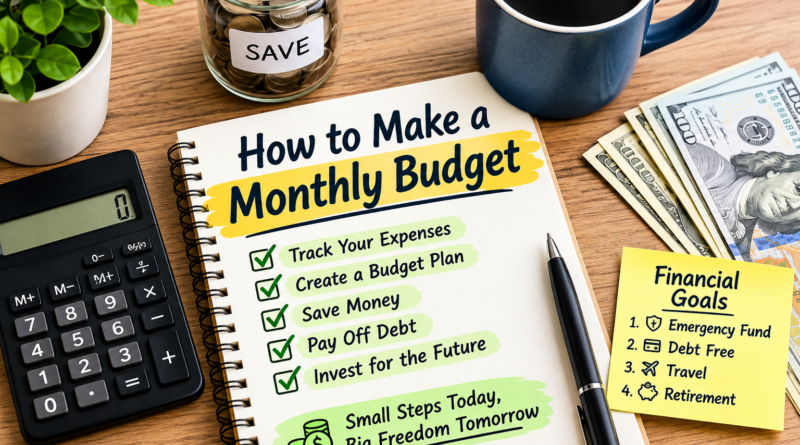
How to Make a Monthly Budget 7 Simple Steps
How to Create a Monthly Budget is an important step toward taking control of your finances. A monthly budget helps you understand your income, track expenses, save money, and avoid unnecessary spending.Managing money becomes much easier when you know where your income is going. A monthly budget gives you a clear picture of what you earn, what you spend, what you save, and where you may need to make changes. If you are wondering how to make a monthly budget, the process does not have to be complicated.
A good budget is simply a plan for your money. It helps you cover essential expenses, prepare for irregular costs, reduce unnecessary spending, pay down debt, and work toward financial goals. You can create one with a notebook, spreadsheet, budgeting app, or simple budget worksheet.
The goal is not to restrict every purchase. Instead, budgeting helps you make deliberate decisions before your money disappears.
How to Make a Monthly Budget
A monthly budget is a plan that compares your expected income with your expected expenses for a specific month. It allows you to decide how much money should go toward housing, food, transportation, debt, savings, entertainment, and other priorities.
Your budget can be as simple or detailed as you need. Someone with a straightforward salary and few bills may only need several broad categories. A household with multiple income sources, debt payments, children, insurance, and irregular expenses may benefit from a more detailed budget plan.
The basic calculation is:
Monthly income − Monthly expenses = Money available for savings, debt, or other goals
For example, imagine your monthly take-home pay is $3,500. If your planned expenses total $2,800, you have $700 left to allocate toward savings, debt repayment, investments, or other financial priorities.
A budget is not a prediction that every month will go exactly as planned. It is a framework that helps you respond when things change.
Why Do You Need a Monthly Budget?
Without a spending plan, it is easy to underestimate small purchases. A few restaurant meals, subscriptions, online purchases, or convenience expenses can gradually consume money that could have gone toward savings How to Make a Monthly Budget
A monthly budget makes these patterns visible.
It can also help you identify whether your spending matches your priorities. If you say saving for an emergency fund is important but there is no money allocated to savings, your budget exposes the gap.
Budgeting Creates Financial Awareness
The first benefit is awareness. You can see how much money comes in and where it goes.
This can reveal spending habits that are difficult to notice when you only check your bank balance.
Budgeting Helps With Financial Goals
A budget can turn a general goal such as “I want to save more” into a specific monthly action.
For example, instead of waiting to see what is left at the end of the month, you might allocate $300 toward an emergency fund immediately after receiving your paycheck.
Budgeting Can Reduce Financial Stress
Knowing that upcoming bills are accounted for can make money management more predictable. You can also prepare for annual expenses rather than being surprised when they arrive.
Practical Example
Suppose someone earns $4,000 per month but frequently reaches the end of the month with little money left.
After reviewing bank statements and credit card statements, they discover that dining, subscriptions, entertainment, and impulse purchases are consuming $900.
The problem may not be insufficient income. It may be a lack of spending awareness.
A budget gives that person a way to redirect part of the $900 toward savings and debt repayment.
How to Make a Monthly Budget
Creating a useful budget involves seven basic steps. You do not need expensive software or complicated financial knowledge. A spreadsheet, calculator, or budget planner can be enough.
1. Calculate Your Monthly Income
Start by determining how much money you actually have available each month.
For employees, this usually means using net income or take-home pay rather than gross salary. Gross income is the amount earned before taxes and deductions, while take-home pay is what actually reaches your bank account.
Include all reliable sources of income, such as:
- Salary or wages
- Regular freelance income
- Side income
- Business income
- Benefits or other recurring payments
- Other predictable sources of money
If your income changes from month to month, do not automatically use your highest earning month as your baseline.
A safer approach is to estimate conservatively and build your budget around an amount you can reasonably expect.
Example: Calculating Income
Imagine your regular paycheck provides $3,200 per month. You also earn approximately $400 from freelance work.
Your estimated monthly income is:
| Income Source | Amount |
|---|---|
| Salary | $3,200 |
| Freelance income | $400 |
| Total | $3,600 |
If the freelance income is inconsistent, you may choose to base essential expenses on the $3,200 salary and treat additional freelance income as flexible money.
This makes the budget more resilient when side income is lower than expected.
2. Track Your Monthly Expenses
Next, identify where your money goes.
Do not rely entirely on memory. Review recent bank statements, credit card statements, bills, receipts, and transaction histories.
Separate expenses into useful categories.
Fixed expenses generally stay similar each month. Examples include:
- Rent or mortgage
- Insurance
- Loan payments
- Some subscription expenses
- Certain utilities
Variable expenses can change from month to month. Examples include:
- Groceries
- Transportation
- Entertainment
- Clothing
- Dining out
- Personal purchases
Also account for expenses that do not happen every month. Car repairs, annual insurance premiums, school costs, gifts, travel, and property expenses can create problems if they are ignored.
One approach is to estimate the annual cost and divide it by 12.
For example, if an annual expense is expected to cost $1,200:
$1,200 ÷ 12 = $100 per month
You can then set aside $100 each month rather than trying to find the entire amount when the bill arrives.
Example: Expense Tracking
A person might discover this monthly spending pattern:
| Category | Planned Amount |
|---|---|
| Housing | $1,200 |
| Utilities | $250 |
| Groceries | $450 |
| Transportation | $300 |
| Insurance | $200 |
| Debt payments | $350 |
| Personal spending | $250 |
| Savings | $400 |
| Miscellaneous | $150 |
| Total | $3,550 |
If monthly income is $3,600, only $50 remains unallocated.
That does not necessarily mean the budget is wrong. It simply shows that most available income already has a purpose.
3. Separate Needs From Wants
One of the most useful budgeting exercises is distinguishing between essential expenses and discretionary spending.
Needs are expenses required for basic living or important obligations. These can include housing, food, utilities, transportation, insurance, and required debt payments.
Wants are purchases that improve comfort or enjoyment but are not usually essential. These might include entertainment, expensive dining, premium subscriptions, frequent shopping, or nonessential upgrades.
This distinction does not mean you should eliminate every want.
A realistic budget should leave some room for enjoyment. The purpose is to understand which expenses can be reduced when money becomes tight.
Example: Needs vs. Wants
Consider a $60 monthly subscription bundle.
If money is comfortable and the service provides genuine value, keeping it may be reasonable.
But if you are struggling to pay essential bills, canceling or reducing subscriptions may free up money without affecting basic needs.
The key is to prioritize rather than eliminate everything enjoyable.
4. Set Your Financial Goals
A budget works better when it is connected to specific goals.
Your financial priorities might include:
- Building an emergency fund
- Paying off credit card debt
- Saving for a home
- Preparing for education expenses
- Increasing retirement savings
- Building long-term investments
- Saving for travel
- Creating financial security
Try to make goals measurable.
Instead of saying, “I want to save money,” decide how much you want to save and by when.
For example:
Goal: Save $2,400 in 12 months.
Monthly target: $2,400 ÷ 12 = $200.
That $200 becomes a planned part of your monthly budget rather than an amount you hope to have left over.
Example: Prioritizing Goals
Suppose you have $500 available after essential expenses.
You could allocate:
- $250 to an emergency fund
- $150 to debt repayment
- $100 to a short-term savings goal
The exact allocation depends on your financial situation, interest rates, obligations, and priorities.
The important point is that the money has a purpose before it is spent.
5. Choose a Budgeting Method
There is no single budgeting system that works for everyone. Choose a method that is easy enough to maintain consistently.
50/30/20 Budget Rule
The 50/30/20 budget rule is a popular framework that divides after-tax income into three broad groups:
- 50% for needs
- 30% for wants
- 20% for savings and debt-related goals
It is a starting framework rather than a universal requirement.
Someone living in an expensive area may spend more than 50% on housing. Someone aggressively paying off debt may allocate much more than 20% toward financial goals.
Zero-Based Budgeting
With zero-based budgeting, every dollar of expected income receives a planned purpose.
This does not mean you spend everything. Savings and extra debt payments can also be categories.
For example:
$4,000 income − $4,000 planned allocations = $0
The objective is to make the entire income intentional.
Envelope Budgeting
Envelope budgeting assigns spending limits to specific categories.
Traditional envelope budgeting uses physical cash, while digital versions can use separate accounts or budgeting software.
This method can be helpful for categories where overspending happens frequently.
Pay-Yourself-First
With this approach, savings are treated as a priority rather than whatever remains at the end of the month.
For example, you might automatically move $300 to savings after receiving your paycheck.
The remaining money is then used for expenses.
Quick Budgeting Method Comparison
| Method | Best For | Main Idea |
|---|---|---|
| 50/30/20 | Beginners | Divide income into broad priorities |
| Zero-based | Detailed planners | Give every dollar a purpose |
| Envelope | Spending control | Set limits by category |
| Pay-yourself-first | Saving consistently | Save before discretionary spending |
6. Create Your Monthly Budget Plan
Now combine your income, expenses, and goals into one plan.
Start with income at the top. Then list essential expenses, financial goals, flexible spending, and miscellaneous costs.
Your budget should ideally balance.
If expenses are higher than income, you have three broad choices:
- Reduce expenses.
- Increase income.
- Change the timing or priority of financial goals.
Avoid solving every budget problem by simply cutting savings to zero. A better strategy is to examine discretionary expenses first and identify areas where reductions are realistic.
Example: Building a Balanced Budget
Suppose your monthly income is $4,500.
| Category | Amount |
|---|---|
| Housing | $1,400 |
| Utilities | $300 |
| Groceries | $500 |
| Transportation | $350 |
| Insurance | $250 |
| Debt payments | $400 |
| Savings | $500 |
| Personal spending | $300 |
| Miscellaneous | $200 |
| Entertainment | $300 |
| Total | $4,500 |
Every dollar has a planned purpose.
If entertainment spending rises to $450, you would need to adjust another category rather than pretending the additional $150 does not exist.
7. Review and Adjust Your Budget
A budget is a living plan.
Actual expenses will rarely match your original estimates perfectly. Groceries may cost more one month. A repair may appear unexpectedly. Your income may change.
At the end of each month, compare planned spending with actual spending.
Ask:
- Which categories were higher than expected?
- Which categories were lower?
- Did I meet my savings target?
- Did unexpected expenses appear?
- Are my financial priorities still the same?
- What should change next month?
A monthly budget review can take only 15 to 30 minutes, but it can make your system much more accurate over time.
Monthly Budget Categories to Include
A strong budget should include the categories that actually matter in your financial life.
Here is a useful starting checklist:
| Budget Category | Examples |
|---|---|
| Housing | Rent, mortgage, property costs |
| Utilities | Electricity, water, internet |
| Food | Groceries, dining |
| Transportation | Fuel, public transit, maintenance |
| Insurance | Health, auto, home, other policies |
| Debt | Credit cards, personal loans, student loans |
| Savings | Emergency fund and other goals |
| Retirement | Retirement contributions |
| Personal | Clothing, hobbies, personal care |
| Subscriptions | Streaming, software, memberships |
| Miscellaneous | Unexpected or irregular costs |
Do not create dozens of categories if that makes budgeting difficult.
The best budget is one you can maintain.
Simple Monthly Budget Example
Consider a household with $5,000 in monthly take-home pay.
They might create the following plan:
| Category | Monthly Amount |
|---|---|
| Housing | $1,500 |
| Utilities | $350 |
| Groceries | $600 |
| Transportation | $400 |
| Insurance | $250 |
| Debt repayment | $500 |
| Emergency savings | $400 |
| Retirement savings | $300 |
| Personal spending | $250 |
| Entertainment | $200 |
| Miscellaneous | $250 |
| Total | $5,000 |
This is only an example. There is no perfect percentage that applies to every person.
The household should adjust these numbers based on local costs, debt, income stability, family responsibilities, and goals.
The biggest advantage of this approach is visibility. Before spending begins, the household already knows what the money is supposed to accomplish.
How to Make a Budget When Money Is Tight
Budgeting can be especially useful when income is limited.
When money is tight, start with the expenses that protect your basic needs and financial stability.
Prioritize:
- Housing
- Essential utilities
- Food
- Transportation needed for work
- Insurance
- Required debt payments
- Essential medical or family costs
After that, examine discretionary spending.
Look for expenses that can be reduced temporarily, such as unused subscriptions, frequent takeout, unnecessary shopping, or expensive entertainment.
Example: Reducing a Shortfall
Suppose monthly income is $2,500 but necessary and discretionary expenses total $2,700.
Instead of randomly cutting $200, review the categories.
You might find:
- $70 in unused subscriptions
- $80 in dining out
- $50 in unnecessary shopping
Reducing these categories closes the $200 gap.
If there is no realistic way to reduce expenses further, increasing income or seeking professional financial assistance may be necessary.
A budget should show the problem clearly rather than hide it.
How to Make a Budget With Irregular Income
Irregular income makes budgeting more challenging, but it is still possible.
Freelancers, contractors, business owners, seasonal workers, and people with commission-based income can use a conservative budgeting approach.
Instead of building your essential expenses around your best month, estimate a realistic minimum.
For example, suppose your income over four recent months was:
- Month 1: $3,200
- Month 2: $4,000
- Month 3: $2,900
- Month 4: $3,700
Your average is $3,450, but you might choose a lower baseline for essential expenses.
During stronger months, extra income can help build a cash buffer, increase savings, or reduce debt.
Practical Strategy
Separate your money into three broad purposes:
Essential: Money needed for core monthly expenses.
Future: Savings, emergency fund, retirement, and other goals.
Flexible: Extra spending that can increase or decrease depending on income.
This approach can make variable income easier to manage.
How to Create a Budget When You Have Debt
Debt should have a specific place in your budget.
List each debt along with its minimum payment, balance, and interest rate.
Then ensure minimum payments are included as fixed obligations.
After covering essential expenses and minimum payments, you can decide how much additional money should go toward debt repayment.
Two common approaches are:
Debt Snowball
Pay extra toward the smallest balance while making minimum payments on other debts.
Once the smallest balance is eliminated, redirect that payment toward the next debt.
Debt Avalanche
Pay extra toward the debt with the highest interest rate while maintaining minimum payments on other balances.
This can reduce the amount of interest paid over time.
Example
Suppose you have three debts:
| Debt | Balance | Interest Rate |
|---|---|---|
| Credit Card A | $1,000 | 24% |
| Credit Card B | $2,500 | 20% |
| Personal Loan | $5,000 | 10% |
A snowball approach would focus on the $1,000 balance first.
An avalanche approach would prioritize Credit Card A because it also has the highest interest rate.
The right method depends on whether you value mathematical efficiency, motivation, or a combination of both.
How to Stick to Your Monthly Budget
Creating a budget is only the beginning. The real benefit comes from using it consistently.
Track Spending Regularly
Do not wait until the end of the month to discover that you exceeded a category.
Check your spending weekly or several times per week.
Use Automatic Transfers
If possible, automate savings after receiving your income.
Automation reduces the number of decisions you need to make.
Keep Spending Limits Realistic
A budget that allows $50 for groceries when your normal grocery spending is $400 is unlikely to last.
Start with realistic numbers and reduce them gradually if possible.
Leave Room for Fun
A budget with no discretionary spending can feel restrictive.
Allowing a reasonable amount for entertainment or personal purchases can make the plan easier to maintain.
Review Your Progress
Look at your budget as a system that improves over time.
If a category consistently exceeds its limit, the answer may not be more discipline. Your original estimate may simply be unrealistic.
Common Budgeting Mistakes to Avoid
Even a detailed budget can fail if the underlying process is flawed.
Ignoring Irregular Expenses
Annual bills and unexpected costs should not be forgotten.
Create a sinking fund for predictable expenses that occur less frequently.
Using Gross Income
Your budget should generally be based on the income actually available to spend, not your salary before taxes and deductions.
Making the Budget Too Complicated
If you need an hour every day to maintain your spreadsheet, you may stop using it.
Keep the system practical.
Forgetting Small Expenses
Small purchases can become significant when repeated.
Coffee, delivery fees, subscriptions, convenience purchases, and impulse shopping should be included when they materially affect your spending.
Treating the Budget as Permanent
Your financial circumstances change.
Income, rent, family needs, debt, goals, and prices can all change. Your budget should change with them.
Focusing Only on Cutting Expenses
Reducing expenses can help, but income is also part of the equation.
Developing skills, negotiating compensation, taking additional work, or growing a business may improve the other side of the budget.
How to Use a Budget Planner, Spreadsheet, or Template
You do not need a sophisticated budgeting app to create an effective system.
A simple budget planner can work well if you prefer writing things down.
A budget spreadsheet is useful when you want automatic calculations, monthly comparisons, and more detailed categories.
A budget template can save time because the main categories are already organized.
Simple Spreadsheet Structure
A basic spreadsheet could contain these columns:
| Category | Planned | Actual | Difference |
|---|---|---|---|
| Housing | $1,200 | $1,200 | $0 |
| Groceries | $450 | $480 | -$30 |
| Transportation | $300 | $270 | +$30 |
| Entertainment | $200 | $240 | -$40 |
| Savings | $400 | $400 | $0 |
The “Difference” column helps identify where your actual spending differs from your plan.
You can use the same structure every month.
The most effective tool is not necessarily the most advanced one. It is the one you will actually use.
Frequently Asked Questions
What Is a Monthly Budget?
A monthly budget is a plan for how you will use your income during a particular month. It includes expected income, expenses, savings, debt payments, and other financial priorities.
How Do I Make a Monthly Budget?
Start by calculating your take-home income. Then list and categorize your expenses, separate needs from wants, set financial goals, choose a budgeting method, allocate your income, and review your actual spending at the end of the month.
What Expenses Should I Include in a Budget?
Include housing, utilities, groceries, transportation, insurance, debt payments, savings, subscriptions, personal spending, and irregular or annual expenses that you expect to occur.
What Is the 50/30/20 Budget Rule?
The 50/30/20 rule is a budgeting framework that suggests allocating about 50% of after-tax income to needs, 30% to wants, and 20% to savings and debt goals. It is a guideline rather than a strict requirement.
How Can I Budget With Irregular Income?
Use a conservative income estimate for essential expenses. During higher-income months, direct extra money toward an emergency fund, future expenses, savings, or debt repayment.
How Do I Track My Monthly Expenses?
Review bank statements, credit card statements, receipts, and transaction histories. Categorize spending and compare actual amounts with your planned budget.
How Often Should I Review My Budget?
A quick review each week can help control spending, while a more detailed monthly review can help you update categories and prepare for the next month.
Is a Budget Only for People With Low Income?
No. Budgeting can benefit people at almost any income level. Higher income does not automatically prevent overspending. A budget can help anyone align spending with savings and financial goals.
Should Savings Be Included in a Monthly Budget?
Yes. Treating savings as a planned category can make it easier to build an emergency fund, prepare for future expenses, and work toward long-term goals.
Final Thoughts
A monthly budget does not need to be complicated to be effective. Start with your real income, understand your expenses, separate needs from wants, assign money to your priorities, and review the results regularly.
The most important step is simply starting. A realistic budget gives every dollar a purpose and turns money management from guesswork into a clear plan.
Read Next
Pingback: 50/30/20 Budget Rule: 7 Powerful Money-Saving Tips