
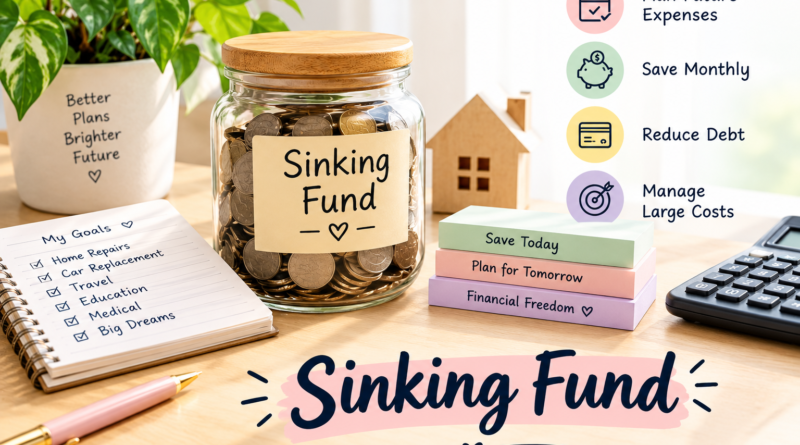
Sinking Fund: A Smart Way to Prepare for Future Expenses
Sinking Fund ek simple personal finance strategy hai jo aapko future ke expected expenses ke liye pehle se paisa save karne mein help karti hai. Iska basic idea yeh hai ke jab koi bada kharcha aane wala ho, to us waqt ek saath bohat zyada paisa arrange karne ke bajaye aap har month thoda-thoda save karte rahen.
For example, agar aapko pata hai ke six months baad car insurance, annual subscription, school fees, home repair, ya holiday expense dena hai, to aap us expense ke liye monthly amount alag rakh sakte hain. Is tarah ek large bill achanak financial pressure nahi banata.
A Sinking Fund emergency fund se different hota hai. Emergency fund unexpected problems ke liye hota hai, jabke sinking fund generally planned or predictable expenses ke liye use kiya jata hai.
What Is a Sinking Fund?
A sinking fund ek dedicated savings account, category, ya money allocation hota hai jahan aap kisi specific future expense ke liye regularly paisa rakhte hain.
Suppose aapko December mein $1,200 ka annual insurance payment karna hai. Agar aap December tak wait karein, to $1,200 ek saath arrange karna difficult ho sakta hai.
Lekin agar aap January se har month $100 save karein:
| Month | Monthly Saving | Total Saved |
|---|---|---|
| January | $100 | $100 |
| February | $100 | $200 |
| March | $100 | $300 |
| April | $100 | $400 |
| May | $100 | $500 |
| June | $100 | $600 |
| July | $100 | $700 |
| August | $100 | $800 |
| September | $100 | $900 |
| October | $100 | $1,000 |
| November | $100 | $1,100 |
| December | $100 | $1,200 |
December tak required amount ready ho jayega.
Yahi sinking fund ka main concept hai: large planned expenses ko small regular savings mein divide karna.
How Does a Sinking Fund Work?
Sinking fund banana relatively simple hai. Sabse pehle aapko future expense identify karna hota hai.
For example:
- Car maintenance
- Annual insurance
- Holiday travel
- Gifts
- Home repairs
- Property taxes
- School expenses
- Technology replacement
- Medical or dental expenses that are expected
- Annual memberships
- Vehicle registration
Phir aap determine karte hain ke expense kab expected hai aur kitna paisa chahiye.
Basic Sinking Fund Formula
Aap simple formula use kar sakte hain:
Required Monthly Saving = Total Expected Cost ÷ Number of Months
For example, agar aapko 8 months baad $800 chahiye:
$800 ÷ 8 = $100 per month
Iska matlab hai ke aapko har month $100 save karna hoga.
Agar expense ka amount ya date change ho jaye, to monthly contribution bhi adjust ki ja sakti hai.
Sinking Fund vs Emergency Fund
Sinking fund aur emergency fund dono savings strategies hain, lekin inka purpose different hai.
| Feature | Sinking Fund | Emergency Fund |
|---|---|---|
| Main purpose | Planned expenses | Unexpected expenses |
| Expense timing | Usually known | Usually unknown |
| Example | Car registration | Sudden job loss |
| Saving method | Specific goal | General financial protection |
| Amount | Expense ke according | Usually several months of essential expenses |
| Usage | Specific planned cost | Financial emergency |
For example, agar aapko pata hai ke car ki annual registration fee next year due hai, to sinking fund appropriate ho sakta hai.
Agar achanak job loss ho jaye aur income temporarily stop ho jaye, to emergency fund zyada relevant hota hai.
A healthy financial plan mein dono savings categories ka role ho sakta hai.
Why Is a Sinking Fund Important?
A sinking fund aapki financial planning ko more organized bana sakta hai. Iska sabse important benefit yeh hai ke large expenses ko manageable monthly amounts mein divide kiya ja sakta hai.
1. Large Expenses Become Easier
$1,000 ka bill ek saath pay karna difficult ho sakta hai. Lekin agar aap 10 months mein $100 per month save karein, to same expense easier manage ho sakta hai.
2. Reduces Dependence on Credit Cards
Agar planned expense ke liye savings available ho, to aapko har baar credit card ya personal loan use karne ki zarurat nahi padti.
Credit ko avoid karna especially useful ho sakta hai jab borrowed money interest ke sath repay karna ho.
3. Makes Budgeting More Predictable
Sinking funds monthly budget ko more realistic bana sakte hain.
Instead of treating a $1,200 annual expense as a surprise, you can treat it as a $100 monthly budget item.
4. Helps Prevent Financial Stress
Unexpectedly large bills financial pressure create kar sakte hain. Regular saving se planned expenses more manageable ho jate hain.
5. Supports Financial Goals
Sinking funds sirf bills ke liye nahi hote. Aap vacations, new electronics, education, furniture, or other planned purchases ke liye bhi use kar sakte hain.
Common Sinking Fund Categories
Aap apni needs ke according multiple sinking funds create kar sakte hain.
Car Sinking Fund
Cars regularly maintenance require karti hain. Oil changes, tires, repairs, registration aur other expenses ke liye separate savings useful ho sakti hain.
For example, agar aap estimate karte hain ke yearly car-related maintenance $1,200 hogi, to:
$1,200 ÷ 12 = $100 per month
Aap $100 monthly save kar sakte hain.
Home Repair Fund
Homeowners ko different repairs ka expense face karna pad sakta hai.
Aap plumbing, appliances, painting, roofing ya other maintenance ke liye dedicated sinking fund create kar sakte hain.
Vacation Fund
Vacation ko debt ke through finance karne ke bajaye pehle se save karna ek budgeting approach ho sakti hai.
Agar trip ka estimated cost $1,500 hai aur 10 months remaining hain:
$1,500 ÷ 10 = $150 per month
Holiday and Gift Fund
Birthdays, weddings, holidays aur gifts ke expenses throughout the year aa sakte hain.
Aap annual gift budget calculate karke monthly contribution set kar sakte hain.
Annual Bills Fund
Kuch bills monthly nahi hote. Insurance, memberships, taxes, registrations aur subscriptions annual ya semi-annual ho sakte hain.
Sinking fund in irregular expenses ko monthly budget mein convert karne mein help karta hai.
How to Create a Sinking Fund Step by Step
Step 1: List Your Future Expenses
Sabse pehle upcoming expenses ki list banayein.
Example:
- Car maintenance
- Insurance
- Vacation
- Gifts
- Home repairs
- School expenses
- Annual subscriptions
Step 2: Estimate the Cost
Har expense ka expected cost determine karein.
Agar exact amount pata nahi hai, to realistic estimate use karein aur zarurat par thoda buffer add karein.
Step 3: Determine the Deadline
Har expense ki due date note karein.
For example:
- Insurance: 6 months
- Vacation: 8 months
- Car registration: 10 months
- Holiday gifts: 12 months
Step 4: Calculate Monthly Contribution
Formula use karein:
Total Cost ÷ Months Remaining = Monthly Contribution
Suppose aapko $600 six months baad chahiye:
$600 ÷ 6 = $100
Step 5: Choose Where to Keep the Money
Aap sinking fund ko separate savings account, sub-account, budgeting app, ya spreadsheet mein track kar sakte hain.
Important point yeh hai ke aapko clearly pata hona chahiye ke kitna paisa kis goal ke liye reserved hai.
Step 6: Automate Your Savings
Agar possible ho to automatic transfer set karein.
For example, payday ke din $100 automatically sinking fund mein transfer ho sakta hai.
Automation saving ko consistent banane mein help kar sakti hai.
Step 7: Track Your Progress
Har month check karein:
- Target amount
- Current balance
- Monthly contribution
- Remaining amount
- Remaining time
Isse aapko pata rahega ke aap goal ke according progress kar rahe hain ya nahi.
Sinking Fund Example
Suppose Sarah wants to prepare for several annual expenses.
Her estimated expenses are:
| Goal | Annual Cost | Monthly Saving |
|---|---|---|
| Car Maintenance | $1,200 | $100 |
| Gifts | $600 | $50 |
| Vacation | $1,800 | $150 |
| Home Repairs | $1,200 | $100 |
| Annual Bills | $600 | $50 |
| Total | $5,400 | $450 |
Sarah would need to allocate approximately $450 per month toward these sinking funds.
Instead of facing $5,400 in expenses throughout the year without preparation, she spreads the cost across the year.
This approach can make irregular expenses easier to include in a monthly budget.
How Many Sinking Funds Should You Have?
There is no universal number that works for everyone.
Too few categories may make tracking difficult because different expenses get mixed together.
Too many categories can make budgeting unnecessarily complicated.
A practical approach is to create categories for expenses that are:
- Expensive
- Predictable
- Irregular
- Important
- Difficult to cover from one month’s income
For smaller expenses, you may simply include them in your normal monthly budget.
Where Should You Keep a Sinking Fund?
The best location depends on the purpose and timing of the money.
For short-term goals, many people prefer accessible savings options because the money may be needed soon.
A separate savings account can make it easier to distinguish sinking-fund money from everyday spending money.
If you use one bank account for multiple goals, you can track each category through a spreadsheet or budgeting app.
The key is to avoid accidentally spending money that has already been allocated to a future expense.
Sinking Fund Mistakes to Avoid
Although sinking funds are simple, some common mistakes can reduce their effectiveness.
Saving Too Little
If your estimate is too low, you may still face a shortage when the bill arrives.
Review previous expenses where possible to make more realistic estimates.
Forgetting Irregular Expenses
People often budget for rent, groceries and utilities but forget annual expenses.
Make a yearly list of bills and planned purchases so these expenses don’t become surprises.
Mixing the Money With Spending Cash
If sinking-fund money is sitting in your everyday checking account, it can be easy to spend it.
Separating the money or tracking it clearly can help.
Not Updating the Fund
Costs can change over time.
For example, insurance premiums, travel costs, repairs or school expenses may increase.
Review your target periodically and adjust your monthly contribution if necessary.
Using the Fund for Unrelated Purchases
If you have $800 saved for car repairs, spending $300 on entertainment means you no longer have the full amount available for the original purpose.
Keep each fund connected to its intended goal.
Sinking Funds and Debt Management
Sinking funds can also work alongside a debt repayment plan.
Suppose you are paying down credit card debt but know that your car registration payment is due in six months.
If you completely ignore the upcoming bill, you may later need to use the credit card again.
A small sinking fund contribution may help prepare for the known expense while you continue working on debt repayment.
The exact balance between saving and debt repayment depends on interest rates, deadlines, available income and personal financial circumstances.
How to Prioritize Sinking Funds
If your income is limited, you may not be able to fund every category at the same time.
Start by identifying expenses that are:
- Necessary
- Due soon
- Expensive
- Difficult to postpone
- Likely to cause financial problems if unpaid
For example, a required insurance payment may receive a higher budgeting priority than a planned entertainment purchase.
This doesn’t mean every expense needs a separate fund. The goal is to use the system where it provides the most value.
Sinking Fund for Beginners
If you’re new to sinking funds, don’t create ten categories immediately.
Start with one or two predictable expenses.
For example:
Car Maintenance Fund: $75 per month
Holiday Fund: $50 per month
After a few months, you can evaluate whether additional categories would be useful.
Starting small can make the habit easier to maintain.
Sinking Fund vs Saving for a Goal
A general savings goal and a sinking fund are similar, but the terminology often depends on the purpose.
A savings goal might be something like:
“I want to save $5,000 for a future investment.”
A sinking fund is generally connected to an expected expense:
“I need $1,000 for car insurance and maintenance later this year.”
Both involve setting money aside, but sinking funds are particularly useful for predictable future costs.
Can You Use a Sinking Fund for Unexpected Expenses?
A sinking fund is primarily designed for planned or reasonably predictable expenses.
If an expense is completely unexpected, an emergency fund may be more appropriate.
However, some expenses feel unexpected only because they happen irregularly.
For example, car repairs may not happen on a predictable date, but vehicle owners generally know that maintenance and repairs are part of owning a car.
In that situation, a car sinking fund can provide a financial cushion.
How Sinking Funds Improve a Monthly Budget
A monthly budget usually focuses on income and expenses.
But some expenses don’t occur every month.
This creates a budgeting problem.
Suppose your annual insurance cost is $1,200. If you only record the expense in the month you pay it, that month can look unusually expensive.
A sinking fund spreads the financial impact:
$1,200 annual expense ÷ 12 months = $100 per month
Now the monthly budget reflects the cost more consistently.
This approach can make your financial plan easier to understand.
Sinking Fund Spreadsheet
A simple spreadsheet can help you track multiple sinking funds.
Suggested columns include:
| Fund | Target | Current Balance | Monthly Contribution | Due Date | Remaining |
|---|---|---|---|---|---|
| Car | $1,200 | $500 | $100 | December | $700 |
| Vacation | $1,500 | $750 | $150 | June | $750 |
| Gifts | $600 | $250 | $50 | December | $350 |
| Home Repairs | $1,000 | $400 | $100 | December | $600 |
You can update the spreadsheet once a month.
A simple tracking system is often enough; you don’t necessarily need complicated financial software.
Frequently Asked Questions About Sinking Funds
What is a sinking fund in simple terms?
A sinking fund is money you regularly save for a known future expense. Instead of paying the entire cost at once, you build the amount gradually.
Is a sinking fund the same as an emergency fund?
No. A sinking fund is generally for planned or predictable expenses, while an emergency fund is intended for unexpected financial emergencies.
How much should I put into a sinking fund?
The amount depends on your expected expense and deadline. Divide the estimated cost by the number of months remaining to calculate a basic monthly contribution.
Can I have multiple sinking funds?
Yes. You can create different funds for car expenses, holidays, insurance, gifts, home repairs and other predictable costs.
Where should I keep sinking-fund money?
For short-term goals, an accessible savings option may be suitable. Some people use separate savings accounts or digital budgeting categories to keep the money organized.
Can sinking funds help avoid debt?
They can help reduce the need to borrow for planned expenses because money is saved before the expense occurs.
Do I need a sinking fund if I already have an emergency fund?
An emergency fund and sinking fund serve different purposes. An emergency fund generally protects against unexpected financial problems, while sinking funds prepare for known future expenses.
Final Thoughts
A Sinking Fund is a straightforward budgeting strategy that can make future expenses easier to manage. Instead of waiting for a large bill to arrive, you can divide the cost into smaller monthly contributions and gradually build the required amount.
The strategy works particularly well for expenses such as car maintenance, insurance, annual bills, holidays, gifts and home repairs.
The most important steps are simple: identify the expense, estimate its cost, determine when you’ll need the money, calculate a monthly contribution and track your progress.
When used consistently, sinking funds can bring more structure and predictability to a monthly budget and may reduce the need to rely on credit for planned expenses.
Read Next