
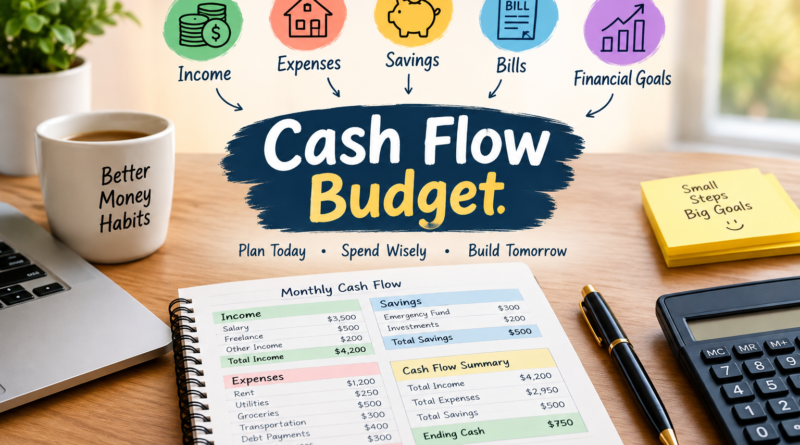
Cash Flow Budget: A Practical Guide to Managing Your Money
Cash Flow Budget is a simple but powerful way to understand how money moves in and out of your finances. Instead of looking only at your total income or expenses, a cash flow budget shows when money comes in, when bills are due, and how much cash you have available throughout the month.
Whether you are managing personal finances, running a small business, or trying to improve your savings, creating a cash flow budget can help you avoid shortfalls and make better financial decisions.
In this guide, we will explain what a cash flow budget is, how it works, how to create one, common mistakes to avoid, and practical examples you can use to build your own.
What Is a Cash Flow Budget?
A cash flow budget is a financial plan that estimates your expected cash income and cash expenses over a specific period.
The basic idea is:
Starting Cash + Cash Inflows − Cash Outflows = Ending Cash
Cash inflows are the money you expect to receive, while cash outflows are the money you expect to spend.
For example, suppose you receive $4,000 during a month. Your expected expenses are:
- Rent: $1,200
- Utilities: $250
- Food: $500
- Transportation: $300
- Debt payments: $400
- Savings: $500
- Other expenses: $400
Your total planned outflows would be $3,550, leaving approximately $450 in available cash.
A cash flow budget helps you see this situation before the month is over.
Why Is a Cash Flow Budget Important?
Having a good income does not automatically mean you will always have enough cash available.
Timing matters.
You might receive your salary at the end of the month while several large bills are due during the first two weeks. Without planning, you could experience a temporary cash shortage even though your monthly income is sufficient.
A cash flow budget helps you:
- Track when money enters your account
- Plan upcoming bills
- Avoid unnecessary overdrafts
- Identify spending problems
- Improve savings
- Prepare for irregular expenses
- Manage debt payments
- Build an emergency fund
- Make better financial decisions
It gives you a clearer picture of your actual cash position.
Cash Flow Budget vs. Regular Budget
A regular budget and a cash flow budget are related, but they are not exactly the same.
A regular budget mainly focuses on how much you earn and spend.
A cash flow budget focuses on when money comes in and when it goes out.
For example, imagine your monthly income is $5,000 and your monthly expenses are $4,000. On paper, you have a $1,000 surplus.
However, if you receive your $5,000 at the end of the month and have $2,500 of bills due during the first week, you need to make sure you have enough cash available to cover those payments.
This is where cash flow planning becomes particularly useful.
Main Components of a Cash Flow Budget
A useful cash flow budget usually includes several important sections.
1. Starting Cash Balance
This is the amount of money available at the beginning of your budgeting period.
For example:
Starting cash = $1,000
This might include money already sitting in your checking account that is available for planned expenses.
2. Cash Inflows
Cash inflows represent money coming into your account.
Common examples include:
- Salary
- Freelance income
- Business revenue
- Rental income
- Interest income
- Dividends
- Bonuses
- Refunds
- Side-hustle income
If your income changes from month to month, estimate each expected payment separately.
3. Cash Outflows
Cash outflows represent money leaving your account.
These may include:
- Housing
- Groceries
- Utilities
- Insurance
- Transportation
- Debt payments
- Entertainment
- Subscriptions
- Education
- Healthcare
- Savings contributions
- Investments
Separating expenses into categories makes your budget easier to manage.
4. Ending Cash Balance
Your ending cash balance shows how much money you expect to have left after accounting for planned inflows and outflows.
The formula is:
Ending Cash = Starting Cash + Total Inflows − Total Outflows
If the result is positive, you have planned cash remaining.
If the result is negative, you may need to reduce expenses, increase income, or adjust the timing of payments.
How to Create a Cash Flow Budget
Creating a cash flow budget does not have to be complicated. You can use a spreadsheet, budgeting app, notebook, or simple table.
Step 1: Determine Your Starting Cash
Begin by identifying how much cash is available for the period.
For example:
Starting balance: $2,000
Only include money that you realistically expect to be available for spending and planned financial commitments.
Step 2: List All Expected Income
Write down every expected source of cash.
For example:
| Income Source | Amount |
|---|---|
| Salary | $4,000 |
| Freelance work | $500 |
| Side income | $200 |
| Total | $4,700 |
If income arrives on different dates, record those dates as well.
Step 3: List Fixed Expenses
Fixed expenses generally remain relatively consistent.
Examples include:
- Rent or mortgage
- Insurance
- Loan payments
- Internet
- Phone bills
- Subscription services
For example:
| Fixed Expense | Amount |
|---|---|
| Rent | $1,200 |
| Car payment | $350 |
| Insurance | $180 |
| Internet | $70 |
| Phone | $60 |
| Total | $1,860 |
Step 4: Estimate Variable Expenses
Variable expenses can change each month.
Examples include:
- Groceries
- Fuel
- Dining out
- Entertainment
- Clothing
- Personal care
Review your previous spending to create realistic estimates instead of guessing.
Step 5: Add Irregular Expenses
Some expenses do not happen every month but still need to be planned.
Examples include:
- Annual insurance premiums
- Property taxes
- School fees
- Holiday spending
- Vehicle repairs
- Home maintenance
- Medical expenses
You can divide a large annual expense into monthly amounts.
For example, if you expect a $1,200 annual insurance payment:
$1,200 ÷ 12 = $100 per month
Setting aside $100 each month can make the eventual payment easier to handle.
Example of a Monthly Cash Flow Budget
Consider a household with the following monthly figures.
Starting cash: $1,000
Cash inflows: $5,000
Cash outflows: $4,200
The calculation would be:
$1,000 + $5,000 − $4,200 = $1,800
The expected ending cash balance is therefore $1,800.
A simple budget could look like this:
| Category | Amount |
|---|---|
| Starting Cash | $1,000 |
| Salary | +$5,000 |
| Housing | -$1,500 |
| Food | -$600 |
| Transportation | -$400 |
| Utilities | -$250 |
| Debt Payments | -$450 |
| Insurance | -$200 |
| Entertainment | -$200 |
| Savings | -$400 |
| Other Expenses | -$200 |
| Ending Cash | $1,800 |
This example shows why looking at the entire cash picture is useful.
Weekly Cash Flow Budget
A monthly budget may not be enough for people who have frequent transactions or irregular income.
A weekly cash flow budget can provide more control.
For example:
| Week | Cash In | Cash Out | Net Cash Flow |
|---|---|---|---|
| Week 1 | $2,000 | $1,200 | +$800 |
| Week 2 | $500 | $900 | -$400 |
| Week 3 | $1,000 | $700 | +$300 |
| Week 4 | $1,500 | $800 | +$700 |
This approach helps you identify weeks where cash may become tight.
It can be particularly useful for freelancers, small-business owners, commission-based workers, and people with irregular income.
How to Handle Irregular Income
Creating a cash flow budget can be more challenging when your income changes frequently.
Instead of assuming that every month will be your highest-income month, use conservative estimates.
For example, if your recent monthly income was:
- $3,000
- $3,500
- $2,800
- $4,200
You may want to build your basic expenses around a lower, sustainable income level rather than assuming you will always receive $4,200.
During higher-income months, you can direct additional money toward:
- Emergency savings
- Debt repayment
- Investments
- Future expenses
- Business reserves
This can make your finances more resilient.
Cash Flow Budget for Small Businesses
Cash flow planning is also important for small businesses.
A profitable business can still experience cash problems if customers pay invoices late while bills must be paid immediately.
For example, a business may have $20,000 in sales but only $8,000 collected in cash during the month.
Meanwhile, it might have $10,000 in immediate expenses.
The business could face a cash shortage despite having strong sales.
A business cash flow budget should consider:
- Customer payments
- Supplier payments
- Payroll
- Rent
- Taxes
- Loan payments
- Equipment purchases
- Inventory
- Operating expenses
This helps business owners plan for periods when cash collections may be lower than expenses.
How to Improve Your Cash Flow
Once you create your budget, the next step is to improve your cash position.
Reduce Unnecessary Expenses
Review your spending and identify expenses that do not provide enough value.
Small recurring costs can add up over time.
For example, canceling unused subscriptions and reducing unnecessary convenience purchases can free up cash for more important goals.
Control Variable Spending
Variable expenses are often easier to adjust than fixed expenses.
You might reduce:
- Restaurant spending
- Entertainment
- Shopping
- Unplanned purchases
- Premium subscriptions
Even modest reductions can improve monthly cash flow.
Build an Emergency Fund
An emergency fund provides a financial cushion when unexpected costs appear.
Common emergencies include:
- Car repairs
- Home repairs
- Medical bills
- Job loss
- Unexpected travel
Rather than relying entirely on credit cards or loans, an emergency fund can provide accessible cash when needed.
Manage Debt Carefully
Debt payments can consume a large portion of monthly cash flow.
Review interest rates, payment amounts, and due dates.
Prioritizing high-interest debt can help reduce interest costs over time, while making all required minimum payments on time helps keep your financial commitments organized.
Increase Income
Expense reductions are only one side of cash flow management.
You can also look for ways to increase cash inflows.
Potential options include:
- Freelancing
- Part-time work
- Selling unused items
- Consulting
- Creating digital products
- Increasing business sales
- Negotiating compensation where appropriate
Additional income can provide more flexibility for saving, investing, and debt repayment.
Common Cash Flow Budget Mistakes
Even a simple budget can fail if the numbers are unrealistic.
Ignoring Small Expenses
Small purchases may appear insignificant individually but can become substantial over a month.
Coffee, delivery fees, subscriptions, and impulse purchases should not automatically be ignored.
Forgetting Annual Expenses
Many people budget for monthly bills but forget expenses that occur once or twice a year.
Create a separate category for irregular expenses so they do not surprise you.
Overestimating Income
Using optimistic income estimates can make your budget look healthier than it really is.
Conservative estimates can provide a more realistic picture.
Underestimating Variable Expenses
Groceries, fuel, entertainment, and household expenses can fluctuate.
Review previous spending to create realistic estimates.
Not Updating the Budget
A cash flow budget is not a document you create once and forget.
Income and expenses change.
Review your budget regularly and update it when circumstances change.
Cash Flow Budget and Savings Goals
A cash flow budget can make saving more intentional.
Instead of waiting to see what money remains at the end of the month, include savings as a planned cash outflow.
For example, you might allocate money toward:
- Emergency savings
- Retirement
- A home
- Education
- Travel
- Investment accounts
- A major purchase
Suppose your monthly cash flow leaves you with $600 after essential expenses.
You could assign part of that amount to an emergency fund and another portion toward long-term investments.
The exact allocation depends on your income, financial obligations, risk tolerance, and goals.
Cash Flow Budget and Investing
Investing requires available cash.
A well-managed cash flow budget can help you determine how much money is realistically available for long-term investing after essential expenses and short-term needs are covered.
For example, if your monthly income is $5,000 and essential expenses consume $3,500, you have $1,500 remaining before considering other goals.
Instead of automatically investing the entire amount, you might first account for emergency savings, upcoming expenses, and debt obligations.
This creates a more sustainable approach to investing.
Tools for Creating a Cash Flow Budget
You do not need expensive software to create a cash flow budget.
Spreadsheet
A spreadsheet can be an excellent option because you can customize categories, formulas, and dates.
You can create columns for:
- Date
- Description
- Cash inflow
- Cash outflow
- Category
- Running balance
Budgeting Apps
Budgeting applications can automatically categorize transactions and provide spending summaries.
However, you should still review the categories and figures to make sure they accurately reflect your financial situation.
Simple Notebook
A notebook can work just as well for people who prefer a manual system.
Write down your starting cash, expected income, upcoming bills, variable expenses, and ending balance.
The most important factor is consistency.
Cash Flow Budget Template
You can use this simple structure as a starting point:
| Cash Flow Category | Planned Amount | Actual Amount |
|---|---|---|
| Starting Cash | $ | $ |
| Salary/Income | $ | $ |
| Side Income | $ | $ |
| Other Income | $ | $ |
| Housing | $ | $ |
| Utilities | $ | $ |
| Food | $ | $ |
| Transportation | $ | $ |
| Debt Payments | $ | $ |
| Insurance | $ | $ |
| Savings | $ | $ |
| Investments | $ | $ |
| Other Expenses | $ | $ |
| Ending Cash | $ | $ |
Comparing planned amounts with actual spending can help you improve future budgets.
How Often Should You Review a Cash Flow Budget?
For most people, reviewing the budget at least once a week can be helpful.
A weekly review allows you to:
- Check upcoming bills
- Compare actual spending with your plan
- Adjust discretionary spending
- Confirm upcoming income
- Identify potential cash shortages
At the end of each month, conduct a more detailed review.
Ask yourself:
- Did income match expectations?
- Which expenses were higher than planned?
- Which expenses were lower?
- Did I save enough?
- Were there unexpected expenses?
- What should change next month?
These questions turn budgeting into an ongoing financial management process.
Frequently Asked Questions About Cash Flow Budget
What is the purpose of a cash flow budget?
The purpose is to estimate when money will come in and when it will go out. It helps you plan payments, manage available cash, and avoid potential shortfalls.
Is a cash flow budget the same as a monthly budget?
Not exactly. A monthly budget focuses mainly on income and expenses, while a cash flow budget also emphasizes the timing of those transactions.
Can I create a cash flow budget in Excel?
Yes. A spreadsheet is one of the easiest ways to create a customizable cash flow budget. You can add formulas to calculate totals and ending balances automatically.
How far ahead should I create a cash flow budget?
Many people start with one month and then expand to three, six, or twelve months. The appropriate period depends on the stability of your income and expenses.
What should I do if my cash flow is negative?
First, review the budget to identify the cause. You may need to reduce discretionary spending, adjust the timing of expenses, increase income, or use available savings responsibly.
Why is cash flow important if I have enough income?
Because timing matters. You can have sufficient income over an entire month but still face a temporary shortage if major bills are due before your income arrives.
Final Thoughts
A cash flow budget gives you a practical view of how money moves through your finances. Instead of simply asking whether you earn enough money, it helps you understand whether you will have enough cash available when you actually need it.
Start by recording your beginning cash balance, expected income, fixed expenses, variable expenses, irregular costs, savings, and debt payments. Then calculate your expected ending balance and compare it with your actual results.
The goal is not to create a complicated financial system. The goal is to create a clear plan that helps you stay aware of your money, prepare for upcoming expenses, and work toward your financial goals with greater control.
Read Next