
Zero Based Budget: A Complete Guide to Smarter Money Management
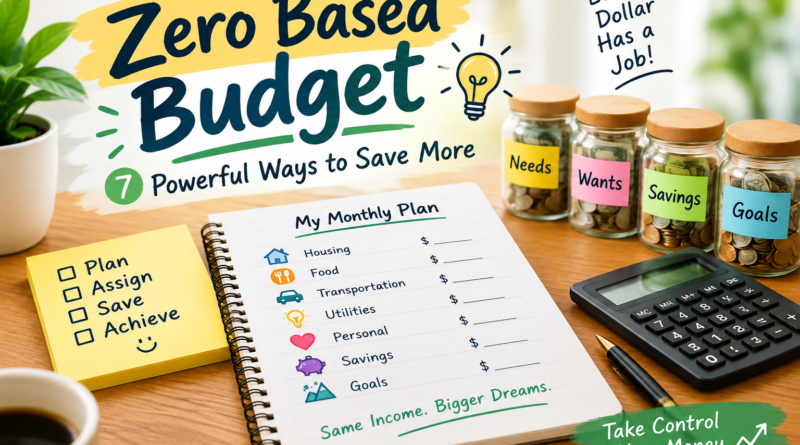
Managing money becomes much easier when every dollar has a clear purpose. A Zero Based Budget is a budgeting method that gives every dollar of income a specific job before the month begins. Instead of leaving money unassigned, you plan for expenses, savings, investments, debt payments, and other financial goals until your income minus planned spending equals zero.
This does not mean you should spend all your money. Savings and investments are also categories in a zero-based budget. The goal is simply to make sure your entire income is intentionally allocated.
What Is a Zero Based Budget?
A Zero Based Budget is a financial planning system where your monthly income minus all planned expenses, savings, investments, and debt payments equals zero.
The basic formula is:
Income − Expenses − Savings − Investments − Debt Payments = $0
For example, suppose your monthly take-home income is $4,000. You might allocate:
| Category | Planned Amount |
|---|---|
| Housing | $1,200 |
| Groceries | $450 |
| Utilities | $250 |
| Transportation | $300 |
| Insurance | $200 |
| Debt Payment | $300 |
| Savings | $500 |
| Investments | $400 |
| Entertainment | $150 |
| Personal Spending | $150 |
| Other Expenses | $100 |
| Total | $4,000 |
Every dollar has a purpose, but that doesn’t mean every dollar is immediately spent.
How Does a Zero Based Budget Work?
The process is straightforward. Start with your expected income for the month and then assign that income to different categories.
You continue allocating money until there is no unassigned income remaining.
For example:
Monthly income: $4,000
Then you assign:
- $1,200 to housing
- $450 to groceries
- $250 to utilities
- $300 to transportation
- $200 to insurance
- $300 to debt repayment
- $500 to savings
- $400 to investments
- $150 to entertainment
- $150 to personal spending
- $100 to miscellaneous expenses
Total planned allocation = $4,000
Remaining unassigned money = $0
That is the basic idea behind zero-based budgeting.
Why Use a Zero Based Budget?
A traditional budget may tell you approximately how much you can spend. A zero-based budget goes a step further by giving every part of your income a specific purpose.
Better Control Over Spending
When you decide how much money belongs in each category before spending it, you’re less likely to spend money impulsively.
For example, if you set aside $150 for entertainment, you know exactly how much is available for restaurants, movies, subscriptions, or other activities.
Helps Increase Savings
Savings become part of the budget rather than something you do only when money is left over.
You can create categories such as:
- Emergency fund
- Retirement savings
- Vacation fund
- Home down payment
- Education
- Long-term investments
This makes saving a planned financial activity.
Makes Debt Repayment More Organized
A zero-based budget can also help you prioritize debt.
You can assign a specific amount to credit cards, personal loans, student loans, or other debts every month.
Once a debt is paid off, you can redirect that money toward another financial goal.
Shows Where Your Money Goes
Many people know their monthly income but don’t know exactly where their money disappears.
Tracking categories can reveal spending patterns that may otherwise go unnoticed.
For example, you may discover that small purchases, subscriptions, takeout, and online shopping are taking up a significant portion of your monthly income.
Zero Based Budget vs Traditional Budget
The main difference is how specifically money is assigned.
| Zero Based Budget | Traditional Budget |
|---|---|
| Every dollar gets a job | Some income may remain unassigned |
| Highly detailed | Can be more general |
| Savings are planned | Savings may depend on leftover money |
| Expenses are actively monitored | Expenses may be tracked less frequently |
| Useful for specific financial goals | Useful for basic spending control |
Neither method is automatically right for everyone. Your choice depends on how much structure you want when managing money.
How to Create a Zero Based Budget
Creating a zero-based budget doesn’t require complicated software. You can use a spreadsheet, budgeting app, notebook, or simple table.
Step 1: Calculate Your Monthly Income
Start by identifying how much money you expect to receive during the month.
For someone with a regular salary, this may be relatively simple.
If your income changes from month to month, you may need to estimate conservatively based on previous earnings.
Include reliable sources of income such as:
- Salary
- Freelance income
- Business income
- Rental income
- Side income
- Other predictable payments
Use take-home income when possible because that is the money actually available for your monthly budget.
Step 2: List Your Fixed Expenses
Fixed expenses generally stay similar from month to month.
Examples include:
- Rent or mortgage
- Insurance
- Loan payments
- Internet
- Phone bills
- Subscription services
- Childcare
These expenses should be included before flexible spending categories.
Step 3: Estimate Variable Expenses
Variable expenses can change each month.
Examples include:
- Groceries
- Gas
- Electricity
- Clothing
- Entertainment
- Dining out
- Household items
Review previous spending to create realistic estimates.
If your grocery spending was $450 last month, budgeting $150 without a specific plan may not be realistic.
Step 4: Add Savings Goals
Savings should be treated as a budget category.
Instead of saying, “I’ll save whatever is left,” decide how much you want to save before the month begins.
For example:
Emergency fund: $250
Vacation savings: $100
Long-term savings: $150
Total savings = $500.
Step 5: Include Debt Payments
If you have debt, include required payments in your budget.
You can also allocate additional money toward debt if reducing balances is one of your financial priorities.
For example:
- Credit card minimum payment: $100
- Extra debt payment: $200
Total debt allocation = $300.
Step 6: Allocate Remaining Money
After listing your essential expenses, savings, and debt payments, determine how much money remains.
That money can be assigned to other categories such as:
- Entertainment
- Personal spending
- Gifts
- Travel
- Hobbies
- Clothing
- Home maintenance
- Miscellaneous expenses
Keep allocating until your planned income and planned allocations are equal.
Zero Based Budget Example
Let’s look at a more detailed example.
Imagine a person earns $5,000 per month after taxes.
Their budget could look like this:
| Category | Amount |
|---|---|
| Rent | $1,500 |
| Utilities | $250 |
| Groceries | $500 |
| Transportation | $350 |
| Insurance | $250 |
| Debt Payments | $400 |
| Emergency Savings | $400 |
| Retirement | $500 |
| Investments | $300 |
| Entertainment | $150 |
| Personal Spending | $200 |
| Clothing | $100 |
| Miscellaneous | $100 |
| Total | $5,000 |
The final balance is zero because all $5,000 has been assigned.
Notice that the person is not spending $5,000. Some of the money is being saved, invested, and used to repay debt.
What If Your Budget Doesn’t Equal Zero?
This is one of the most common questions about zero-based budgeting.
Suppose your monthly income is $4,000 but your planned expenses total $3,600.
You have $400 unassigned.
Instead of leaving the money without a purpose, you could allocate it toward:
- Emergency savings
- Retirement
- Investments
- Debt repayment
- A future purchase
- Annual expenses
Now your budget equals zero.
On the other hand, if your planned expenses total $4,300 while your income is $4,000, you have a $300 deficit.
You’ll need to adjust the plan.
You might reduce discretionary spending, review subscriptions, lower variable expenses, or change the amount allocated toward certain goals.
Zero Does Not Mean Spending Everything
One important misunderstanding is that a zero-based budget encourages people to spend every dollar.
It doesn’t.
The “zero” represents unassigned money, not money that must be consumed.
For example, if you earn $4,000 and put $600 into savings, $300 into investments, and $300 toward debt repayment, those amounts are still part of the budget.
Your goal is:
Income − planned allocations = $0
Not:
Income − spending = $0
This distinction is extremely important.
How to Handle Irregular Expenses
Not every expense happens every month.
You may have annual expenses such as:
- Car registration
- Insurance premiums
- Property taxes
- Holiday gifts
- School expenses
- Medical costs
- Home repairs
- Travel
A zero-based budget can handle these by creating sinking funds.
For example, suppose you expect to spend $1,200 on car insurance over the next year.
Instead of suddenly finding $1,200 when the bill arrives, you could set aside:
$1,200 ÷ 12 = $100 per month
After 12 months, you would have approximately $1,200 available.
This approach can make irregular expenses easier to manage.
Zero Based Budget for Families
Families can use zero-based budgeting to coordinate household finances.
Start by calculating total household income and then list shared expenses.
Possible categories include:
- Housing
- Food
- Transportation
- Utilities
- Childcare
- Insurance
- Education
- Debt
- Savings
- Retirement
- Entertainment
Family members can also have separate personal spending categories.
For example, each partner might receive a predetermined personal spending amount that can be used without affecting household essentials.
This can make conversations about discretionary spending more straightforward.
Zero Based Budget for Variable Income
People with freelance, commission, seasonal, or business income may find budgeting more challenging.
One approach is to create a conservative monthly income estimate.
For example, if your recent monthly income has ranged between $3,000 and $5,000, you might build your essential budget around a lower reliable amount rather than assuming you will earn $5,000 every month.
When income exceeds your budgeted amount, the extra money can be assigned to financial priorities.
Possible uses include:
- Emergency savings
- Taxes
- Debt repayment
- Investments
- Business expenses
- Future purchases
This can reduce the risk of building a budget around income that may not arrive.
Common Mistakes With Zero Based Budgeting
Zero-based budgeting can be effective, but mistakes can make the system difficult to maintain.
Forgetting Irregular Expenses
If you budget only for monthly bills, large annual expenses may surprise you.
Include sinking funds for predictable irregular costs.
Setting Unrealistic Categories
A budget that looks perfect on paper but doesn’t match your actual lifestyle may be difficult to follow.
Review your previous spending and use realistic numbers.
Ignoring Small Expenses
Small purchases can add up.
Coffee, delivery fees, subscriptions, snacks, and online purchases may seem insignificant individually but can become meaningful monthly expenses.
Making the Budget Too Complicated
You don’t necessarily need dozens of categories.
Start with broad categories and add detail only where it helps you understand your spending.
Failing to Adjust the Budget
Your budget is a plan, not a permanent contract.
If your electricity bill increases or an unexpected expense appears, adjust other categories rather than abandoning the entire budget.
How Often Should You Review a Zero Based Budget?
Ideally, review your budget regularly.
A quick weekly review can help you see:
- How much you’ve spent
- Which categories are running low
- Whether upcoming bills are covered
- Whether you need to move money between categories
At the end of the month, compare your planned amounts with actual spending.
Ask:
- Which categories were accurate?
- Where did I overspend?
- Where did I underspend?
- Did unexpected expenses occur?
- Should next month’s categories change?
This process helps make future budgets more realistic.
Zero Based Budget and Emergency Funds
An emergency fund can be one of the most important categories in a budget.
Unexpected expenses can include:
- Car repairs
- Home repairs
- Medical bills
- Job loss
- Emergency travel
- Major appliance replacement
Instead of relying entirely on credit cards when an emergency occurs, savings can provide a financial cushion.
The appropriate emergency savings amount depends on your income, expenses, job stability, household situation, and other circumstances.
Zero Based Budget and Investing
A zero-based budget can also make investing more consistent.
Rather than investing only when extra money happens to remain at the end of the month, you can create an investment category in advance.
For example:
Monthly income: $4,500
Investment allocation: $300
That $300 becomes part of the monthly plan.
Depending on your financial circumstances, investments might include retirement accounts, diversified funds, or other investments you have researched and determined are appropriate.
Investing involves risk, so money needed for near-term expenses generally shouldn’t be treated the same way as long-term investment capital.
Zero Based Budgeting Tools
You can create a zero-based budget using almost any system that allows you to track income and expenses.
Spreadsheet
A spreadsheet gives you complete control over categories and formulas.
You can create columns for:
- Category
- Planned amount
- Actual amount
- Difference
Budgeting App
Budgeting apps can automate some tracking and categorization.
However, make sure you understand how the app handles transfers, credit cards, refunds, and savings.
Notebook
A simple notebook can work just as well.
Write down your income, list each category, assign an amount, and update your spending throughout the month.
The best method is often the one you can consistently maintain.
Is a Zero Based Budget Right for You?
A zero-based budget may be useful if you want a detailed understanding of where your money goes.
It can be particularly useful for people who:
- Want more control over spending
- Have specific savings goals
- Are paying down debt
- Want to increase investing
- Need a structured financial plan
- Regularly wonder where their money goes
However, people who prefer a simpler budgeting method may find detailed category tracking unnecessary.
The key is choosing a budgeting approach that you can realistically maintain.
Tips for Making Zero Based Budgeting Easier
Start with a simple system rather than trying to track every possible expense immediately.
Use these practical steps:
1. Budget before the month begins.
Create your plan before most spending happens.
2. Use realistic numbers.
Look at previous months rather than guessing.
3. Pay yourself through savings.
Include savings as an actual budget category.
4. Plan for irregular expenses.
Use sinking funds for predictable annual costs.
5. Review weekly.
Small adjustments are easier than fixing a major problem at the end of the month.
6. Give yourself discretionary money.
A realistic budget should leave room for enjoyment.
7. Adjust when circumstances change.
A budget should help you manage money, not make money management unnecessarily stressful.
Final Thoughts
A Zero Based Budget gives every dollar of income a clear purpose. Instead of simply tracking what you spent after the fact, you create a plan for your money before spending begins.
The method can help you organize expenses, increase savings, manage debt, prepare for irregular costs, and make investing more intentional.
The most important concept is simple: income minus planned expenses, savings, investments, and debt payments should equal zero.
A successful budget doesn’t need to be complicated. It needs to reflect your actual financial situation and be reviewed regularly. Start with your income, list your essential expenses, add financial goals, assign the remaining money to appropriate categories, and adjust the plan as your circumstances change.
READ nEXT