
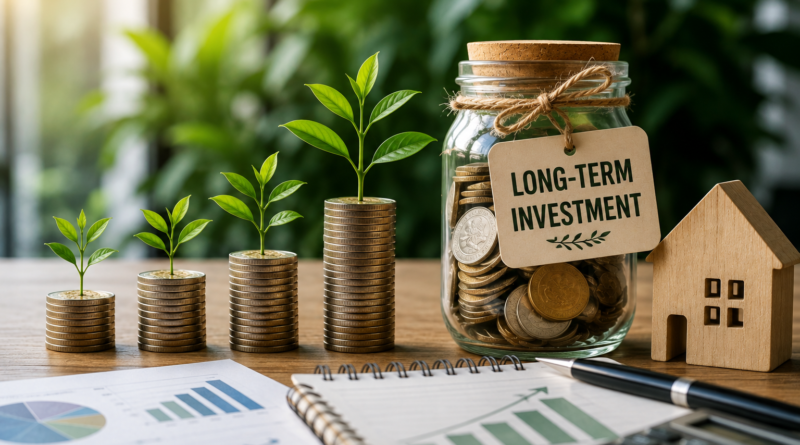
Best Long-Term Investments for Building Wealth
Best Long-Term Investments Smart Ways to Build Wealth
Building wealth usually takes more than finding one investment with a high potential return. The strongest approach is often to choose investments that match your financial goals, risk tolerance, time horizon, and ability to stay invested through market volatility. For many investors, the best long-term investments are those that provide a reasonable balance between growth, diversification, costs, and risk.
Long-term investing means giving your money time to potentially grow over many years. Instead of focusing on daily price movements, long-term investors generally concentrate on their investment plan and broader financial objectives.
Whether you are a beginner investor or an experienced DIY investor, understanding different long-term investment options can help you create a more suitable portfolio. Stocks, bonds, index funds, ETFs, mutual funds, real estate, and retirement accounts can all play different roles.
The right choice depends on the individual. A portfolio designed for someone saving for retirement decades from now may look very different from one designed for a financial goal five years away.
What Are Long-Term Investments?
Long-term investments are assets that investors intend to hold for an extended period, often several years or decades. The goal is generally to allow investment growth and compound returns to work over time rather than trying to make quick profits from short-term market movements.
A long investment horizon can make temporary market declines easier to manage because an investor may have more time to recover from periods of weakness. However, a longer time horizon does not eliminate investment risk.
For example, stocks can experience significant short-term market volatility. An investor who plans to hold a diversified stock portfolio for 20 years may have a different risk capacity from someone who needs the money next year.
Common long-term investments include:
| Investment | Typical Role | Main Consideration |
|---|---|---|
| Stocks | Growth | Higher market risk |
| Index funds | Diversified growth | Market exposure |
| ETFs | Flexible diversification | Fees and holdings |
| Mutual funds | Managed diversification | Expenses and strategy |
| Bonds | Income and stability | Interest-rate risk |
| Government bonds | Lower-risk exposure | Return may be lower |
| CDs | Principal-focused savings | Limited liquidity |
| Real estate | Growth and income | Costs and liquidity |
| Retirement accounts | Long-term wealth building | Rules and tax treatment |
The purpose of this table is not to rank investments from best to worst. Instead, it shows that each asset class can serve a different purpose within an investment portfolio.
Practical example: Imagine two people with $10,000 to invest. One expects to use the money in two years for a home purchase. Another plans to leave the money invested for 25 years for retirement. Their investment time horizons are very different, so their asset allocation and acceptable risk level may also be different.
Why Consider Long-Term Investing?
Long-term investing can provide several potential advantages.
One major benefit is time. When money remains invested for many years, returns can potentially generate additional returns. This process is commonly called compound growth.
Another advantage is that long-term investors may be less dependent on short-term market timing. Trying to predict every market high and low is difficult, and frequent trading can also increase costs.
Long-term investing can also support major financial goals such as retirement planning, education savings, buying a home, or building financial independence.
Regular investing is another useful concept. Rather than waiting for the perfect market moment, an investor may contribute money periodically according to a predetermined investment plan.
Practical example: Suppose an investor contributes a fixed amount to an investment account every month. During periods when prices are lower, the same contribution may purchase more shares. During periods when prices are higher, it may purchase fewer shares. This is the basic idea behind dollar-cost averaging.
Long-term investing does not guarantee profits. Investments can decline in value, and some investments can lose a substantial portion of their value. The objective is to build a strategy that gives your money an opportunity to grow while keeping risk appropriate for your situation.
Best Long-Term Investments to Consider
There is no single investment that is automatically the best for every investor. The best option depends on your goals, risk tolerance, time horizon, portfolio diversification needs, and investment costs.
Stocks
Stocks represent ownership interests in companies. They are commonly used by long-term investors seeking capital growth.
Historically, stocks have offered substantial long-term growth potential, but they also come with market risk. Individual companies can perform poorly, and stock prices can fall sharply during market downturns.
For this reason, investors who choose stocks should consider diversification rather than relying entirely on one company or industry.
Example: An investor saving for retirement over several decades might use a diversified group of stocks to seek long-term growth while accepting that the portfolio may experience significant short-term declines.
Index Funds
Index funds are designed to track a particular market index. Instead of attempting to select individual winners, an index fund generally provides exposure to a broader group of securities.
This can make index investing attractive for investors who want broad market exposure and a relatively simple long-term strategy.
One of the major benefits can be diversification. Rather than purchasing shares in only a few companies, an investor can gain exposure to many securities through one fund.
Example: Instead of researching individual companies, a beginner investor may choose a broad-market index fund as one component of a diversified portfolio.
ETFs
Exchange-traded funds, commonly called ETFs, hold collections of investments and trade on exchanges.
ETFs can provide diversification while offering flexibility during market hours. Some ETFs track broad indexes, while others focus on particular sectors, industries, bonds, commodities, or investment strategies.
When evaluating an ETF, investors should consider its holdings, expense ratio, trading characteristics, liquidity, and how well it fits their overall investment mix.
Mutual Funds
Mutual funds pool money from multiple investors and invest it according to a stated strategy.
Some mutual funds are actively managed, while others follow an index. They can provide diversification and may be useful for investors who prefer a professionally structured fund.
However, investment fees matter. Investors should understand expense ratios, transaction costs, account charges, and any other applicable expenses before investing.
Bonds
Bonds are debt investments. When an investor purchases a bond, they are generally lending money to the issuer in exchange for interest payments and repayment of principal according to the bond’s terms.
Bonds can provide income and may help balance a portfolio that contains growth-oriented assets.
However, bonds are not completely risk-free. Bond prices can change as interest rates move, and corporate bonds also carry credit risk.
Government Bonds
Government bonds are issued by governments to raise money.
Depending on the issuer and type of bond, they may be viewed as lower-risk investments compared with many corporate or equity investments. However, lower risk generally comes with trade-offs, including potentially lower returns.
Government bonds can have a useful role in a diversified investment portfolio, particularly for investors who prioritize stability or income.
Certificates of Deposit
Certificates of deposit, or CDs, are deposit products offered by financial institutions. Generally, the investor agrees to leave money deposited for a specified period in exchange for a stated interest rate.
CDs can be useful for investors who prioritize stability and have a known time frame for their savings.
Their major limitation is usually liquidity. Taking money out before maturity can result in penalties or other restrictions depending on the product.
Example: Someone saving for a financial goal several years away may consider a CD when preserving principal is more important than pursuing aggressive investment growth.
Real Estate
Real estate can be another long-term investment option. Investors may gain potential returns through property appreciation, rental income, or both.
However, real estate requires more involvement than many publicly traded investments. Property owners may face maintenance expenses, taxes, insurance, vacancies, financing costs, and other risks.
Real estate is also less liquid than many stocks and ETFs because selling a property can take time.
Retirement Accounts
Retirement accounts are designed to help people save and invest for long-term financial goals.
Depending on the country and account type, retirement accounts may offer tax advantages. Examples include 401(k), IRA, and Roth IRA accounts in the United States.
The specific rules vary by account and jurisdiction, so investors should understand contribution limits, withdrawal rules, taxes, and employer benefits where applicable.
For long-term wealth building, retirement accounts can be valuable because they combine investing with a structured savings framework.
What Are the Safest Long-Term Investments?
The word “safe” needs to be used carefully when discussing investments. Almost every investment involves some form of risk.
Lower-risk options may include certain government securities, insured deposit products, and other cash-oriented investments, depending on the jurisdiction and specific product.
Government Bonds
Certain government securities can provide relatively lower credit risk than many corporate investments. However, their market value can still change, particularly when interest rates move.
Certificates of Deposit
CDs can offer predictable interest over a defined period. They may be suitable when an investor prioritizes principal stability and knows when the money will be needed.
Diversified Index Funds
Diversified index funds are not risk-free, but broad diversification can reduce the impact of poor performance from any single company.
The important distinction is that diversification manages concentration risk; it does not eliminate market risk.
Cash and Savings Options
Cash and savings products can be useful for short-term financial needs and emergency reserves. They generally should not automatically be considered substitutes for long-term growth investments.
Practical example: An investor may keep near-term expenses in cash or savings while using a diversified investment portfolio for money that will not be needed for many years. Separating these goals can make the overall financial plan easier to manage.
How to Choose the Best Long-Term Investment
Choosing investments should begin with your personal financial situation rather than with a list of popular assets.
Consider Your Financial Goals
Start by identifying why you are investing.
Your goal could be retirement, financial independence, education, a future home purchase, or long-term wealth creation.
A clear goal gives your investment plan direction.
Understand Your Risk Tolerance
Risk tolerance describes how comfortable you are with potential investment losses.
Someone who cannot tolerate a 30% decline may need a different portfolio from someone who can remain invested through substantial market volatility.
Risk tolerance and risk capacity are also different. You may emotionally tolerate risk but still not have the financial capacity to take it.
Consider Your Investment Time Horizon
Your investment time horizon is the period before you expect to use the money.
Longer horizons may allow investors to accept more short-term volatility, although the appropriate level of risk depends on the individual.
Example: Money needed next year generally deserves a different strategy from money intended for retirement 25 years from now.
Compare Investment Fees
Fees can reduce investment returns over time.
Look at expense ratios, account fees, trading costs, advisory fees, and other charges that may apply.
Even small annual costs can become meaningful when compounded over many years.
Consider Inflation and Taxes
Inflation can reduce the purchasing power of money over time.
An investment that earns a return below inflation may increase in dollar value while still losing purchasing power in real terms.
Taxes can also affect your actual return. Tax-efficient investing means considering how different investments and accounts are taxed rather than focusing only on headline returns.
Long-Term Investing vs. Short-Term Investing
Long-term investing focuses on financial goals that may be years or decades away. Short-term investing focuses on a much shorter period.
| Factor | Long-Term Investing | Short-Term Investing |
|---|---|---|
| Time horizon | Years or decades | Months or shorter periods |
| Main focus | Growth and financial goals | Short-term price movements |
| Market volatility | More time to potentially recover | Can have greater impact |
| Trading frequency | Often lower | Often higher |
| Strategy | Buy and hold, diversification | Timing and tactical decisions |
| Suitable goal | Retirement and wealth building | Near-term objectives |
A long-term investor does not necessarily ignore market movements. Instead, the investor generally avoids allowing temporary price changes to completely disrupt the overall investment strategy.
Practical scenario: If the stock market falls 15% but your retirement is still 25 years away, you may have more flexibility than someone who needs the invested money next month.
How to Build a Long-Term Investment Portfolio
A long-term portfolio should be designed around your financial goals rather than around individual investments that happen to be popular.
Choose an Asset Allocation
Asset allocation is the process of dividing a portfolio among asset classes such as stocks, bonds, and cash.
A growth-oriented investor may allocate more toward stocks, while someone seeking greater stability may use a larger allocation to bonds or cash-oriented investments.
There is no universal allocation that is appropriate for everyone.
Diversify Your Investments
Portfolio diversification means spreading investments across different assets, companies, sectors, geographic areas, or other categories.
Diversification can reduce concentration risk.
For example, an investor whose entire portfolio consists of one company’s stock faces much greater company-specific risk than an investor who owns a diversified collection of securities.
Invest Consistently
Regular contributions can help investors maintain discipline.
Automatic investing can make regular contributions easier by moving a predetermined amount into an investment account on a recurring schedule.
Consistency can also reduce the temptation to wait indefinitely for the “perfect” time to invest.
Rebalance Your Portfolio
Over time, investments can grow at different rates, causing your asset allocation to change.
Rebalancing involves adjusting the portfolio to bring it closer to the intended investment mix.
Example: Suppose a portfolio begins with 70% stocks and 30% bonds. If stocks grow significantly, the portfolio might eventually become 80% stocks. Rebalancing may restore the intended allocation, depending on the investor’s strategy.
Best Long-Term Investing Strategies
Different strategies can work for different investors.
Buy-and-Hold Investing
Buy-and-hold investing involves purchasing investments and holding them for an extended period rather than frequently trading.
The strategy can reduce unnecessary trading and keep attention focused on long-term financial goals.
Dollar-Cost Averaging
Dollar-cost averaging involves investing a fixed amount at regular intervals.
This approach can help reduce the emotional pressure of deciding whether today is the perfect time to invest.
It does not guarantee profits or prevent losses, but it can provide a structured approach to regular investing.
Dividend Reinvestment
Dividend reinvestment means using dividends received from investments to purchase additional shares.
Over long periods, reinvested dividends can contribute to compound growth.
Some investors use a dividend reinvestment plan, commonly called a DRIP, to automate this process where available.
Passive Index Investing
Passive index investing aims to track a market index rather than actively selecting investments in an attempt to outperform it.
For many investors, a broad index strategy can provide diversification and relatively simple portfolio management.
Tax-Efficient Investing
Tax-efficient investing involves considering how taxes affect investment returns.
Using appropriate account types, understanding taxable income, and avoiding unnecessary taxable transactions may help investors keep more of their returns.
Tax rules vary by country and individual circumstances, so professional advice may be appropriate for complex situations.
The Role of Compound Growth in Long-Term Investing
Compound growth is one of the main reasons time matters so much in investing.
When investment returns remain invested, future returns can potentially be earned on both the original amount and previous gains.
Consider a simplified example.
Suppose an investor starts with $10,000 and earns an average hypothetical annual return of 7%, with all returns reinvested.
After one year, the account would be approximately $10,700.
If the same hypothetical return continued, the next year’s growth would be calculated on approximately $10,700 rather than the original $10,000.
Over many years, this difference can become significant.
The example is purely mathematical and does not represent a guaranteed investment return. Real investments experience changing returns, including negative years.
The broader lesson is that time, regular contributions, and reinvestment can matter greatly in long-term wealth building.
Common Long-Term Investing Mistakes
Even a well-designed investment strategy can fail if investors repeatedly make poor decisions.
Trying to Time the Market
Trying to buy at the lowest point and sell at the highest point sounds attractive, but consistently predicting market movements is difficult.
Long-term investors may benefit from having a predefined investment strategy instead of making decisions based on every market headline.
Ignoring Investment Fees
Fees may appear small, but their impact can accumulate over a long investment horizon.
Always understand what you are paying for an investment, fund, brokerage account, or financial advice.
Lack of Diversification
Putting too much money into one company, sector, or asset class can increase portfolio risk.
Diversification cannot guarantee that you will avoid losses, but it can reduce dependence on any single investment.
Emotional Investment Decisions
Fear and excitement can lead investors to buy after prices rise or sell after prices fall.
Creating an investment plan before emotions become intense can make it easier to remain disciplined.
Taking More Risk Than You Can Handle
Higher potential returns usually come with greater risk.
An investment is not automatically suitable simply because its historical returns look attractive.
Your investment choices should reflect your risk tolerance, financial goals, and time horizon.
How to Start Long-Term Investing
Getting started does not require creating a complicated portfolio on day one.
Set Your Financial Goals
Define what you are investing for and when you expect to need the money.
A specific goal is more useful than simply saying, “I want to make money.”
Determine Your Investment Budget
Review your income, expenses, emergency savings, and existing financial obligations.
Invest only money that fits within your broader financial plan.
Open an Investment Account
Depending on your country and goals, you may use a brokerage account, retirement account, or another type of investment account.
Compare available platforms based on fees, investment choices, account features, and regulatory protections.
Choose Your Investments
Select investments that match your desired asset allocation.
Beginners may prefer diversified investments such as broad-market funds rather than attempting to select many individual securities immediately.
Monitor Your Portfolio
Long-term investing does not mean completely ignoring your portfolio.
Review your goals, asset allocation, investment costs, and overall financial situation periodically.
Avoid checking prices so frequently that normal market volatility causes unnecessary emotional decisions.
Frequently Asked Questions About Long-Term Investments
What is the best long-term investment?
There is no universally best investment. Stocks, index funds, ETFs, bonds, real estate, and retirement accounts can each serve different purposes. The best choice depends on your goals, risk tolerance, time horizon, diversification needs, and costs.
What is the safest long-term investment?
No investment should automatically be described as completely safe. Certain government securities, CDs, and cash-oriented products may have lower risk than stocks, but each has different risks and potential returns.
Are stocks good for long-term investing?
Stocks can be useful for long-term investing because they offer significant growth potential. However, they can also experience substantial market declines. Diversification and an appropriate time horizon are important considerations.
How much should I invest for the long term?
There is no universal amount. A practical starting point is an amount that fits comfortably within your budget after accounting for essential expenses and emergency savings. Consistent contributions can be more important than trying to start with a very large amount.
Can beginners start long-term investing?
Yes. Beginners can start by learning investment basics, defining financial goals, understanding risk tolerance, and considering diversified investment options. Starting with a simple investment plan can be easier than trying to manage a complicated portfolio immediately.
Final Thoughts on the Best Long-Term Investments
The best long-term investments are not necessarily the investments with the highest short-term returns. A strong long-term strategy combines an appropriate investment mix, realistic financial goals, diversification, sensible costs, disciplined contributions, and enough time for potential compound growth.
Whether you choose stocks, index funds, ETFs, bonds, real estate, retirement accounts, or a combination of assets, the key is to build a strategy you can realistically maintain.
Long-term wealth building is a process, not a single investment decision. Define your goals, understand your risk, diversify thoughtfully, invest consistently, and give your strategy time to work.
Read Next
Pingback: Beginner Investing: 9 Simple Steps to Get Started