
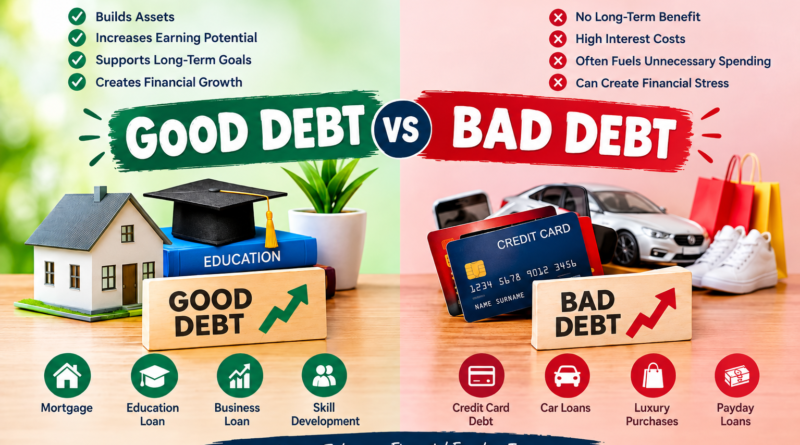
Good Debt vs Bad Debt: A Complete Guide to Smart Borrowing
Debt is a common part of personal finance. People borrow money to buy homes, pay for education, purchase vehicles, start businesses, or handle unexpected expenses. While debt can sometimes help people achieve important financial goals, it can also become a serious financial burden when it is expensive or poorly managed. This is why understanding Good Debt vs Bad Debt is important for anyone who wants to make better financial decisions.
The main difference is not simply whether you have debt. What matters is why you borrowed the money, how much it costs, whether you can afford the payments, and whether the borrowing can provide a meaningful financial benefit.
Some debt may help you build assets, increase your earning potential, or support a business. Other debt may be used for unnecessary purchases that lose value quickly while continuing to generate interest charges.
In this guide, we will explain the difference between good debt and bad debt, provide common examples, discuss credit cards, mortgages, student loans, and car loans, and explain how you can manage debt more responsibly.
What Is Good Debt?
Good debt generally refers to borrowing that has the potential to provide a long-term financial benefit. It may help you purchase an asset, develop valuable skills, increase your income, or invest in a productive activity.
For example, a reasonably sized mortgage may allow you to purchase a home that provides housing and may potentially build equity over time. Similarly, borrowing for education or professional training could increase your future earning opportunities.
However, debt should not automatically be considered good just because it is connected to an asset or investment. The amount borrowed, interest rate, repayment period, and expected benefit are all important.
Good debt should ideally be affordable and connected to a clear financial purpose.
Examples of Good Debt
Common examples can include:
- An affordable mortgage
- Student loans used for valuable education
- Business loans used for productive purposes
- Loans for professional training
- Certain loans used to acquire income-producing assets
The financial value of these debts depends on the borrower’s circumstances.
What Is Bad Debt?
Bad debt generally refers to borrowing that does not provide a meaningful financial benefit and may make your financial situation more difficult.
This type of debt is often associated with unnecessary spending, high interest rates, impulse purchases, or borrowing more than you can afford to repay.
For example, buying expensive electronics with a high-interest credit card and carrying the balance for several years can make the original purchase much more expensive.
Bad debt can reduce the amount of money available for important goals such as saving, investing, building an emergency fund, or paying necessary expenses.
Examples of Bad Debt
Examples may include:
- High-interest credit card balances
- Payday loans
- Expensive personal loans
- Unnecessary consumer loans
- Debt used for impulse purchases
- Borrowing excessively for luxury items
- Loans that are difficult to repay with your current income
The same type of debt can have different effects on different people. What matters is the purpose, cost, and affordability of the borrowing.
Good Debt vs Bad Debt: Main Differences
Understanding Good Debt vs Bad Debt becomes easier when you compare their purpose and financial impact.
| Good Debt | Bad Debt |
|---|---|
| May support long-term financial goals | Often supports short-term spending |
| Can potentially increase income or wealth | May reduce available income |
| May help purchase a productive asset | Often pays for items that lose value |
| Usually has a clear financial purpose | May result from impulse spending |
| Can have manageable borrowing costs | Often involves expensive interest |
| May improve future opportunities | Can make future finances more difficult |
This table provides a general guideline rather than an absolute rule. A mortgage, for example, may be affordable for one person but financially stressful for another.
Is Mortgage Debt Good Debt?
Mortgage debt is often considered good debt because it can help you purchase a home without paying the entire purchase price upfront.
Homeownership can provide a place to live and may allow you to build equity over time. However, owning a home also involves costs beyond the mortgage payment.
These can include:
- Mortgage interest
- Property taxes
- Home insurance
- Maintenance
- Repairs
- Closing costs
- Association fees where applicable
A mortgage can become financially stressful if you borrow more than you can comfortably afford.
Before purchasing a home, consider the complete cost of ownership rather than looking only at the monthly mortgage payment. You should also think about your emergency savings, income stability, other debts, and long-term financial goals.
The goal should be to choose a home and mortgage that fit comfortably within your overall financial situation.
Is Student Loan Debt Good Debt?
Student loans can sometimes be considered good debt because education and professional training may increase future earning potential.
For example, someone may borrow money to complete a degree, certification, or professional program that helps them qualify for better employment opportunities.
However, student debt can become problematic when the amount borrowed is too large compared with the expected income after graduation.
Before borrowing for education, consider:
- Total tuition costs
- Living expenses
- Amount you need to borrow
- Interest rate
- Expected monthly payment
- Expected income after graduation
- Scholarships and grants
- Other funding options
Education can be a valuable investment, but borrowing should still be approached carefully.
Is Credit Card Debt Bad Debt?
Credit card debt is often considered bad debt when balances are carried from month to month and significant interest charges accumulate.
Credit cards themselves are not necessarily bad. They can provide convenience and may offer benefits such as purchase protection or rewards, depending on the card and its terms.
The problem usually occurs when people spend more than they can afford and continue carrying the balance.
For example, suppose someone charges $2,000 of unnecessary purchases to a credit card but can only afford to make small payments. Interest can continue accumulating, making those purchases much more expensive.
Using a credit card responsibly is different from relying on credit to finance an unaffordable lifestyle.
Are Car Loans Good or Bad Debt?
Car loans require careful consideration because most vehicles lose value over time.
A vehicle may be necessary for commuting, work, family responsibilities, or other important needs. Financing a reasonably priced vehicle may therefore be practical.
Problems can arise when someone takes a large loan to purchase a vehicle that is far beyond their budget.
The cost of owning a car includes more than the loan payment. You may also need to pay for:
- Fuel
- Insurance
- Maintenance
- Repairs
- Registration
- Taxes
- Depreciation
A longer loan term can make monthly payments appear lower, but it may increase the total amount of interest paid.
Before financing a vehicle, compare the total cost with your income and existing financial commitments.
Is Business Debt Good Debt?
Business debt can be either productive or problematic.
A business loan may help an owner purchase equipment, expand operations, hire employees, increase inventory, or invest in activities that could generate additional revenue.
For example, a company might borrow money to purchase equipment that increases production capacity. If the investment generates enough additional revenue to cover its costs, the borrowing may support business growth.
However, business borrowing also involves risk.
Before taking a business loan, consider:
- Expected revenue
- Loan interest rate
- Monthly payment
- Business cash flow
- Operating costs
- Potential changes in demand
- Total repayment cost
Borrowing money for a business does not guarantee that the investment will succeed.
Why Interest Rates Matter
Interest is one of the most important factors when evaluating debt.
When you borrow money, the interest rate determines how much you pay in addition to the original amount borrowed. A high interest rate can significantly increase the total cost of a loan.
When comparing loans, look at more than the monthly payment. Consider:
- Interest rate
- Annual percentage rate
- Loan term
- Fees
- Monthly payment
- Total repayment amount
A loan with a lower monthly payment is not necessarily cheaper. A longer repayment period can reduce monthly costs while increasing the amount of interest paid over time.
Understanding the complete borrowing cost can help you avoid expensive debt.
Can Good Debt Become Bad Debt?
Yes. Debt that begins as a reasonable financial decision can become problematic if circumstances change or the borrower takes on too much.
For example, an affordable mortgage may become difficult to manage after a major reduction in income. Similarly, education debt may become a burden if the borrower takes on a large balance without considering future repayment ability.
This is why Good Debt vs Bad Debt should not be viewed as a simple list of loan types.
The circumstances matter.
A loan should be evaluated based on its purpose, affordability, interest rate, repayment period, and potential financial benefit.
Five Questions to Ask Before Taking on Debt
Before borrowing money, ask yourself several important questions.
1. Why Am I Borrowing?
Start by identifying the purpose of the debt.
Are you borrowing for an essential expense, education, housing, business, or an unnecessary purchase?
Understanding the reason for borrowing can help you determine whether the debt supports your financial goals.
2. Can I Afford the Monthly Payment?
Review your income and expenses before accepting a loan.
Make sure the payment fits within your budget while still allowing you to cover essential costs, save money, and handle unexpected expenses.
3. What Is the Total Cost?
Do not focus only on the monthly payment.
Look at the total amount you will repay, including interest and fees.
A loan may seem affordable each month but become expensive over several years.
4. What Happens If My Income Changes?
Consider what would happen if your income decreased.
Would you still be able to make the payment?
Thinking about possible financial changes before borrowing can help you avoid taking on more debt than you can safely manage.
5. Will This Debt Help My Future?
Consider whether the debt has a reasonable connection to your long-term financial goals.
Borrowing may make sense when it helps you acquire an asset, develop useful skills, or support a productive business activity. Borrowing for unnecessary consumption deserves more caution.
How to Avoid Bad Debt
Avoiding unnecessary debt starts with good financial habits.
Create a Budget
A budget helps you understand where your money goes each month.
Include expenses such as:
- Housing
- Food
- Transportation
- Utilities
- Insurance
- Debt payments
- Savings
- Entertainment
- Other personal expenses
Once you understand your cash flow, it becomes easier to determine what you can afford.
Build an Emergency Fund
Unexpected expenses can cause people to rely on credit cards or loans.
An emergency fund can provide a financial cushion for situations such as major repairs, unexpected bills, or temporary income disruptions.
Even small contributions can help you gradually build savings.
Avoid Impulse Purchases
Impulse spending is a common reason people take on unnecessary debt.
Before making a large purchase, give yourself time to think about whether you actually need it and whether you can afford it without relying heavily on credit.
Compare Loan Options
If you need to borrow, compare different lenders and loan terms.
Look at the interest rate, fees, repayment period, and total cost.
Never assume that the first loan offer is automatically the most affordable option.
How to Pay Off Bad Debt
If you already have high-interest debt, creating a structured repayment plan can help you make progress.
Start by writing down each debt, including:
- Total balance
- Interest rate
- Minimum payment
- Due date
Once you have this information, choose a repayment strategy that fits your situation.
Debt Avalanche Method
The debt avalanche method focuses on paying the debt with the highest interest rate first while making minimum payments on other debts.
After the highest-interest debt is paid off, you move to the next one.
This strategy can help reduce interest costs over time.
Debt Snowball Method
The debt snowball method focuses on paying the smallest balance first.
After eliminating the smallest debt, you use the money that was going toward it to attack the next balance.
Some people prefer this approach because eliminating smaller balances can create a sense of progress.
The important thing is to choose a strategy you can follow consistently.
Debt and Your Credit Score
Debt can affect your credit history and, depending on the scoring system, factors such as payment history and amounts owed can influence your credit score.
Making payments on time can help maintain a positive credit history. Missing payments or carrying very high balances can create problems.
However, you should not borrow money simply to build credit.
Responsible management of existing credit is generally more useful than taking on unnecessary debt.
Warning Signs of Too Much Debt
Debt may become a serious concern when it starts interfering with your everyday finances.
Warning signs can include:
- Regularly making only minimum payments
- Missing payment due dates
- Using credit cards for basic living expenses
- Taking new loans to repay existing debt
- Increasing balances every month
- Having little or no emergency savings
- Struggling to cover essential expenses
- Borrowing money for unnecessary purchases
If these problems appear, reviewing your budget and repayment plan can be an important first step.
A Simple Example of Good Debt vs Bad Debt
Consider two hypothetical borrowers.
Person A takes out a reasonably sized mortgage for an affordable home. The payment fits within the household budget, and the person continues saving for emergencies and other long-term goals.
Person B uses several high-interest credit cards to finance expensive shopping and vacations. Because the balances are not paid off, interest continues accumulating.
Both people have debt, but the purpose and financial consequences are different.
Person A’s borrowing is connected to acquiring a home and may support a long-term financial objective.
Person B’s borrowing is primarily being used for consumption and may create additional interest costs without creating a comparable financial asset.
This example demonstrates why the type of debt alone does not tell the complete story.
How to Manage Debt Responsibly
Responsible debt management involves understanding your borrowing and monitoring it regularly.
Useful habits include:
- Borrow only what you need
- Read loan terms before signing
- Compare interest rates
- Make payments on time
- Avoid unnecessary borrowing
- Maintain emergency savings
- Review your debt regularly
- Pay extra toward debt when financially possible
- Avoid taking new high-interest debt while struggling with existing balances
The goal is not necessarily to eliminate every form of debt immediately. Instead, the goal is to use borrowing carefully and make sure it supports rather than undermines your financial goals.
Final Thoughts on Good Debt vs Bad Debt
Understanding Good Debt vs Bad Debt can help you make more informed borrowing decisions. Good debt may support goals such as homeownership, education, professional development, or productive business activities. Bad debt often involves expensive borrowing for unnecessary purchases and can make it harder to save, invest, or manage everyday expenses.
However, there is no universal rule that every mortgage, student loan, credit card, or personal loan is automatically good or bad. The amount borrowed, interest rate, repayment period, purpose, and affordability all matter.
Before taking on debt, look beyond the monthly payment. Consider the total cost, your ability to repay, and whether the borrowing fits your long-term financial plan.
A useful question to ask is:
“Will this debt support my financial goals, and can I comfortably afford the cost?”
Taking time to answer that question can help you avoid unnecessary borrowing and build healthier financial habits over the long term.
Frequently Asked Questions
What is good debt?
Good debt generally refers to borrowing that may provide a long-term financial benefit, such as education, an affordable home, or a productive business investment.
What is bad debt?
Bad debt generally refers to expensive or unnecessary borrowing that does not provide a meaningful financial benefit and may make it harder to achieve financial goals.
Is credit card debt always bad?
No. Credit cards can be useful when managed responsibly. However, carrying high-interest balances for long periods can make purchases significantly more expensive.
Is a mortgage considered good debt?
A mortgage is often considered good debt because it can help you purchase a home. However, borrowing more than you can comfortably afford can create financial stress.
Can good debt become bad debt?
Yes. A debt that begins as a reasonable financial decision can become problematic if payments become unaffordable, income falls, or too much debt is accumulated.
How can I reduce bad debt?
Start by listing your balances, interest rates, and minimum payments. Then create a repayment strategy, reduce unnecessary spending, and avoid adding new high-interest debt.
Should I avoid all debt?
Not necessarily. Some debt can support important financial goals. The key is to understand the purpose, cost, risks, and repayment requirements before borrowing.
Read Next