
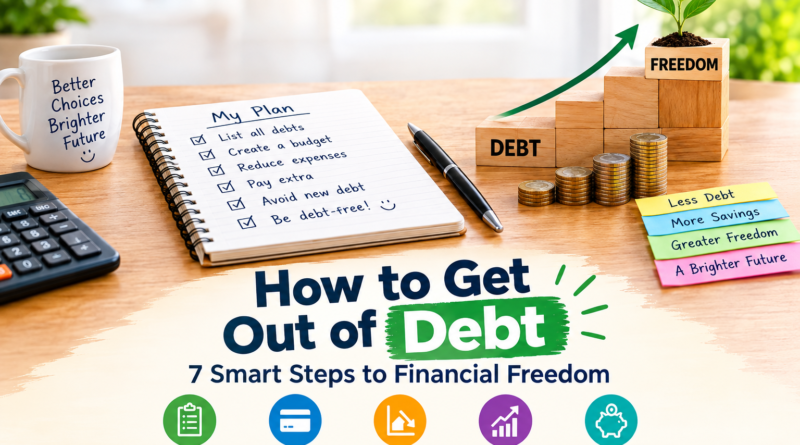
How to Get Out of Debt: A Practical Guide to Becoming Debt-Free
Debt can make it difficult to feel financially secure. Monthly payments, high interest rates, and unexpected expenses can create a cycle that feels difficult to escape. Learning how to get out of debt starts with understanding your finances and creating a realistic repayment plan.
Whether you have credit card debt, personal loans, medical bills, student loans, or other financial obligations, you can take practical steps toward becoming debt-free. You do not need to change everything overnight. Small, consistent improvements in spending, saving, and debt payments can make a meaningful difference over time.
The first step is to stop avoiding the numbers. Once you know exactly how much you owe, what interest rates you are paying, and how much money you can put toward debt each month, you can build a strategy that works for your situation.
What Does It Mean to Get Out of Debt?
Getting out of debt means paying off the money you owe to creditors or lenders and reaching a point where those financial obligations no longer control your monthly budget.
Being debt-free does not mean you can never use credit again. Instead, it means you have eliminated your current debt and developed healthier financial habits.
A debt repayment plan usually involves:
- Listing all your debts
- Understanding interest rates and minimum payments
- Creating a monthly budget
- Reducing unnecessary expenses
- Increasing debt payments
- Choosing a repayment strategy
- Avoiding unnecessary new debt
- Building savings for emergencies
The goal is not simply to make payments. The goal is to create a financial system that helps you reduce debt while preventing the same problem from returning.
Why Is Getting Out of Debt Important?
Debt can affect almost every part of your financial life. Large monthly payments can leave less money available for savings, investments, emergencies, and other important goals.
High-interest debt can be especially expensive because interest continues to increase the cost of carrying a balance.
Getting out of debt can help you:
Reduce Financial Stress
Fewer monthly payments can make your finances easier to manage.
Save Money on Interest
Paying high-interest balances faster can reduce the amount of interest you pay over time.
Increase Your Savings
Once debt payments decrease, you can redirect some of that money toward an emergency fund and other goals.
Improve Financial Flexibility
With fewer obligations, you may have more room in your budget when unexpected expenses appear.
Work Toward Long-Term Goals
Money that previously went toward debt can eventually be used for investing, retirement savings, education, home ownership, or other financial goals.
Step 1: List All Your Debts
The first practical step in learning how to get out of debt is knowing exactly how much you owe.
Many people avoid calculating their total debt because the number may feel overwhelming. However, ignoring debt does not make it disappear. A clear list gives you a starting point.
Create a table containing each debt, its balance, interest rate, and minimum payment.
| Debt | Balance | Interest Rate | Minimum Payment |
|---|---|---|---|
| Credit Card A | $2,500 | 24% | $75 |
| Personal Loan | $5,000 | 12% | $150 |
| Credit Card B | $1,200 | 19% | $50 |
| Car Loan | $8,000 | 7% | $220 |
Your numbers will be different, but the idea is the same.
Include every major debt you have. Once you list everything, calculate your total balance.
This simple step can turn a vague financial problem into a measurable goal.
Step 2: Create a Monthly Budget
A budget tells you where your money is going and how much you can realistically use for debt repayment.
Start with your monthly take-home income. Then list essential expenses such as:
- Housing
- Utilities
- Groceries
- Transportation
- Insurance
- Minimum debt payments
- Necessary household costs
After that, look at discretionary spending.
This may include:
- Restaurant meals
- Entertainment
- Shopping
- Streaming services
- Unnecessary subscriptions
- Expensive hobbies
- Impulse purchases
You do not have to eliminate everything you enjoy. Instead, look for expenses that can be reduced without making your budget impossible to follow.
For example, reducing unnecessary spending by $150 per month gives you an additional $1,800 per year that could potentially be directed toward debt.
Step 3: Stop Adding New Debt
It is difficult to become debt-free if your balances continue to increase.
If you are using credit cards to pay for everyday expenses because you do not have enough cash available, your first priority should be creating enough room in your budget to stop that cycle.
Before making a nonessential purchase, ask:
Can I afford this without borrowing money?
If the answer is no, consider delaying the purchase.
Credit can be useful when managed responsibly, but borrowing for unnecessary purchases can make debt repayment much harder.
Step 4: Build a Small Emergency Fund
When you have debt, it may seem logical to put every extra dollar toward repayment. However, having no emergency savings can create another problem.
Imagine that you use your remaining cash to make a large credit card payment. A few days later, your car needs an unexpected repair. Without savings, you may have to use the credit card again.
A small emergency fund can provide a financial buffer.
You do not necessarily need to build a large emergency fund before making debt payments. Start with an amount that can cover a basic unexpected expense, then gradually increase your savings as your financial situation improves.
The right amount depends on your income, expenses, job stability, and personal circumstances.
Step 5: Choose a Debt Repayment Method
There are two popular methods for organizing debt repayment: the debt snowball and the debt avalanche.
Debt Snowball Method
The debt snowball method focuses on paying off your smallest balance first.
You continue making the minimum payment on your other debts while putting extra money toward the smallest debt.
For example:
- Credit card — $500
- Personal loan — $2,000
- Credit card — $4,000
- Car loan — $10,000
After paying off the $500 balance, you move that payment toward the next debt.
The biggest advantage is motivation. Paying off an entire balance can create a strong sense of progress.
Debt Avalanche Method
The debt avalanche method focuses on the debt with the highest interest rate.
For example:
- Credit card — 25%
- Credit card — 21%
- Personal loan — 12%
- Car loan — 7%
You continue paying the required minimums on all debts while putting extra money toward the highest-interest balance.
This method can help reduce interest costs over time.
Which Method Should You Use?
The best strategy is one you can follow consistently.
If quick wins help you stay motivated, the snowball method may be useful.
If saving money on interest is your main priority, the avalanche method may be preferable.
The most important thing is to choose a clear system and stick with it.
Step 6: Pay More Than the Minimum
Minimum payments may keep your accounts current, but they can take a long time to eliminate high-interest debt.
If your budget allows, make additional payments toward your priority debt.
For example, if your minimum payment is $75 but you can afford $175, the additional $100 can speed up your progress.
You can find extra money by reducing spending or using additional income from:
- Overtime
- Freelance work
- Bonuses
- Selling unused items
- Temporary part-time work
- Tax refunds
Whenever possible, give unexpected money a purpose before spending it.
Step 7: Cut Unnecessary Expenses
Reducing expenses can free up money for debt repayment.
Review your bank and credit card statements from the previous month. Look for purchases that are not essential.
Review Subscriptions
Cancel services you rarely use.
Reduce Dining Out
Preparing more meals at home can lower food costs.
Control Impulse Shopping
Create a waiting period before purchasing nonessential items.
Find Lower-Cost Entertainment
Use free activities, local events, libraries, parks, or affordable alternatives.
Review Transportation Costs
If practical, combine trips, carpool, or use public transportation.
The goal is not to remove every enjoyable activity. A realistic budget is more likely to succeed than an extremely restrictive one.
Step 8: Increase Your Income
Reducing expenses can help, but increasing income can also accelerate debt repayment.
Depending on your skills and available time, you may consider:
- Freelancing
- Tutoring
- Consulting
- Part-time work
- Selling unused belongings
- Online services
- Weekend work
- Overtime
For example, earning an additional $300 each month provides $3,600 per year in additional income before taxes.
If you dedicate much of that money to debt repayment instead of lifestyle upgrades, your progress can accelerate.
Even temporary extra income can be useful if it has a specific purpose.
Step 9: Consider Debt Consolidation Carefully
Debt consolidation combines multiple debts into one loan or payment.
It may make sense when the new loan has favorable terms and makes your finances easier to manage. However, consolidation is not automatically a way to save money.
Before consolidating debt, compare:
- Interest rate
- Loan term
- Fees
- Monthly payment
- Total repayment cost
- Other conditions
A lower monthly payment does not always mean a lower total cost. A longer repayment period may cause you to pay more interest overall.
Also, avoid using newly available credit to accumulate additional balances after consolidation.
Step 10: Talk to Creditors If You Cannot Pay
If you are struggling to make required payments, do not ignore the problem.
Contact your creditors as soon as possible and explain your situation.
Depending on the creditor and your circumstances, there may be options such as payment arrangements or hardship programs.
Not every creditor offers the same solutions, and eligibility varies.
The important thing is to communicate rather than allowing missed payments to continue without taking action.
Step 11: Be Careful With Debt Relief Promises
People who are struggling financially can be vulnerable to companies promising quick debt solutions.
Be cautious about organizations that:
- Guarantee that they can eliminate your debt
- Demand large fees before providing services
- Make unrealistic promises
- Pressure you to make an immediate decision
- Tell you to stop communicating with creditors without clearly explaining the risks
Before using a debt-relief service, research its reputation, costs, services, and potential consequences.
Never assume that a company can erase legitimate debt simply because an advertisement promises a fast solution.
Step 12: Track Your Progress
Tracking your debt every month can help you stay motivated.
Record your:
- Starting balance
- Payments
- Interest charges
- Ending balance
- Total debt remaining
For example:
| Month | Starting Debt | Payment | Remaining Debt |
|---|---|---|---|
| January | $12,000 | $500 | $11,500 |
| February | $11,500 | $550 | $10,950 |
| March | $10,950 | $600 | $10,350 |
| April | $10,350 | $650 | $9,700 |
Actual results will depend on interest and fees, but tracking makes progress visible.
Even if the balance decreases slowly, seeing it move in the right direction can help you stay committed.
A Simple Debt Payoff Example
Imagine someone has $10,000 in total debt.
Their monthly income is $3,500, and after essential expenses and minimum payments, they have $300 available for additional debt repayment.
They make several changes:
- Reduce unnecessary spending by $150
- Earn an additional $200 per month
- Put the additional money toward debt
- Continue making minimum payments on other accounts
- Prioritize their highest-interest debt
- Avoid taking on unnecessary new debt
Their additional repayment capacity increases from $300 to $650 per month.
This does not guarantee a particular payoff date because interest rates and account terms differ. However, it demonstrates how controlling expenses and increasing income can significantly improve repayment capacity.
Common Debt Repayment Mistakes
Trying to Do Everything at Once
Trying to aggressively pay every debt simultaneously can make your plan difficult to manage.
Choose one priority while keeping other accounts current.
Ignoring Interest Rates
High-interest debt can become expensive quickly. Always understand the cost of each balance.
Continuing to Borrow
If you keep adding new debt while making payments, your progress may be very slow.
Having No Emergency Savings
Without a financial buffer, unexpected expenses can force you to borrow again.
Creating an Extreme Budget
A budget that removes every enjoyable activity may be difficult to maintain.
Giving Up After a Setback
Unexpected expenses happen. One difficult month does not mean your entire plan has failed.
Review your situation, make adjustments, and continue.
How Long Does It Take to Get Out of Debt?
There is no universal timeline.
Your debt-free date depends on:
- Total debt
- Interest rates
- Monthly income
- Monthly expenses
- Minimum payments
- Extra payments
- New borrowing
- Unexpected expenses
Someone with $3,000 of debt and significant disposable income may repay it relatively quickly.
Someone with $30,000 of high-interest debt and limited disposable income may need considerably longer.
Instead of comparing your timeline with someone else, focus on whether your debt balance is consistently decreasing.
How to Stay Out of Debt
Paying off debt is a major achievement, but staying debt-free requires continued financial discipline.
Keep Using a Budget
Continue tracking income and expenses even after your debt is gone.
Build Emergency Savings
Work toward an emergency fund that can help cover unexpected expenses.
Save for Large Purchases
Instead of borrowing for every major expense, create savings goals for purchases such as travel, vehicle repairs, education, or home improvements.
Avoid Lifestyle Inflation
When your income increases, do not automatically increase your spending by the same amount.
Consider directing some of the additional income toward savings and long-term goals.
Use Credit Responsibly
If you use credit cards, avoid carrying balances that create expensive interest whenever possible.
Debt Payoff Checklist
Use this checklist to organize your plan:
- List every debt
- Calculate your total balance
- Record interest rates
- Record minimum payments
- Create a monthly budget
- Reduce unnecessary expenses
- Stop unnecessary borrowing
- Build a small emergency fund
- Choose a repayment method
- Make extra payments
- Look for ways to increase income
- Track your balance monthly
- Review your strategy regularly
- Build long-term savings after becoming debt-free
Frequently Asked Questions
What is the fastest way to get out of debt?
The fastest approach depends on your financial situation. Increasing the amount you can pay each month, avoiding new debt, and focusing extra payments on high-interest balances can help accelerate repayment.
Should I pay debt or save money first?
Many people benefit from keeping a small emergency fund while paying down high-interest debt. The appropriate balance depends on your income, expenses, debt costs, and financial stability.
Is the debt snowball or avalanche method better?
The snowball method focuses on the smallest balance, while the avalanche method focuses on the highest interest rate. Snowball can provide psychological motivation, while avalanche can reduce interest costs.
Can I get out of debt without increasing my income?
Yes. Reducing unnecessary expenses, creating a budget, avoiding new borrowing, and making consistent payments can help you reduce debt. However, additional income may make repayment faster.
Should I consolidate my debts?
Debt consolidation may be useful in some situations, but you should compare interest rates, fees, repayment terms, and total costs before making a decision.
How can I avoid debt after paying it off?
Continue budgeting, maintain emergency savings, plan for large expenses, and avoid unnecessary borrowing. Building strong financial habits can help prevent the same debt cycle from returning.
Final Thoughts
Learning how to get out of debt is about creating a clear plan and following it consistently. You do not have to solve your entire financial situation in one day.
Start by listing your debts, creating a realistic budget, reducing unnecessary expenses, and stopping unnecessary borrowing. Then choose a repayment method that fits your personality and financial goals.
If possible, increase your income and direct additional money toward your priority debt. At the same time, keep a small emergency fund so an unexpected expense does not immediately send you back into borrowing.
Debt repayment can take time, but every payment that reduces your balance is progress. Once you become debt-free, continue using the habits that helped you get there by building savings, managing spending, and working toward long-term financial goals.
With patience, consistency, and a practical strategy, becoming debt-free can move from an overwhelming idea to a realistic financial goal.
Read Next