
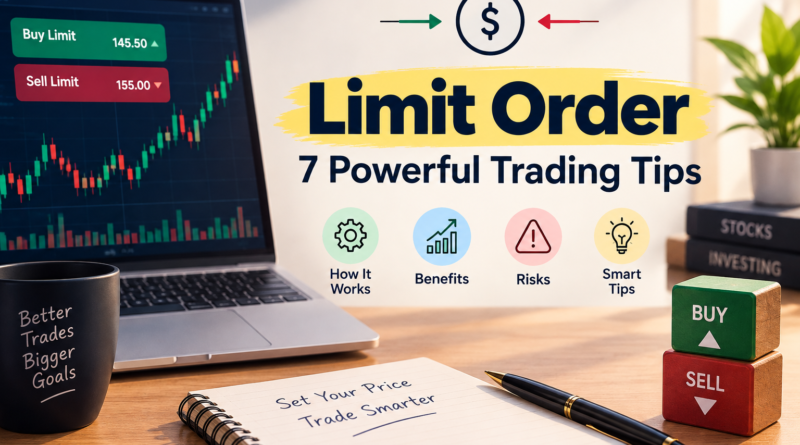
Limit Order: A Complete Guide for Beginners
Introduction to Limit Orders
A limit order is one of the most useful tools investors can use when buying or selling stocks, exchange-traded funds (ETFs), and other financial assets. It allows traders to set the maximum price they are willing to pay when buying an asset or the minimum price they are willing to accept when selling it. Instead of accepting the current market price, investors can specify their preferred price and let the market determine whether the order can be executed.
Understanding how a limit order works is important for anyone who wants to make informed investment decisions. Stock prices can change quickly, especially during periods of high market volatility. A limit order gives investors greater control over the price of a transaction, helping them avoid paying more than they intended or selling an investment below their preferred price.
However, limit orders also have limitations. An order may remain unfilled if the market never reaches the specified price. This means investors must balance their desired price against the possibility that a trade will not happen.
In this guide, you will learn what a limit order is, how it works, the difference between limit orders and market orders, their advantages and disadvantages, and practical strategies for using them effectively.
What Is a Limit Order?
A limit order is an instruction to buy or sell a financial asset at a specified price or better. The investor determines the price at which the transaction may take place rather than simply accepting the best available market price.
There are two main types of limit orders:
- Buy limit order: An instruction to purchase an asset at the specified price or lower.
- Sell limit order: An instruction to sell an asset at the specified price or higher.
For example, imagine a stock is currently trading at $100 per share. You believe it would be a good investment at $95 but do not want to pay $100. You can place a buy limit order at $95. If the market reaches a price at which your order can execute, your broker may complete the purchase.
Similarly, suppose you own shares currently trading at $100 and want to sell them for at least $110. You can place a sell limit order at $110. Your shares may be sold if buyers are willing to purchase them at that price or higher.
The important point is that a limit order controls the acceptable execution price, but it does not guarantee that the transaction will occur.
How Does a Limit Order Work?
A limit order follows a straightforward process. The investor chooses an asset, sets a price, selects the order quantity, and submits the instruction through a brokerage account.
Here is how the process generally works.
1. Choose an Investment
First, identify the stock, ETF, or other eligible financial asset you want to buy or sell. Review its current market price, recent price movements, trading volume, and your investment objectives.
Research helps you decide whether your preferred limit price is reasonable.
2. Set the Limit Price
Next, determine the maximum price you are willing to pay or the minimum price you are willing to accept.
For a buy limit order, the price is generally placed below the current market price when the investor wants to buy at a discount. For a sell limit order, the price is generally placed above the current market price when the investor wants to sell at a higher level.
These are common approaches, but limit orders can also execute immediately if the specified price is already compatible with available market prices.
3. Enter the Number of Shares
Choose how many shares you want to trade. For example, you might place a buy limit order for 20 shares at $45 per share.
Your planned purchase amount would be:
20 shares × $45 = $900.
Brokerage fees, taxes, and other transaction costs may increase the total amount.
4. Choose the Order Duration
Most brokers allow investors to choose how long an order remains active. Common options include a day order, which normally expires at the end of the trading session if unfilled, and a good-till-canceled order, which remains active until it is filled or canceled, subject to the broker’s rules and any applicable time limits.
Some brokers also offer additional order-duration choices.
5. Submit and Monitor the Order
After submitting the order, the broker routes it according to its execution policies and available trading venues.
The order may be filled completely, filled partially, remain pending, or expire without execution. Investors should check their order status and cancel or modify the order if their investment plans change.
Example of a Buy Limit Order
Suppose a company’s stock is trading at $80 per share. You believe the stock offers better value at $75 and decide to place a buy limit order for 10 shares at that price.
Buy limit order example
Current share price
$80
Your buy limit price
$75
Number of shares
10
Maximum planned purchase cost
$750
If the stock falls to $75 and sufficient sell orders are available at compatible prices, your order may be executed. You could also receive a better price if sellers are willing to sell below your limit.
If the stock rises to $90 without reaching your limit price, your order may remain unfilled. You would miss that purchase unless you adjust your order or use another trading approach.
This example demonstrates the main trade-off of limit orders: you gain control over your acceptable price but sacrifice certainty of execution.
Example of a Sell Limit Order
Now imagine you purchased 15 shares of a company at $40 per share. The stock is currently trading at $48, and you want to sell your shares if the price reaches $55.
You place a sell limit order at $55.
If buyers are available at $55 or higher and your order receives an execution, you may sell your shares at your limit price or better.
Your potential gross proceeds at the limit price would be:
15 shares × $55 = $825.
Your original purchase cost was $600, so the difference would be $225 before brokerage fees, taxes, and other costs.
However, if the stock never reaches $55, the order may not execute. The stock could even decline substantially while your sell order remains unfilled.
A sell limit order does not guarantee a profit or protect you from losses. It simply specifies the minimum acceptable selling price.
Limit Order vs. Market Order
A limit order and a market order are two common ways to buy and sell investments. Their primary difference is the balance between price control and execution certainty.
A market order generally seeks execution as quickly as possible at the best available prices. A limit order specifies the worst acceptable execution price, but the transaction may not occur.
| Feature | Limit Order | Market Order |
|---|---|---|
| Price control | High | No guaranteed execution price |
| Execution | Not guaranteed | Usually prioritized for prompt execution |
| Best suited for | Price-sensitive trades | Trades where execution speed matters |
| Risk of no execution | Yes | Generally lower during normal trading conditions |
| Protection against unfavorable prices | Limits acceptable price | Can fill at changing prices |
| Suitable market conditions | Many conditions, depending on liquidity | Often most practical in liquid markets |
For example, if a stock is trading at $50 and you submit a market buy order, the order may execute at $50.05, $50.10, or another available price depending on market conditions.
If you place a buy limit order at $49.50, you will not pay more than $49.50 per share for executions under that order. However, if the available selling prices stay above $49.50, you may not buy the shares.
Neither order type is automatically better. The right choice depends on your priorities, the asset’s liquidity, market volatility, and how urgently you want to complete the transaction.
Advantages of Limit Orders
Limit orders offer several benefits that can help investors manage transactions more deliberately.
1. Greater Price Control
The biggest advantage of a limit order is that it allows you to establish an acceptable price before entering a trade.
When buying, you can avoid paying more than your chosen limit. When selling, you can avoid accepting a price below your specified minimum.
This is particularly useful for investors who follow a disciplined investment plan instead of reacting emotionally to short-term price changes.
2. Protection Against Unfavorable Execution Prices
Market prices can change rapidly, especially when trading volume is low or significant news affects investor sentiment.
A limit order helps protect against executions at prices worse than your specified limit. However, it does not guarantee that your trade will execute at that price, and it does not prevent the investment’s market value from declining afterward.
3. Support for Planned Investment Strategies
Investors can use limit orders to follow predetermined entry and exit prices.
For instance, someone researching a company may decide that its shares become attractive at $30. A buy limit order at that price can support the investor’s plan without requiring constant monitoring.
The price should still be based on research, valuation, and financial goals rather than an arbitrary number.
4. Reduced Need for Constant Monitoring
A limit order can remain active according to the selected duration, allowing the market to reach your desired price while you focus on other responsibilities.
However, this convenience should not replace regular monitoring. Company news, earnings reports, changes in market conditions, and investment goals can make an existing order less appropriate.
5. Useful for Less Liquid Securities
Some investments have relatively few buyers and sellers. In these situations, a market order can encounter a wider bid-ask spread or unfavorable execution prices.
A limit order can establish a clear price boundary. However, low liquidity also makes it more likely that the order will remain unfilled or receive only a partial execution.
Disadvantages of Limit Orders
Despite their benefits, limit orders have important disadvantages that investors should understand before using them.
1. No Guarantee of Execution
A limit order may never be filled if the market does not reach a compatible price or there are insufficient matching orders.
For example, if you place a buy limit order at $25 and the stock remains between $27 and $30, the order will not execute under ordinary trading conditions.
If the stock continues rising, you may miss the opportunity to buy it.
2. Partial Fills
A limit order may be filled for only part of the requested quantity.
Suppose you place an order to buy 100 shares at $20, but only 35 shares are available to sell at compatible prices while your order is eligible for execution. Your order might fill for 35 shares, leaving the remaining 65 shares unfilled.
Partial fills can affect your investment allocation and may create additional transaction costs, depending on your broker’s fee structure.
3. Prices Can Move Away From Your Limit
Market conditions can change quickly. A stock might approach your limit price and then move in the opposite direction before sufficient orders become available.
Even if a security briefly trades at your limit price, your order is not guaranteed to execute. Other orders may have priority, or there may not be enough available liquidity.
4. Missed Investment Opportunities
Investors sometimes set limit prices too aggressively in an attempt to obtain a bargain.
For example, a stock trading at $100 might be available at a reasonable valuation, but an investor may insist on buying it at $85. If the stock rises instead, the order may never fill.
A limit price should reflect a thoughtful assessment of value and risk, not simply the desire to pay less.
5. Additional Monitoring Requirements
Although limit orders can reduce the need to watch prices constantly, investors still need to review active orders.
A limit order that made sense before an earnings announcement may no longer fit the investment plan after the company releases disappointing results. Reviewing order duration and canceling outdated instructions can help prevent unintended trades.
What Is the Difference Between a Limit Order and a Stop Order?
A limit order and a stop order serve different purposes, even though both can be used to manage trades.
A limit order specifies the maximum buying price or minimum selling price acceptable for execution. A stop order generally becomes active when a specified stop price is reached, after which it is handled according to the order’s instructions and broker rules.
A conventional stop order often becomes a market order once triggered. Consequently, its execution price may differ significantly from the stop price.
For example, suppose a stock trades at $60 and you place a stop order to sell at $55. If the stop price is reached, the order may become a market order, potentially selling below $55 in a fast-moving market.
A stop-limit order combines a stop trigger with a limit price. Once triggered, it becomes a limit order, which means it may not execute if the market moves beyond the acceptable limit.
The distinction matters because investors should choose an order type based on whether their priority is price control, execution, or a specific trading trigger.
What Is a Stop-Limit Order?
A stop-limit order is a trading instruction that uses two prices: a stop price and a limit price.
The stop price determines when the order becomes active. The limit price determines the worst acceptable execution price once the order is activated.
For example, suppose a stock is trading at $70. You want to sell if it begins falling, but you do not want to accept a selling price below $64. You might establish a stop price of $66 and a sell limit price of $64.
If the stock reaches the stop price, the sell limit order is activated. It can execute at $64 or higher, subject to available buyers and the order’s priority.
However, if the stock falls rapidly from $66 to $60, your limit order might remain unfilled because buyers are no longer available at $64 or higher.
A stop-limit order can provide more price control than a conventional stop order, but it cannot guarantee an exit. Investors should understand this limitation before relying on it to manage downside risk.
When Should You Use a Limit Order?
Limit orders can be useful in several situations, depending on your investment objectives and the characteristics of the security.
Buying at a Target Price
If you have researched a company and determined the maximum price you are willing to pay, a buy limit order can help you stick to that valuation.
For example, you may believe that a company’s shares offer an attractive long-term opportunity at $45 but not at $50. A buy limit order at $45 lets you wait for that price without automatically accepting a higher one.
Remember that a lower share price does not necessarily mean a stock is undervalued. Review the company’s earnings, financial position, competitive advantages, and future prospects before investing.
Selling at a Target Price
Investors may use sell limit orders when they want to sell shares at a predetermined price.
Suppose you own a stock trading at $35 and decide that you are willing to sell at $42. A sell limit order at $42 may help you follow that plan if buyers are available.
However, target prices should be reviewed as your investment thesis and the company’s financial outlook change.
Trading Less Liquid Stocks
Less liquid stocks can have wider bid-ask spreads. A limit order allows you to specify the price at which you are prepared to trade rather than automatically accepting an available market price.
Consider the order book, trading volume, and possibility of partial execution before placing a large order.
Managing Entry Prices During Volatile Markets
During volatile periods, prices can change sharply within seconds. A limit order can help prevent a buy order from executing above your chosen price.
However, volatility can also make limit orders harder to fill. Prices may move through your limit quickly, or the available liquidity may disappear before the order executes.
Common Mistakes to Avoid When Using Limit Orders
Using limit orders effectively requires more than choosing a price. Avoiding common mistakes can help you make better trading decisions.
Setting Unrealistic Limit Prices
An extremely low buy limit or extremely high sell limit may have little chance of execution.
Review recent trading prices, liquidity, company valuation, and your reasons for entering the trade. Set a price that reflects your investment strategy rather than an unrealistic expectation.
Ignoring the Bid-Ask Spread
The bid price is the highest price a buyer is currently offering, while the ask price is the lowest price a seller is currently requesting.
The difference between these prices is called the bid-ask spread.
For example, if a stock has a bid of $49.80 and an ask of $50.10, the spread is $0.30. A buy limit order at $49.80 may not execute unless a seller is willing to trade at that price and your order receives an execution opportunity.
Understanding the spread can help you select a more informed limit price.
Forgetting to Check Order Duration
Some limit orders expire at the end of the trading day, while others can remain active for longer periods under the broker’s rules.
If you assume an order is still active when it has already expired, you may miss a planned transaction. Conversely, leaving an outdated order active could result in a trade you no longer want.
Check the status and expiration of every active order.
Placing Orders Without Research
A limit order controls the price of a transaction, not the quality of the investment.
Buying a stock at a low price does not make it a good investment if the company has weak fundamentals or declining business prospects.
Before placing an order, consider the company’s financial statements, valuation, industry conditions, and the role the investment would play in your portfolio.
Assuming the Limit Price Guarantees a Complete Trade
A limit order may fill partially or remain unfilled. Investors should not assume that a submitted order means the intended number of shares has been purchased or sold.
Always check the executed quantity and remaining order balance.
How to Place a Limit Order Through a Brokerage Account
The exact steps depend on your broker and the financial market in which you trade, but the process is generally similar across many platforms.
- Open your brokerage account: Sign in to the platform and select the investment you want to trade.
- Choose buy or sell: Decide whether you want to purchase new shares or sell shares you already own.
- Select the limit order type: Do not accidentally select a market order or another order type.
- Enter your limit price: Specify the maximum buying price or minimum selling price.
- Enter the quantity: Choose the number of shares or units you want to trade.
- Select the order duration: Choose an available option, such as a day order or good-till-canceled order.
- Review the order details: Check the price, quantity, estimated cost or proceeds, and any applicable fees.
- Submit the order: Confirm the transaction instruction.
- Monitor its status: Check whether it is open, partially filled, filled, canceled, or expired.
Brokerage platforms can differ in their order rules, supported securities, and trading-session restrictions. Some brokers also limit which order types are available outside regular trading hours.
Read the broker’s instructions before submitting an order, especially if you are trading a volatile or thinly traded security.
Limit Orders During Regular and After-Hours Trading
Limit orders can be particularly relevant when investors trade outside regular stock market hours.
During extended-hours sessions, fewer market participants may be active. Trading volume may be lower, and bid-ask spreads may be wider than during the regular session.
A limit order can help control the acceptable transaction price during these periods. However, it cannot eliminate the risks associated with low liquidity or rapidly changing prices.
Not every brokerage accepts all order types during extended hours. Some brokers require limit orders for such trading, while others impose specific restrictions on order duration, eligible securities, or execution venues.
Investors should also recognize that a stock’s closing price may differ significantly from the price available during after-hours trading.
Before submitting an extended-hours order, check the broker’s trading-session rules and consider whether the potential benefit justifies the additional execution risks.
Tips for Using Limit Orders More Effectively
A few practical habits can make limit orders easier to manage.
- Research the investment first: Evaluate the asset’s fundamentals, valuation, and risks before deciding on an acceptable price.
- Review market liquidity: More liquid securities generally offer more opportunities for orders to match, although execution is never guaranteed.
- Understand the bid-ask spread: A very wide spread can affect the price at which an order is likely to execute.
- Choose an appropriate duration: Select an order duration that matches your investment plan and remember to review active orders.
- Avoid emotional decisions: Do not continually change your limit price simply because a stock is moving quickly.
- Monitor partial fills: Check whether the complete quantity has executed before placing additional orders.
- Review transaction costs: Brokerage commissions, exchange fees, and taxes can affect the overall result.
- Use limit orders with a broader strategy: A suitable order price should support your financial goals, risk tolerance, and investment time horizon.
For long-term investors, patience can be valuable, but it should not become an excuse to ignore changing fundamentals. An order is a tool for implementing an investment decision, not a replacement for that decision.
Frequently Asked Questions About Limit Orders
1. What is a limit order in simple terms?
A limit order is an instruction to buy an asset at a specified price or lower, or sell it at a specified price or higher. It gives investors control over the acceptable execution price, but the trade is not guaranteed to happen.
2. Does a limit order guarantee a specific price?
A limit order sets the worst acceptable price for executions under that order. A buy limit order cannot execute above its limit, and a sell limit order cannot execute below its limit. However, the order may remain unfilled or execute only partially.
3. Can a limit order expire?
Yes. A day limit order generally expires at the end of the applicable trading session if it has not been filled. Good-till-canceled orders may remain active longer, subject to broker policies and market rules.
4. Is a limit order safer than a market order?
A limit order offers greater control over the execution price, which can be useful when prices fluctuate. However, it introduces the risk of non-execution. A market order generally prioritizes execution but can fill at an unfavorable price. The better choice depends on the situation.
5. Can a limit order be filled partially?
Yes. If sufficient matching orders are unavailable for the entire quantity, some shares may be purchased or sold while the remainder stays open, depending on the order’s conditions.
6. What happens if a stock never reaches my limit price?
Your order may remain open until it is filled, canceled, or expires. If the stock never reaches a price compatible with your order, the transaction may not happen.
7. Can beginners use limit orders?
Yes. Beginners can use limit orders to set clear price boundaries when buying or selling investments. They should first learn how order types work, understand trading fees, and recognize that a limit order does not guarantee execution.
8. What is the difference between a limit order and a stop-limit order?
A regular limit order becomes eligible for execution according to its limit price and order conditions. A stop-limit order first requires a stop-price trigger and then becomes a limit order. The stop-limit order may not execute if the market moves beyond its acceptable price.
Conclusion
A limit order is a valuable trading tool that allows investors to control the maximum price they are willing to pay when buying an asset or the minimum price they are willing to accept when selling it. By setting a specific price, investors can follow their plans more consistently and avoid executions at prices worse than their stated limits.
However, limit orders do not guarantee that a trade will be completed. Orders can remain unfilled, execute partially, or expire before the desired transaction occurs. These limitations become particularly important during volatile market conditions or when trading securities with low liquidity.
The most effective approach is to combine limit orders with careful research, realistic price expectations, and a clear investment strategy. Before submitting an order, consider the asset’s valuation, bid-ask spread, trading volume, and your financial objectives.
Ultimately, understanding when and how to use a limit order can help you make more informed trading decisions and manage the execution of your investments with greater discipline.
Read Next