
Dividend Yield: A Complete Guide for Smarter Dividend Investing
Dividend Yield is one of the most useful metrics for investors who want to understand how much income a stock may generate compared with its current market price. It is especially important for dividend investors because it provides a simple way to compare the income potential of different dividend-paying stocks.
However, a high dividend yield does not automatically mean that a stock is a good investment. A company may have a high yield because it pays generous dividends, but the yield can also rise when its share price falls sharply. Therefore, investors should look beyond the yield percentage and consider dividend growth, company earnings, cash flow, debt, payout ratio, and overall financial strength.
In this guide, we will explain Dividend Yield, how it is calculated, why it matters, how to interpret it, and what investors should consider before choosing a high-yield dividend stock.
What Is Dividend Yield?
Dividend Yield is a financial ratio that shows how much a company pays in annual dividends compared with its current stock price. It is normally expressed as a percentage.
For example, suppose a company pays $2 in dividends per share every year and its stock currently trades at $50 per share. The dividend yield would be:
Dividend Yield = ($2 ÷ $50) × 100 = 4%
This means an investor buying the stock at $50 could theoretically receive an annual dividend equal to 4% of the purchase price, assuming the dividend remains unchanged.
Dividend yield is particularly useful when comparing income-producing investments. Investors can use it to compare different dividend stocks and evaluate how much income a stock might provide relative to its market price.
How Is Dividend Yield Calculated?
The basic dividend yield formula is simple:
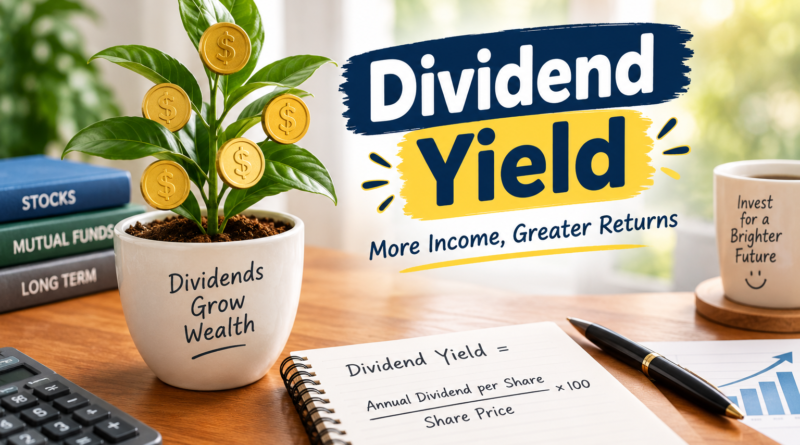
Dividend Yield = Annual Dividend Per Share ÷ Current Stock Price × 100
There are two main pieces of information you need:
- Annual dividend per share
- Current stock price
Example of Dividend Yield Calculation
Imagine Company ABC pays quarterly dividends of $0.50 per share.
Its annual dividend is:
$0.50 × 4 = $2.00
If the current stock price is $40, then:
Dividend Yield = ($2 ÷ $40) × 100 = 5%
Therefore, Company ABC has a 5% dividend yield based on its current price and annual dividend.
If the stock price changes while the dividend stays the same, the yield changes as well.
For example:
| Stock Price | Annual Dividend | Dividend Yield |
|---|---|---|
| $50 | $2 | 4% |
| $40 | $2 | 5% |
| $30 | $2 | 6.67% |
| $25 | $2 | 8% |
This demonstrates an important point: a rising dividend yield is not always good news. Sometimes it simply reflects a falling share price.
Why Does Dividend Yield Matter?
Dividend yield matters because it gives investors a quick estimate of the income they may receive from a dividend-paying stock.
For income-focused investors, dividends can be an important part of total investment returns. Investors may use dividend income to pay expenses, reinvest into additional shares, or build a long-term income stream.
Dividend yield can help investors:
- Compare dividend-paying stocks
- Estimate potential income
- Identify income-focused investments
- Evaluate dividend stocks within the same industry
- Track changes in a company’s income potential
- Build a diversified dividend portfolio
However, dividend yield should be considered alongside other financial metrics rather than used alone.
Dividend Yield vs. Dividend Growth
Dividend yield and dividend growth are related but different concepts.
Dividend yield measures the current dividend relative to the stock price.
Dividend growth measures how much a company’s dividend payments increase over time.
For example, Company A might have a 7% dividend yield but rarely increase its dividend. Company B might have a 2.5% yield but increase its dividend by 8% every year.
An investor focused on current income might prefer Company A. However, a long-term investor may find Company B attractive because growing dividends can increase future income.
This is why investors should consider both current yield and the company’s history of dividend growth.
What Is a Good Dividend Yield?
There is no universal dividend yield that is considered good for every company or investor.
A reasonable yield depends on:
- Industry
- Company size
- Business stability
- Earnings
- Cash flow
- Interest rates
- Economic conditions
- Dividend growth
- Investor goals
A 3% yield may be attractive for one company but unusually low for another. Similarly, a 9% yield may look appealing but could indicate that the market expects the dividend to be reduced.
Instead of asking only, “What is the highest dividend yield?” investors should ask:
“Is the dividend sustainable?”
A sustainable dividend supported by strong earnings and cash flow can be more valuable than an extremely high yield that may be cut in the future.
High Dividend Yield: Is It Always Better?
A common mistake among new investors is assuming that a higher dividend yield is automatically better.
It is not.
Suppose two companies have the following characteristics:
| Metric | Company A | Company B |
|---|---|---|
| Dividend Yield | 3% | 9% |
| Earnings Growth | Strong | Weak |
| Debt | Moderate | High |
| Cash Flow | Strong | Declining |
| Dividend History | Stable | Recently Reduced |
At first glance, Company B’s 9% yield looks more attractive. However, its weak financial position could make the dividend less reliable.
Company A may provide a lower current income but could potentially offer stronger long-term dividend growth and capital appreciation.
This situation is sometimes called a dividend yield trap.
What Is a Dividend Yield Trap?
A dividend yield trap occurs when a stock appears attractive because its dividend yield is unusually high, but the high yield is caused by a falling stock price or an unsustainable dividend.
For example, suppose a company pays an annual dividend of $3 and trades at $60.
Its yield is:
$3 ÷ $60 × 100 = 5%
Now imagine the stock falls to $30 while the company continues paying the same dividend.
The yield becomes:
$3 ÷ $30 × 100 = 10%
The stock now looks extremely attractive based on yield alone. But why did the stock fall from $60 to $30?
Perhaps the company is losing customers, experiencing declining profits, carrying too much debt, or facing serious industry problems.
If earnings continue to weaken, management may eventually reduce or eliminate the dividend.
Therefore, an unusually high dividend yield deserves further investigation.
Factors to Check Before Buying a High-Yield Stock
Before investing in a stock because of its dividend yield, investors should examine several additional factors.
1. Dividend History
Look at how consistently the company has paid dividends.
A long history of stable or increasing dividends can provide useful information about management’s commitment to shareholder distributions.
However, past performance does not guarantee future results.
2. Payout Ratio
The payout ratio measures the percentage of earnings a company distributes as dividends.
For example, if a company earns $5 per share and pays $2 per share in dividends:
Payout Ratio = ($2 ÷ $5) × 100 = 40%
A moderate payout ratio can leave the company with money to reinvest in its business, reduce debt, or build financial reserves.
A very high payout ratio may require closer examination.
3. Free Cash Flow
Dividends ultimately need to be supported by cash generation.
A company may report accounting profits while having weak free cash flow. Therefore, investors should examine whether the business generates enough cash to support its dividend.
Strong and consistent free cash flow can provide a stronger foundation for dividend payments.
4. Debt Levels
High debt can create pressure on a company’s finances.
When interest expenses rise, a heavily indebted company may have less cash available for dividends.
Investors should therefore consider debt levels before choosing a high-yield stock.
5. Earnings Stability
Companies with stable and predictable earnings may have an easier time maintaining dividends during difficult economic periods.
Businesses with highly volatile earnings may have more difficulty maintaining consistent shareholder distributions.
Dividend Yield and Total Return
Dividend yield is only one part of an investment’s total return.
Total return can generally come from two major sources:
- Dividend income
- Capital appreciation
For example, imagine you buy a stock for $100 and receive $4 in dividends during the year. If the stock rises to $108, your approximate return before taxes and other costs would be:
$8 capital gain + $4 dividend = $12
That represents a 12% return on the original $100 investment.
On the other hand, a stock with a high dividend yield could still produce a poor total return if its share price declines significantly.
This is why investors should avoid evaluating stocks based solely on dividend income.
Dividend Yield and Dividend Reinvestment
Dividend investors can choose to reinvest their dividend payments instead of taking the cash.
This strategy is commonly known as dividend reinvestment.
When dividends are reinvested, investors use the income to purchase additional shares. Those additional shares may then generate more dividends in the future.
Over long periods, this can create a compounding effect.
For example:
- You own 100 shares.
- The company pays dividends.
- You use those dividends to buy additional shares.
- Your share count increases.
- The larger share position may produce more dividends.
- You reinvest those dividends again.
The process can continue over many years.
However, reinvesting dividends does not eliminate investment risk. The stock price can still fall, and dividends can still be reduced or suspended.
Dividend Yield vs. Interest Rate
Dividend yield is sometimes compared with interest rates, but they are not the same.
Interest from a savings account or certain fixed-income investments may be based on contractual terms, while dividends are generally paid at the discretion of a company’s board and depend on the company’s financial condition and policies.
A stock with a 5% dividend yield does not mean an investor is guaranteed a 5% return.
The stock price can rise or fall, and the company can change its dividend.
Therefore, investors should understand that dividend yield is an income indicator, not a guaranteed return.
How Dividend Yield Changes Over Time
Dividend yield changes whenever the dividend or stock price changes.
Consider a company that pays a $2 annual dividend.
If the stock price is $50:
Yield = 4%
If the stock price rises to $80:
Yield = 2.5%
If the stock price falls to $25:
Yield = 8%
Notice that the company did not change its dividend. The yield changed entirely because the stock price changed.
This is why investors should always look at the current stock price when evaluating dividend yield.
Trailing Dividend Yield vs. Forward Dividend Yield
Investors may encounter different versions of dividend yield.
Trailing Dividend Yield
Trailing dividend yield is generally based on dividends paid over the previous 12 months.
It provides a historical view of the company’s dividend payments.
Forward Dividend Yield
Forward dividend yield uses an estimate of future annual dividend payments, often based on the most recent dividend payment or expected future distributions.
Forward yield can be useful, but it relies on assumptions about future dividends.
If a company changes its dividend policy, the actual future yield may differ from the estimate.
How to Compare Dividend Stocks
When comparing dividend stocks, avoid focusing on yield alone.
A better approach is to create a checklist that includes:
- Dividend yield
- Dividend growth
- Payout ratio
- Earnings growth
- Free cash flow
- Debt levels
- Revenue growth
- Business stability
- Competitive position
- Valuation
- Industry conditions
For example, a 4% yield from a financially strong company with growing earnings may be more attractive than a 10% yield from a company with declining profits.
The goal is not simply to find the highest yield. The goal is to find a dividend that offers a reasonable balance between income, sustainability, growth, and risk.
Common Mistakes Investors Make With Dividend Yield
Chasing the Highest Yield
The highest yield is not necessarily the best investment. Extremely high yields can signal increased risk.
Ignoring the Stock Price
Investors sometimes focus on dividend payments without considering whether the stock itself is losing value.
Forgetting Dividend Cuts
A company can reduce or eliminate its dividend when financial conditions deteriorate.
Ignoring Taxes
Dividend income may be subject to taxes depending on the investor’s country, account type, and tax rules.
Holding Too Few Stocks
Concentrating an entire portfolio in a few dividend companies can increase company-specific risk.
Focusing Only on Current Income
Some investors overlook dividend growth and long-term capital appreciation because they focus exclusively on today’s yield.
Benefits of Using Dividend Yield
Dividend yield has several advantages for investors.
Simple to Understand
The calculation is straightforward and can provide a quick overview of income potential.
Useful for Comparison
Investors can compare dividend-paying stocks within similar industries.
Helpful for Income Planning
Dividend yield can help investors estimate potential income from an investment portfolio.
Useful for Dividend Screening
Investors can use dividend yield as one of several filters when researching dividend stocks.
Supports Long-Term Investment Analysis
When combined with dividend growth, earnings, cash flow, and valuation, dividend yield can become a useful part of a long-term investment process.
Limitations of Dividend Yield
Despite its usefulness, dividend yield has limitations.
It does not tell you:
- Whether the stock price will increase
- Whether the dividend will continue
- Whether the company is financially healthy
- Whether the stock is fairly valued
- Whether the dividend will grow
- How much tax you may owe
- How risky the investment is
Therefore, dividend yield should always be treated as one piece of a larger investment analysis.
A Simple Dividend Yield Example
Suppose you are researching three companies:
| Company | Stock Price | Annual Dividend | Dividend Yield |
|---|---|---|---|
| Company A | $100 | $3 | 3% |
| Company B | $75 | $3 | 4% |
| Company C | $50 | $4 | 8% |
Company C has the highest yield.
However, before investing, you should investigate why the yield is so high.
If Company C has strong cash flow, manageable debt, stable earnings, and a sustainable payout ratio, its yield may be attractive.
But if its stock price has fallen because its business is deteriorating, the 8% yield may be misleading.
The numbers provide a starting point for research, not a final investment decision.
How Beginners Can Use Dividend Yield
Beginners can use dividend yield as part of a broader stock research process.
A simple process could look like this:
Step 1: Identify dividend-paying companies.
Step 2: Check the current dividend yield.
Step 3: Review the company’s dividend history.
Step 4: Examine earnings and free cash flow.
Step 5: Check the payout ratio.
Step 6: Review debt levels.
Step 7: Consider dividend growth.
Step 8: Evaluate the company’s overall valuation.
Step 9: Compare the company with similar businesses.
Step 10: Consider whether the investment fits your financial goals and risk tolerance.
This approach can help investors avoid making decisions based on one percentage alone.
Frequently Asked Questions About Dividend Yield
What does a 5% dividend yield mean?
A 5% dividend yield means the annual dividend is equal to approximately 5% of the current stock price, assuming the stated dividend remains unchanged.
Is a higher dividend yield better?
Not necessarily. A higher yield can provide more current income, but it may also indicate greater risk or a falling stock price.
How is dividend yield calculated?
Dividend yield is calculated by dividing the annual dividend per share by the current stock price and multiplying the result by 100.
Can dividend yield change without a dividend change?
Yes. If the stock price changes while the dividend remains the same, the dividend yield changes automatically.
What is considered a good dividend yield?
There is no universal number. Investors should consider the company’s industry, financial health, dividend history, growth prospects, and risk before deciding whether a yield is attractive.
Can a company reduce its dividend?
Yes. Companies can reduce, suspend, or eliminate dividends depending on their financial condition and business strategy.
Should beginners invest in high-dividend stocks?
Beginners should research the company carefully rather than choosing a stock simply because it has a high dividend yield. Diversification and risk management are also important.
Does dividend yield guarantee income?
No. Dividend yield is not a guarantee. Future dividends can change, and stock prices can fluctuate.
Conclusion
Dividend Yield is an important metric for investors who want to understand the income potential of dividend-paying stocks. It provides a simple percentage that compares a company’s annual dividend with its current share price.
However, dividend yield should never be used as the only reason to buy a stock. A high yield can sometimes indicate an attractive income opportunity, but it can also be a warning sign when the stock price has fallen because of serious business problems.
Smart dividend investing requires a broader analysis that includes dividend history, payout ratio, earnings, free cash flow, debt, dividend growth, valuation, and overall business quality.
The most important lesson is simple: do not chase yield blindly. Instead, look for dividends that appear sustainable and fit your long-term investment objectives.
When used correctly, dividend yield can be a valuable tool for comparing income-producing investments and building a more informed dividend investment strategy.
Read Next