
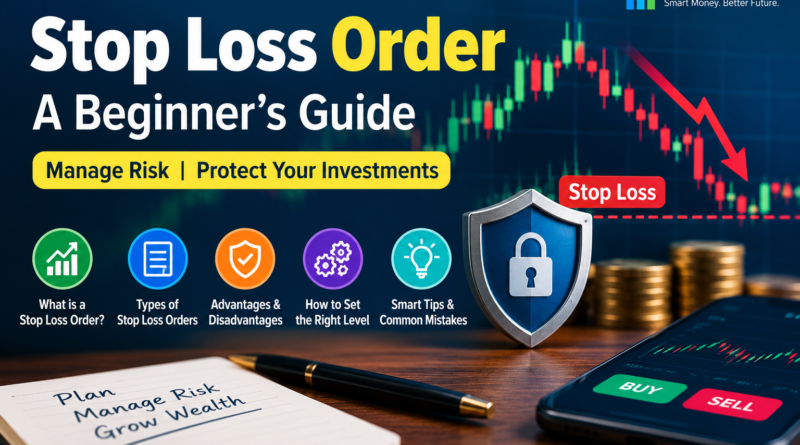
Stop Loss Order: A Complete Guide to Protecting Your Investments
Introduction to Stop Loss Order
A stop loss order is an important tool that investors and traders use to manage risk in the stock market. It helps limit potential losses by instructing a broker to sell a security when its market price reaches a specific level. Instead of constantly watching stock prices throughout the day, traders can use a stop loss order to establish a predefined exit point for a trade.
Investing in the stock market offers opportunities to build wealth, but it also involves uncertainty. Stock prices can rise and fall because of company earnings, economic news, interest rate changes, market sentiment, and unexpected events. Even a stock that appears attractive today can experience a significant decline tomorrow. A stop loss order can help investors prepare for these situations and make more disciplined decisions.
For beginners, understanding how a stop loss order works is an essential step toward learning effective risk management. It can help reduce emotional decision-making, protect trading capital, and create a more structured investment strategy. However, a stop loss order does not guarantee that an investor will avoid losses or sell at the exact price selected.
In this guide, you will learn what a stop loss order is, how it works, the different types available, its advantages and disadvantages, and how to use it responsibly. You will also explore practical examples and common mistakes to avoid when managing stock market risk.
What Is a Stop Loss Order?
A stop loss order is an instruction given to a broker to buy or sell a financial asset once its market price reaches a specified stop price. Traders commonly use this order to manage the risk of an existing position.
For example, suppose you purchase shares of a company for $100 per share. You are concerned that the stock could decline, so you set a stop loss at $90. If the market price falls to the stop price, your order is triggered according to the order type and market conditions.
For a standard sell stop order, reaching the stop price generally converts the order into a market order. The broker then attempts to sell the shares at the best available price. The actual selling price could be lower than $90 if the stock drops quickly or the market opens at a lower price.
A stop loss order is commonly used by short-term traders, swing traders, and some long-term investors. Its main purpose is to establish a planned exit point before a trade moves against the investor.
It is important to understand that a stop loss order manages one part of investment risk. It cannot prevent every loss, eliminate market volatility, or guarantee a specific selling price.
How Does a Stop Loss Order Work?
A stop loss order follows a straightforward process. The investor selects a security, determines an appropriate stop price, and submits the order through a brokerage account.
Once the order is active, the broker monitors the relevant market price according to the order’s terms. If the stop condition is met, the order is triggered.
Here is how the process typically works:
- Purchase a security: You buy shares or another eligible financial asset.
- Determine your risk level: You decide how much of a price decline you are willing to tolerate.
- Set the stop price: You enter the price at which you want the order to activate.
- Submit the order: Your broker accepts the order according to its rules and available trading options.
- The price reaches the stop: The order is triggered when the specified condition is satisfied.
- The broker attempts execution: Depending on the order type, the broker attempts to sell the security or execute another specified transaction.
Consider an investor who buys 20 shares at $50 each. The total purchase cost is $1,000, excluding fees. The investor sets a sell stop order at $45.
If the order executes at $45, the shares generate $900 in sale proceeds before fees. The resulting loss is $100, or $5 per share.
However, if the market price falls rapidly from $46 to $42, the order may execute near $42 instead. In that situation, the loss would be $160 before fees.
This example demonstrates why a stop loss order should be viewed as a risk-management tool rather than a guarantee against losses.
Types of Stop Loss Orders
Different stop-related orders offer different levels of control over execution price and execution certainty. Understanding their differences can help investors choose an order that suits their trading strategy.
1. Standard Stop Loss Order
A standard stop loss order, often called a stop market order, becomes a market order when the stop price is reached.
Suppose you buy a stock at $80 and place a sell stop at $72. If the stock reaches $72, the order is triggered and becomes a market order.
The primary advantage is that the order attempts to sell the shares without requiring the market to offer your exact stop price. However, the execution price may differ from the stop price because of volatility, low liquidity, or price gaps.
This order may suit investors who prioritize exiting a position over controlling the exact sale price.
2. Stop Limit Order
A stop limit order combines a stop price with a limit price. When the stop condition is met, the order becomes a limit order rather than a market order.
For example, suppose you own a stock trading at $100. You place a sell stop limit order with a stop price of $90 and a limit price of $88.
If the stock reaches $90, the order activates. It can then execute at $88 or higher, subject to the applicable order rules. If the stock falls rapidly below $88, the order may remain unfilled.
The advantage is greater control over the minimum acceptable selling price. The disadvantage is that you may continue holding the stock while its price declines.
A stop limit order can therefore help control execution price, but it does not guarantee that the position will be sold.
3. Trailing Stop Loss Order
A trailing stop order adjusts its stop price as the market moves favorably, based on a specified dollar amount or percentage.
For example, suppose a stock is purchased at $100 and you set a trailing stop of 10%. If the stock rises to $120, the trailing stop may adjust upward to $108. If the stock subsequently falls, the stop generally remains at its highest adjusted level rather than moving downward.
If the market price reaches the adjusted stop, the order is triggered according to its execution rules.
Trailing stops can help traders protect some unrealized gains while allowing a profitable position room to grow. However, ordinary price fluctuations can trigger the order earlier than expected, and a sudden market gap can result in an execution price below the stop.
4. Stop Loss Order for Short Positions
Stop orders can also be used to manage risk when traders sell short.
Short selling generally involves borrowing shares, selling them, and attempting to buy them back at a lower price. Because a short position loses money when the stock price rises, a trader may use a buy stop order above the current market price.
For example, a trader sells a stock short at $50 and places a buy stop at $56. If the price rises to the stop level, the order is triggered to help close the position.
Short selling carries substantial risks because a stock’s price can rise significantly, potentially creating losses greater than the original amount received from the short sale. Stop orders do not eliminate this risk.
Stop Loss Order vs. Stop Limit Order
Although these orders sound similar, their execution rules are different.
| Feature | Stop Loss (Stop Market) | Stop Limit |
|---|---|---|
| Trigger condition | Reaches the stop price | Reaches the stop price |
| Order after triggering | Market order | Limit order |
| Price control | Limited | Greater |
| Execution certainty | Not guaranteed, but prioritizes execution | Not guaranteed |
| Main risk | Execution at an unfavorable price | Order may remain unfilled |
| Common purpose | Attempting to exit a position | Avoiding execution below a chosen limit |
For example, if a stock falls sharply from $50 to $40, a sell stop market order triggered at $45 may execute around $40, depending on available liquidity. A stop limit order with a $45 stop and a $44 limit may not execute at all if the available market price is below $44.
Neither order is universally better. The appropriate choice depends on your priorities, the security’s liquidity, market conditions, and tolerance for execution risk.
Why Do Investors Use Stop Loss Orders?
Investors use stop loss orders for several reasons. Although these orders cannot eliminate investment risk, they can provide a consistent framework for managing potential losses.
Protecting Trading Capital
Trading capital is the money available to open and manage investment positions. Protecting it is important because large losses can make it harder to recover financially.
A stop loss order establishes a planned exit condition that may help prevent a losing trade from remaining open indefinitely.
For example, an investor who purchases a stock at $60 might decide in advance that a decline to $54 would invalidate the original trading idea. A stop order can help implement that decision without requiring the investor to monitor every price movement.
Reducing Emotional Decisions
Fear and greed can influence investment decisions. Some traders hold losing positions because they hope prices will recover, while others sell profitable investments too early because they fear losing their gains.
A predefined stop level encourages traders to make decisions according to a plan rather than reacting impulsively to every market movement.
However, the stop level itself should be selected carefully. Setting it without considering the security’s volatility can lead to frequent, unnecessary exits.
Supporting Risk Management
A stop loss order can be part of a broader risk-management plan that includes position sizing, diversification, investment objectives, and portfolio limits.
For example, a trader might decide to risk no more than $100 on a particular trade. If the entry price is $50 and the planned stop is $45, the intended risk is $5 per share. Ignoring fees and slippage, the trader could purchase 20 shares to establish a planned $100 risk.
This is only an estimate because actual losses can exceed the planned amount when execution occurs below the stop price.
Saving Time
Not every investor can monitor the market continuously. A stop loss order allows a trader to establish an exit condition in advance.
This can be useful for people with jobs, studies, or other responsibilities. Nevertheless, investors should periodically review their orders because company news, changing market conditions, and order expiration rules may affect whether the original plan remains appropriate.
How to Set an Appropriate Stop Loss Level
Choosing a stop loss level requires more thought than selecting an arbitrary percentage below the purchase price. A suitable level should reflect the security’s volatility, the investment strategy, the planned risk, and the reason for entering the trade.
1. Use a Percentage-Based Approach
Some traders set their stop at a fixed percentage below the entry price.
For example, if you purchase a stock for $100 and choose a 5% stop, the stop price would be $95.
This method is straightforward and easy to calculate. However, the same percentage may be too tight for a volatile stock and unnecessarily wide for a relatively stable security.
A percentage should therefore be a starting point for analysis, not a universal rule.
2. Consider Market Volatility
Stocks experience different levels of price movement. A highly volatile stock may regularly fluctuate several percentage points in a single session, while another stock may move much less.
A stop placed too close to the current market price may be triggered by ordinary price fluctuations instead of a meaningful change in the investment outlook.
Investors can examine historical price movements and tools such as Average True Range (ATR) to understand volatility. These measures may help inform a stop level, although they cannot predict future market movements.
3. Identify Important Price Levels
Technical traders sometimes place stop orders near support levels, previous lows, or other price areas that matter to their trading strategy.
For example, if a stock has repeatedly found buyers near $45, a trader might consider whether a decisive move below that level would weaken the trading idea.
Support levels are not guaranteed to hold. A price may move below support temporarily or continue falling after breaking it, so investors should not treat chart patterns as certain predictions.
4. Calculate Position Size
Position sizing determines how many shares you buy relative to your planned risk.
Suppose you have decided to risk $120 on a trade. Your entry price is $40, and your planned stop price is $36.
The planned risk per share is:
\[ \$40-\$36=\$4 \]
The estimated position size is:
\[ \frac{\$120}{\$4}=30\text{ shares} \]
You could purchase 30 shares, creating a planned price-based risk of $120 before fees and slippage.
This approach connects the stop price to the amount of capital at risk instead of choosing the share quantity first and hoping the potential loss is manageable.
Practical Stop Loss Order Example
Consider a fictional investor who purchases 50 shares of ABC Company at $40 per share.
The total purchase cost is $2,000, excluding transaction costs. After reviewing the company’s price behavior and the investment thesis, the investor decides to place a sell stop order at $36.
The planned calculations are:
| Item | Amount |
|---|---|
| Purchase price per share | $40 |
| Stop price | $36 |
| Shares purchased | 50 |
| Total purchase cost | $2,000 |
| Planned loss per share | $4 |
| Planned total loss | $200 |
| Planned loss as a percentage of cost | 10% |
If the shares sell at $36, the investor receives $1,800 before fees and incurs a $200 loss.
Now imagine the company releases disappointing earnings after the market closes. The stock opens the next morning at $32. If the stop order is triggered and executed near $32, the sale proceeds would be approximately $1,600.
The resulting loss would be $400 before transaction costs, twice the planned amount.
This example highlights an important principle: the stop price determines when an order is triggered, not necessarily the final execution price.
Investors should account for this possibility when deciding how much capital to allocate to an individual trade.
Advantages of Stop Loss Orders
Stop loss orders can be valuable when used as part of a thoughtful trading plan.
1. Helps limit potential losses: A stop order can trigger an exit when the price moves against a position, potentially reducing the size of a loss compared with continuing to hold it.
2. Encourages discipline: Selecting an exit level in advance helps investors follow a structured strategy instead of making every decision emotionally.
3. Reduces the need for constant monitoring: Traders can establish an order before stepping away from their screens, subject to the order’s duration and brokerage rules.
4. Supports position management: Stop orders can be incorporated into a broader approach that considers position size, portfolio exposure, and the amount of capital allocated to a trade.
5. Can help manage profitable positions: Trailing stop orders may adjust upward as prices rise, allowing a trader to establish a potential exit point that follows favorable price movements.
6. Works with different trading approaches: Stop orders may be useful in day trading, swing trading, and certain longer-term strategies when their limitations are understood.
Despite these benefits, a stop loss order should not replace research, diversification, or an understanding of the asset being traded.
Disadvantages and Risks of Stop Loss Orders
Stop loss orders also have limitations that investors should understand before using them.
Market Volatility Can Trigger the Order
A stock may experience a temporary decline before recovering. If the stop is placed too close to the current price, normal market volatility may trigger a sale even when the investor’s longer-term outlook has not changed.
This can result in repeated small losses if a trader continually re-enters the same position.
Price Gaps Can Cause Larger Losses
A price gap occurs when a security moves from one price level to another without sufficient trading at the prices in between.
This can happen after earnings announcements, economic reports, unexpected company news, or major market events. A stop market order may execute at a substantially different price from its trigger level.
Stop Limit Orders May Not Execute
A stop limit order provides greater control over the acceptable execution price but can remain unfilled when the market moves beyond the limit.
An investor might expect the order to close a losing position, only to discover that the shares remain in the account while the price continues falling.
Trading Costs Can Reduce Returns
Frequent stop-outs can generate transaction costs and, where applicable, taxes on realized gains. Repeatedly entering and exiting positions may reduce overall returns even if individual trades appear small.
Stops Cannot Protect Against Every Market Risk
Stop orders may be affected by liquidity problems, trading halts, exchange rules, broker procedures, or limitations on order execution. They cannot guarantee a maximum loss or prevent a portfolio from declining during a broad market downturn.
Understanding these risks helps investors use stop orders realistically instead of treating them as a complete solution to investment uncertainty.
Common Stop Loss Order Mistakes to Avoid
Even experienced traders can make mistakes when planning stop levels. Avoiding the following errors can improve the consistency of a risk-management strategy.
Setting Stops Without a Clear Plan
Choosing a stop price simply because it feels comfortable may not reflect the stock’s volatility or the reason for buying it.
Instead, identify the conditions that would make the original trading idea invalid. Use those conditions to help determine the exit level and calculate the position size.
Placing Stops Too Close to the Entry Price
A very tight stop can trigger during ordinary price fluctuations. The solution is not necessarily to use a wider stop in every situation. Instead, assess the security’s volatility and adjust the position size to keep the planned risk manageable.
Moving a Stop Further Away to Avoid a Loss
Some traders move their stop price downward whenever a stock approaches it. This can turn a predefined risk limit into an open-ended loss.
If the original investment thesis has weakened, extending the stop merely to avoid accepting a loss may increase the risk unnecessarily. Any change should be based on a deliberate strategy rather than fear.
Ignoring Market Gaps
Investors sometimes assume they will always sell at the stop price. As discussed earlier, this assumption can be incorrect.
Plan for the possibility of slippage, especially when trading volatile securities, thinly traded stocks, or assets exposed to significant news events.
Using the Same Stop Strategy for Every Investment
A short-term trading position and a long-term investment may have very different objectives. A short-term trader may use a technical price level to manage a specific trade, while a long-term investor may prioritize the company’s financial strength and long-term prospects.
An order that suits one strategy may undermine another. Select an approach that matches your investment horizon and risk tolerance.
Stop Loss Orders for Beginners
Beginners should start by understanding how their brokerage platform handles stop orders before using them with meaningful amounts of money.
First, learn the difference between a stop market order and a stop limit order. Confirm whether the broker supports the order type for the security you want to trade and whether the order can remain active outside regular market hours.
Second, practice calculating potential losses before entering a position. Consider the entry price, planned stop price, share quantity, transaction costs, and possibility of slippage.
Third, avoid placing too much capital in one stock. Even a carefully planned stop order cannot eliminate the risk of a sudden price decline or a market disruption.
Finally, review your positions periodically. A stop order should support your overall investment plan, not substitute for understanding the assets you own.
If you are learning to trade, consider using a paper-trading account to practice placing and managing orders without risking real money. Remember that simulated execution may not fully reflect real-world liquidity, slippage, and emotional pressure.
Stop Loss Orders in Different Market Conditions
The effectiveness of a stop loss strategy can change depending on the market environment.
During a Bull Market
In a rising market, stop orders may help traders manage individual positions while allowing prices to move upward. Trailing stops can be useful for some strategies because their stop levels can follow favorable price changes.
However, short-term pullbacks may still trigger exits before an upward trend resumes.
During a Bear Market
In a falling market, stop orders may help investors implement planned exits from positions that are declining. However, rapid selling can create price gaps and unfavorable execution prices.
Investors should also consider whether they are trading individual stocks or managing a diversified long-term portfolio. Automatically selling every investment after a small decline may not fit a long-term strategy.
During Earnings Announcements
Company earnings can lead to sudden price changes when reported results differ from expectations. A stock may open significantly above or below its previous closing price.
Investors who hold positions through earnings announcements should understand that a stop order may not execute near the specified stop price.
During Low-Liquidity Periods
A security with limited trading activity may have a wide bid-ask spread and fewer buyers or sellers available at a given price. These conditions can increase execution uncertainty.
Checking liquidity and understanding the order rules of your brokerage can help you make better-informed decisions.
Is a Stop Loss Order Suitable for Long-Term Investors?
A stop loss order can be useful for some long-term investors, but it is not necessary for every investment strategy.
Long-term investors often focus on business fundamentals, diversification, asset allocation, and financial goals. A temporary decline in a stock’s price does not automatically mean that the underlying business has become less valuable.
For example, an investor who owns shares of a financially strong company for retirement may experience a temporary market decline despite having a long investment horizon. A tight stop could sell those shares during the decline, potentially preventing participation in a subsequent recovery.
On the other hand, an investor may use a stop order when the original reason for holding a position has changed or when a particular position creates too much portfolio risk.
The key is to distinguish short-term price movements from meaningful changes in investment value. Long-term investors should also consider diversification and appropriate asset allocation rather than relying solely on stop orders to protect their portfolios.
Frequently Asked Questions (FAQs)
1. What is a stop loss order in simple terms?
A stop loss order is an instruction to a broker to trigger a transaction when a security reaches a specified price. Traders commonly use sell stop orders to help manage losses on positions they own.
2. Does a stop loss order guarantee that I will not lose money?
No. A stop loss order does not guarantee a specific selling price or eliminate investment losses. Market gaps, volatility, liquidity problems, and execution limitations can cause the actual loss to exceed the amount initially planned.
3. What is the difference between a stop loss order and a stop limit order?
A stop market order becomes a market order when triggered and prioritizes execution at available prices. A stop limit order becomes a limit order and offers greater price control, but it may not execute if the market moves beyond the limit.
4. Can I use a stop loss order for long-term investments?
Yes, if it fits your investment strategy. However, long-term investors should consider whether short-term price fluctuations might trigger an unnecessary sale and whether the order aligns with their financial goals.
5. What percentage should I use for a stop loss?
There is no universally appropriate percentage. The choice depends on volatility, trading strategy, risk tolerance, position size, and the price level at which the investment thesis would no longer be valid.
6. Can a stop loss order sell my stock outside regular trading hours?
That depends on your brokerage, the security, the order type, and the broker’s rules for extended-hours trading. Some stop orders trigger only during specified trading sessions. Confirm the exact conditions with your broker.
7. What is a trailing stop loss order?
A trailing stop order adjusts its stop price as the market moves favorably by a specified amount or percentage. It can help traders manage positions while allowing potential gains to develop, but it cannot guarantee a particular selling price.
8. Can I cancel a stop loss order?
In many cases, you can cancel or modify an active order before it executes, subject to brokerage rules and the order’s status. A cancellation request may not prevent execution if the order has already been triggered or filled.
9. Are stop loss orders suitable for beginners?
They can be useful learning tools when beginners understand their limitations. New investors should practice calculating risk, learn their broker’s order rules, and avoid assuming that the stop price guarantees the final sale price.
10. Can a stop loss order make trading completely safe?
No. All investing and trading involve risk. Stop loss orders may help manage some price-related risks, but they cannot eliminate market risk, company-specific risk, liquidity risk, or the possibility of unfavorable execution.
Conclusion
A stop loss order is a practical tool for managing trading risk and establishing a planned exit point. It allows investors to specify a price condition that triggers an order, helping them respond to unfavorable market movements without making every decision in the moment.
Understanding the differences between stop market orders, stop limit orders, and trailing stop orders is essential. Each offers different trade-offs between execution and price control, and none guarantees protection against every possible loss.
The most effective approach combines appropriate stop placement with sensible position sizing, diversification, careful research, and realistic expectations about market behavior. Investors should also consider their time horizon and financial objectives before deciding whether a stop loss order is suitable.
Ultimately, a stop loss order works best as one part of a disciplined risk-management plan. By understanding its benefits and limitations, beginners and experienced traders alike can make more informed decisions and approach the stock market with greater confidence.
REad Next