
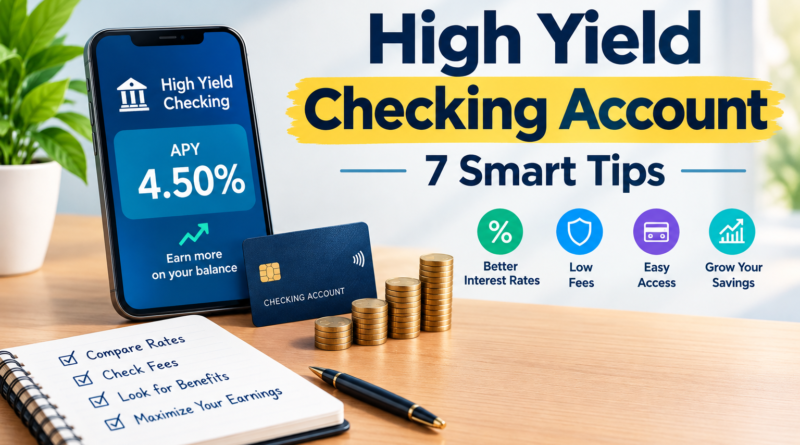
High Yield Checking Account: A Complete Guide to Earning More on Your Money
Introduction to High Yield Checking Accounts
A High Yield Checking Account is a type of bank account that allows you to manage your everyday money while earning interest on your balance. Unlike traditional checking accounts, which often pay little or no interest, high yield checking accounts may offer competitive annual percentage yields (APYs) that help your money grow over time.
Checking accounts are commonly used for receiving salaries, paying bills, purchasing groceries, transferring money, and handling everyday expenses. However, keeping money in a standard checking account may not provide much financial benefit beyond convenient access to your funds. A high yield checking account combines everyday banking features with the opportunity to earn interest.
For people who want their money to remain accessible while earning a return, this type of account can be an attractive option. Some accounts offer debit cards, online bill payments, mobile banking, direct deposit, and ATM access. Certain banks also provide additional benefits, such as low fees or early access to qualifying direct deposits.
However, high interest rates do not automatically make every account a good choice. Some banks require customers to complete specific activities, maintain certain balances, or receive a minimum number of debit card transactions to qualify for the advertised rate.
Understanding how these accounts work can help you compare options and select one that suits your financial needs. This guide explains the meaning of a high yield checking account, its benefits, possible drawbacks, eligibility requirements, and the factors to consider before opening one.
What Is a High Yield Checking Account?
A high yield checking account is a checking account that pays interest on deposited funds. The interest rate is generally expressed as an annual percentage yield, or APY, which reflects the effect of compounding over one year under stated assumptions.
The primary purpose of a checking account is to provide convenient access to money. Customers can usually deposit funds, withdraw cash, make electronic transfers, pay bills, and use a debit card for purchases. A high yield version offers these everyday banking services while providing an opportunity to earn interest.
For example, imagine you keep $5,000 in a checking account. A traditional account might pay little or no interest, while a high yield account could pay a higher rate if you meet its requirements. Over time, the interest earned can provide a small additional benefit without requiring you to invest your money in the stock market.
However, advertised rates and account features vary by financial institution. Some banks pay a competitive rate on the entire balance, while others apply the highest rate only to a limited amount of money. It is important to read the account terms carefully before making a decision.
How Is It Different From a Traditional Checking Account?
A traditional checking account is mainly designed for everyday transactions. It may offer convenient banking services but provide little interest on deposited money.
A high yield checking account serves a similar purpose but adds an interest-earning feature.
The main differences include:
- Interest earnings: High yield accounts may offer higher APYs than standard checking accounts.
- Account requirements: Some high yield accounts require qualifying transactions, direct deposits, or minimum balances.
- Fees: Monthly maintenance fees and other charges vary by bank.
- Balance limits: Some accounts offer their highest rate only on balances below a specified limit.
- Banking convenience: Both account types may provide debit cards, online banking, bill payments, and ATM access.
The best option depends on how you use your money and whether you can meet the requirements for earning interest.
How Does a High Yield Checking Account Work?
A high yield checking account works much like an ordinary checking account, with one important difference: the bank pays interest on eligible deposits.
After opening the account, you deposit money through direct deposit, electronic transfers, mobile check deposits, or other supported methods. You can then use the funds for regular expenses.
The bank calculates interest according to its account terms. Interest may accrue daily and be credited monthly, although the exact method and payment schedule depend on the institution.
Your earnings depend on several factors, including:
- The amount of money in your account.
- The APY offered by the bank.
- The length of time your money remains deposited.
- Whether you qualify for the advertised rate.
- Any applicable account fees.
Example of Interest Earnings
Suppose you deposit $5,000 into a high yield checking account offering a hypothetical 3% APY. Assume the rate remains unchanged for one year, you maintain the full balance, and no fees apply.
Your approximate earnings would be:
| Account detail | Amount |
|---|---|
| Initial deposit | $5,000 |
| Hypothetical APY | 3% |
| Approximate interest after one year | $150 |
| Balance after one year | $5,150 |
These figures are illustrative, not a current bank offer. Actual earnings depend on the account’s interest calculation, rate changes, qualifying conditions, and fees.
If the account requires qualifying debit card purchases or direct deposits and you do not meet those conditions, your actual earnings could be lower.
What Is APY?
APY stands for Annual Percentage Yield. It represents the annual return earned on a deposit after accounting for the effects of compounding.
For example, an account with a 2% APY is designed to earn approximately $20 over one year on a $1,000 balance if the rate remains unchanged and the account meets all requirements.
APY makes it easier to compare deposit accounts because it incorporates compounding. However, you should also compare fees, rate restrictions, and access to your funds.
Benefits of a High Yield Checking Account
High yield checking accounts can offer several advantages to people who want to manage daily expenses while earning interest.
1. Earn Interest on Everyday Money
One of the biggest advantages is earning interest on money that you might otherwise keep in a traditional checking account.
Many people maintain checking balances to cover rent, utility bills, groceries, transportation, and other regular expenses. A high yield account can help these funds generate some interest while remaining available for everyday use.
Although the earnings may not replace investment income, they can provide an additional financial benefit with relatively little effort.
2. Convenient Access to Your Funds
Unlike many investments, checking account funds are generally designed to remain accessible for routine transactions.
Depending on the account, you may be able to use a debit card, withdraw cash from ATMs, transfer money electronically, and pay bills online.
This convenience makes high yield checking accounts useful for people who want to earn interest without sacrificing ordinary banking access.
Nevertheless, ATM limits, withdrawal fees, transfer restrictions, and other conditions may apply.
3. Online and Mobile Banking
Many financial institutions offer digital banking tools that allow customers to manage their accounts from a computer or smartphone.
Common features include:
- Checking account balances.
- Reviewing recent transactions.
- Depositing checks through a mobile app.
- Scheduling bill payments.
- Transferring money between accounts.
- Receiving transaction alerts.
- Monitoring account activity.
These features can make it easier to organize finances and identify unexpected charges.
4. Potentially Lower Banking Costs
Some high yield checking accounts have no monthly maintenance fee. Others waive their fees when customers meet specific conditions.
Avoiding monthly fees can improve the overall value of an account.
For example, a $10 monthly maintenance fee would cost $120 over a year. If your account earns only $80 in interest, the fee would exceed your earnings.
This is why comparing the complete fee schedule is just as important as comparing interest rates.
5. Useful for Short-Term Financial Goals
A high yield checking account may be suitable for money you expect to use in the near future.
Examples include funds reserved for monthly expenses, upcoming purchases, insurance premiums, or a planned trip.
Because checking accounts are designed for regular transactions, they can provide flexibility when you need to spend the money.
For larger emergency savings or funds you do not need for daily transactions, a high yield savings account may offer a more suitable combination of interest and account features.
Disadvantages of High Yield Checking Accounts
Although these accounts can be useful, they also have limitations. Understanding the disadvantages helps you decide whether an account fits your financial situation.
1. Strict Qualification Requirements
Some banks advertise high APYs that are available only when customers complete certain activities.
Requirements may include receiving qualifying direct deposits, making a specified number of debit card purchases, enrolling in electronic statements, or meeting other conditions.
If you fail to qualify during a statement period, the bank may pay a much lower interest rate.
Before opening an account, confirm exactly what you must do to earn the advertised APY.
2. Limits on Eligible Balances
Some institutions offer their highest interest rate only on a limited balance.
For example, a hypothetical account might pay 4% APY on the first $10,000 but a much lower rate on the remaining balance. Keeping $20,000 in that account would not mean the entire amount earns 4%.
Check whether the APY applies to your whole balance or only to a specified portion.
3. Monthly and Transaction Fees
Some accounts charge maintenance fees, out-of-network ATM fees, overdraft fees, or other service charges.
These fees can reduce or eliminate the interest you earn.
A bank may also impose charges for particular services or account activities. Reviewing the account disclosure before applying can help you avoid unexpected costs.
4. Variable Interest Rates
Many high yield checking accounts have variable rates. The bank may change the APY based on market conditions or its own pricing decisions.
An account that offers an attractive rate today may offer less interest in the future.
If you choose an account based only on its current rate, your actual long-term earnings may differ from your expectations.
5. Potentially Lower Returns Than Other Options
High yield checking accounts are designed for banking convenience rather than maximum investment growth.
Depending on prevailing rates, a high yield savings account, certificate of deposit, or other suitable financial product may offer a different return.
However, these alternatives can have their own limitations. Certificates of deposit, for example, may impose early withdrawal penalties, while investments can lose value.
The right choice depends on when you need the money, how much risk you can accept, and whether you prioritize access or potential returns.
High Yield Checking Account vs. High Yield Savings Account
A high yield checking account and a high yield savings account both pay interest, but they serve somewhat different purposes.
A checking account is generally designed for frequent transactions. A savings account is primarily intended to help you set aside money for future needs.

High Yield Checking Account
- Designed for everyday spending.
- Often includes debit card and bill payment features.
- May require qualifying transactions to earn the highest APY.
- Useful for bills and frequently accessed funds.

High Yield Savings Account
- Designed primarily for saving money.
- May offer competitive interest rates.
- Often has fewer spending features than checking accounts.
- Useful for emergency savings and future goals.
Savings account withdrawal and transfer rules vary by institution and jurisdiction. Do not assume that every savings account has the same limits or restrictions.
Which Account Is Better?
A high yield checking account may be better if you want your everyday banking balance to earn interest while remaining available for regular spending.
A high yield savings account may be preferable if you want to separate savings from spending and are looking for a dedicated place to keep money for future expenses.
Some people benefit from maintaining both accounts. They can keep enough money in checking for routine expenses and transfer additional savings to a separate account.
This approach may help reduce unnecessary spending while keeping money organized.
High Yield Checking Account vs. Money Market Account
Money market deposit accounts are another option to consider when comparing interest-earning bank accounts.
Depending on the institution, a money market deposit account may offer a competitive APY, check-writing privileges, debit card access, or other transaction features.
However, the exact features differ between banks. Some money market accounts require a minimum opening deposit or minimum ongoing balance. Others may impose transaction limits or fees.
It is also important to distinguish a money market deposit account from a money market mutual fund. A bank deposit account may qualify for applicable deposit insurance, while a money market mutual fund is an investment and is not insured by the FDIC.
When comparing these products, evaluate the interest rate, access rules, fees, minimum balance, and applicable protections rather than relying on the account name alone.
How to Choose the Best High Yield Checking Account
Selecting the right account requires more than finding the highest advertised APY. Consider the following factors before applying.
1. Compare Annual Percentage Yields
Start by reviewing the APYs offered by several financial institutions.
Look for the rate available to someone with your expected balance and banking habits. Determine whether the advertised APY is available to all eligible customers or requires additional activities.
Also check whether the rate is variable and whether the bank can change it.
2. Review Monthly Maintenance Fees
An account with a high APY may not be worthwhile if it charges substantial fees.
Check whether monthly fees apply and whether you can avoid them. Also review charges for overdrafts, returned payments, ATM withdrawals, wire transfers, and other services you might use.
A low-fee account with a slightly lower APY can sometimes provide better overall value.
3. Understand Debit Card Requirements
Some high yield checking accounts require a minimum number of qualifying debit card purchases per month.
Before applying, confirm which transactions count. Certain transactions, such as ATM withdrawals, transfers, or prepaid card loads, may not qualify.
Choose an account whose requirements fit your normal spending habits. Avoid making unnecessary purchases simply to qualify for interest.
4. Check Minimum Balance Rules
Some banks require an opening deposit or minimum balance.
Others pay the highest rate only on balances below a specified limit.
Choose an account that works with the amount you can comfortably maintain without interfering with your bills or emergency needs.
5. Examine ATM Access
ATM access can be especially important if you regularly withdraw cash.
Check whether the bank operates its own ATM network, reimburses out-of-network ATM fees, or charges customers for certain withdrawals.
An account that earns more interest may be less convenient if accessing your money is expensive.
6. Evaluate Online Banking Features
Review the bank’s website and mobile app features.
Useful services may include mobile check deposits, bill payments, electronic transfers, transaction alerts, account statements, and customer support.
A straightforward digital experience can make it easier to manage your money and monitor activity.
7. Verify Deposit Insurance
If you are opening an account in the United States, verify that the bank is insured by the Federal Deposit Insurance Corporation (FDIC), or that the applicable credit union has qualifying National Credit Union Administration (NCUA) insurance.
Coverage applies to eligible deposits subject to the relevant rules and limits. For FDIC-insured banks, the standard coverage limit is generally $250,000 per depositor, per insured bank, per ownership category.
Deposit insurance does not protect against every possible financial loss, and investment products offered by a bank are not automatically insured deposits.
Customers outside the United States should check the deposit protection scheme and rules in their own country.
Who Should Consider a High Yield Checking Account?
A high yield checking account may be appropriate for people who want convenient access to money and the opportunity to earn interest.
People Who Maintain Regular Checking Balances
If you usually keep enough money in your checking account to cover bills and everyday expenses, an interest-paying account may help you earn something on that balance.
The benefit will depend on the amount you maintain and the APY you actually qualify for.
People Who Prefer Digital Banking
Customers who are comfortable using mobile apps and online banking may appreciate accounts that combine electronic transactions with interest earnings.
Digital features can make it easier to manage payments, review transactions, and transfer funds.
People Who Want to Avoid Unnecessary Fees
A no-monthly-fee high yield checking account may suit people who want to minimize banking costs while earning interest.
However, it is important to check all applicable fees rather than focusing exclusively on the monthly maintenance charge.
People Who Need Frequent Access to Their Money
If you regularly pay bills, make debit card purchases, or transfer money, a checking account may be more practical than a product designed for less frequent withdrawals.
High yield checking can provide a way to combine regular account access with interest earnings.
Who May Not Benefit From a High Yield Checking Account?
Not everyone needs this type of account.
People who rarely maintain a checking balance may earn very little interest. Those who cannot meet the qualifying requirements may also receive a lower return than expected.
Additionally, people who want to keep long-term savings separate from everyday spending may prefer a dedicated savings account.
If your main goal is long-term wealth growth, you may need to consider a broader financial plan that includes appropriate savings and investment options. A checking account alone is generally not a complete long-term investment strategy.
Common Mistakes to Avoid
Choosing a checking account without reviewing its terms can lead to unnecessary costs or disappointing returns.
Here are some common mistakes to avoid.
Focusing Only on the Advertised APY
The highest advertised rate is not always the best deal. It may apply only to a limited balance or require several qualifying activities.
Compare the APY you can realistically earn rather than the headline rate.
Ignoring Fees
Monthly charges and ATM fees can offset your interest earnings.
Calculate the likely cost of using the account based on your actual banking habits.
Missing Qualification Requirements
Failing to complete required debit card transactions or qualifying direct deposits may reduce the interest you receive.
Review the rules and monitor your progress during each relevant statement period.
Keeping Too Much Money in One Account
Although checking accounts are useful for everyday spending, keeping all your savings in a checking account may not be the most effective approach.
Consider maintaining an appropriate checking balance and placing money intended for emergencies or future goals in suitable savings products.
Overlooking Bank Security
Choose a reputable financial institution and use strong, unique passwords. Enable multifactor authentication when available, set account alerts, and review transactions regularly.
Never share your banking credentials through unsolicited emails, messages, or phone calls.
How to Open a High Yield Checking Account
Opening a high yield checking account is usually a straightforward process, although eligibility requirements vary by institution.
Step 1: Compare financial institutions. Research APYs, fees, account features, deposit insurance, and qualification requirements.
Step 2: Review eligibility. Check age, residency, identification, opening deposit, and any credit or banking history requirements that may apply.
Step 3: Complete the application. Many banks allow applications online, while others require an in-person visit.
Step 4: Provide the required information. Depending on the bank and country, you may need government-issued identification, contact details, tax identification information, and other verification documents.
Step 5: Fund the account. Transfer money from an existing bank account, make an eligible deposit, or use another supported funding method.
Step 6: Set up banking features. Activate your debit card, enroll in online banking, configure account alerts, and arrange direct deposit if appropriate.
Step 7: Meet the account requirements. If your APY depends on qualifying activities, follow the bank’s instructions and confirm that you meet the conditions.
Before transferring a large amount, make sure you understand the bank’s terms, deposit protection, transfer timing, and any applicable fees.
Strategies to Get the Most From Your Account
You can improve the value of a high yield checking account by using it thoughtfully.
First, maintain a balance that supports your regular spending without leaving excessive money idle. You should have enough for scheduled bills and a reasonable buffer for unexpected expenses.
Second, use direct deposit if it is convenient and helps you meet the bank’s requirements. Do not switch accounts solely for an advertised rate without confirming that the expected interest justifies the effort.
Third, monitor the APY periodically. If the bank lowers its rate or introduces new requirements, compare your account with other suitable options.
Fourth, avoid unnecessary transactions made only to qualify for interest. The cost of additional spending can easily exceed the benefit of earning a few extra dollars.
Finally, organize your finances around your goals. Your checking account can handle everyday spending, while separate savings accounts may help you prepare for emergencies, planned purchases, and other financial priorities.
Frequently Asked Questions About High Yield Checking Accounts
1. Is a High Yield Checking Account Worth It?
It can be worthwhile if you maintain a regular checking balance, qualify for the advertised APY, and avoid excessive fees. Compare the expected interest earnings with the account’s requirements and costs before opening one.
2. How Much Interest Can I Earn?
Your earnings depend on your balance, APY, and how long the money stays in the account. For example, $10,000 earning a hypothetical 2% APY could generate approximately $200 over one year if the rate remains unchanged, no fees apply, and you qualify for the rate.
3. Are High Yield Checking Accounts Safe?
Eligible deposits at properly insured institutions may receive protection under the applicable deposit insurance rules and limits. In the United States, qualifying deposits at FDIC-insured banks are generally insured up to $250,000 per depositor, per insured bank, per ownership category. Always verify the institution’s insurance status and understand which products are covered.
4. Can I Use a High Yield Checking Account for Everyday Expenses?
Yes. These accounts are generally designed for everyday banking. Depending on the institution, you may be able to use a debit card, pay bills, make electronic transfers, and withdraw cash.
5. Do High Yield Checking Accounts Have Monthly Fees?
Some have no monthly maintenance fee, while others charge a fee unless you meet specific requirements. Review the complete fee schedule before opening an account.
6. Is a High Yield Checking Account Better Than a Savings Account?
Neither is universally better. Checking accounts are generally more convenient for frequent transactions, while savings accounts are designed primarily for setting money aside. Compare the APY, access rules, fees, and features to determine which is more suitable.
7. Can the Interest Rate Change?
Yes. Many high yield checking accounts have variable interest rates. A bank may change its APY over time, so your future earnings may differ from your initial estimate.
8. Do I Need a Large Deposit to Open an Account?
Not necessarily. Some institutions have no minimum opening deposit, while others require an initial deposit or minimum balance. Check the account terms before applying.
Conclusion
A High Yield Checking Account can be a practical way to earn interest while keeping your money available for everyday banking. It may provide useful features such as debit card access, online bill payments, electronic transfers, and mobile banking, alongside the opportunity to earn more than a traditional checking account.
However, the value of an account depends on more than its advertised interest rate. Qualification requirements, balance limits, fees, ATM access, variable rates, and deposit insurance all deserve careful consideration.
Before opening an account, compare several institutions and calculate how much interest you could realistically earn after accounting for any fees. Choose an option that fits your banking habits and financial goals rather than selecting an account based only on its headline APY.
With careful comparison and regular account reviews, a high yield checking account can become a useful part of an organized personal finance strategy.
Read Next