
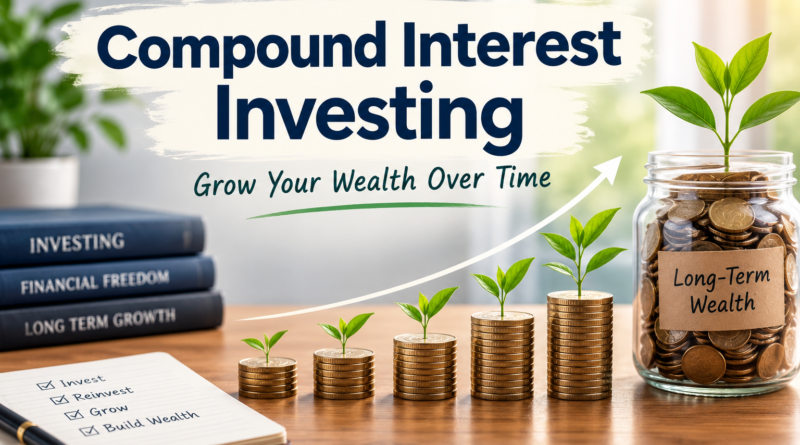
Compound Interest Investing: A Complete Guide to Growing Wealth
Compound interest investing is one of the most powerful concepts in personal finance and long-term wealth building. Instead of earning returns only on your original investment, compound growth allows your earnings to generate additional earnings over time. When this process continues for many years, even relatively small investments can potentially grow into a much larger amount.
The key to compound interest investing is not simply finding the highest possible return. Time, consistency, reinvestment, and patience all play important roles. The earlier an investor starts and the longer money remains invested, the more opportunity there is for compounding to work.
Whether you are a beginner or already investing for retirement, understanding compound interest can help you make better-informed financial decisions. This guide explains how compound interest works, why time matters, how regular contributions affect growth, and practical ways to use compounding as part of a long-term investment strategy.
What Is Compound Interest Investing?
Compound interest investing means allowing the returns generated by an investment to remain invested so that they can potentially generate additional returns.
With simple interest, returns are calculated only on the original amount. With compound growth, returns can accumulate on both the initial investment and previously earned returns.
For example, suppose you invest $1,000 and earn a hypothetical 8% annual return. After the first year, the investment could grow to $1,080. In the second year, the 8% return would apply to $1,080 rather than only the original $1,000.
Over many years, this difference can become significant.
The basic compound-growth formula is:
FV = PV(1 + r)^n
Where:
- FV = future value
- PV = present value or initial investment
- r = rate of return per period
- n = number of periods
In real investing, returns are not guaranteed, so an actual investment may grow faster, slower, or decline during some periods.
How Does Compound Interest Work in Investing?
Compounding happens when investment earnings are reinvested instead of being withdrawn.
Imagine you invest $5,000 and the investment earns a hypothetical 7% return in a year. The account could increase to approximately $5,350. If the next year’s return is also 7%, the calculation applies to the larger balance.
This creates a snowball effect.
The basic process is:
- You invest an initial amount.
- Your investment generates returns.
- Those returns remain invested.
- The larger balance generates additional returns.
- The process continues over time.
The longer this cycle continues, the more important the compounding effect can become.
A Simple Example
Consider an investor who puts $10,000 into a hypothetical investment earning an average annual return of 7%.
If the investor leaves the money invested and does not withdraw the gains, the balance could grow substantially over several decades.
The important point is that the investor does not need to contribute all of the eventual wealth personally. A portion of the growth comes from returns earned on earlier returns.
This is why compound interest investing is closely associated with long-term investing.
Why Time Is So Important for Compound Interest Investing
Time is one of the biggest factors affecting compound growth.
An investment that compounds for 30 years has considerably more opportunity to grow than one that compounds for 10 years, assuming the same hypothetical rate and other conditions.
For example, consider two investors:
- Investor A starts investing at age 25.
- Investor B starts investing at age 40.
Even if both eventually invest substantial amounts, the earlier investor has more years for contributions and returns to compound.
This does not mean someone who starts later cannot build wealth. It simply means investors who begin earlier have more time available for the compounding process.
The Value of Starting Early
Starting early can be valuable because investors have more time to experience both positive and negative market periods.
For long-term investors, market fluctuations may become less significant when viewed over several decades, although investment risk never disappears.
The main lesson is simple:
Time in the market can matter greatly because compounding needs time to develop.
Compound Interest vs. Simple Interest
Understanding the difference between simple and compound interest can make the concept easier to understand.
| Feature | Simple Interest | Compound Growth |
|---|---|---|
| Return calculated on | Original principal | Principal plus accumulated earnings |
| Reinvestment | Usually not part of the calculation | Earnings remain invested |
| Long-term effect | More linear | Can accelerate over time |
| Common relevance | Certain loans and financial calculations | Savings and investments |
| Effect of time | More predictable | Increasingly significant |
In investing, returns can fluctuate rather than arriving at a fixed interest rate every year. Therefore, compound interest is best understood as a mathematical concept that illustrates how reinvested returns can produce additional growth.
The Role of Regular Contributions
Initial investments are only one part of compound interest investing. Regular contributions can make a major difference.
Suppose an investor contributes $200 every month to a long-term investment account. Each contribution has the opportunity to earn returns, and those returns may themselves generate additional returns.
This creates two potential sources of growth:
- Money contributed by the investor
- Returns generated by the investments
Over many years, regular contributions can significantly increase the amount invested.
Monthly Investing Example
Imagine investing $250 every month for 30 years at a hypothetical average annual return of 7%.
The investor would contribute:
$250 × 12 × 30 = $90,000
The final value could be considerably higher than the amount personally contributed because investment returns have had decades to compound.
Actual results will vary because market returns are uncertain and investment costs, taxes, inflation, and account rules can affect outcomes.
Compound Interest Investing and Reinvestment
Reinvestment is an important part of compounding.
For example, some investments may generate dividends or interest payments. If those payments are taken out and spent, they are no longer available to generate additional returns.
If they are reinvested, they can purchase additional investments or increase the amount earning returns.
Reinvesting Dividends
Dividend-paying investments can demonstrate this concept clearly.
Suppose an investment pays dividends. An investor can potentially:
- Take the dividend as cash
- Reinvest the dividend
- Use it for another financial goal
When dividends are reinvested, the investor may own more shares or units. Those additional holdings can potentially generate future dividends.
Dividend reinvestment does not guarantee profit, and dividend payments can change or be reduced.
Compound Interest Investing for Beginners
Beginners do not need a complicated strategy to understand compounding.
A simple approach is to focus on several fundamentals.
1. Start With a Manageable Amount
You do not necessarily need a large amount of money to begin learning about investing.
A small, consistent contribution can help develop an investing habit.
2. Invest Regularly
Consistency can be more practical than trying to predict the perfect time to invest.
For example, an investor might contribute a fixed amount every month.
3. Reinvest Returns
Where appropriate, keeping investment earnings invested can help support compounding.
4. Think Long Term
Compounding works over time. Constantly moving investments in response to short-term market movements can interfere with a long-term strategy.
5. Understand Risk
Higher potential returns generally come with greater investment risk. Before investing, understand what you are buying and how much loss you could potentially tolerate.
Investments That Can Benefit From Compounding
Different types of investments can provide opportunities for reinvested growth.
Stocks
Stocks can generate returns through price appreciation and, for some companies, dividends.
Over long periods, diversified stock-market investments have historically provided opportunities for growth, but stocks can also lose substantial value.
Index Funds
Index funds generally seek to track a market index. They can provide broad exposure to many companies or securities through one investment.
When dividends and distributions are reinvested, investors can potentially benefit from compounding.
ETFs
Exchange-traded funds can hold a collection of stocks, bonds, or other securities.
Some ETFs distribute dividends or other income that investors may choose to reinvest.
Bonds
Bonds can generate interest income. Depending on the investment and account, interest may be reinvested to create additional earning potential.
However, bonds have their own risks, including interest-rate risk and credit risk.
Savings Accounts and Certificates of Deposit
Bank savings products can also demonstrate compound interest because interest may be added to the account balance.
These products generally have different risk and return characteristics from stocks and other market investments.
How Compound Interest Is Affected by Investment Returns
The assumed rate of return has a major effect on a compound-growth calculation.
For example, consider a hypothetical $10,000 investment:
- At 4% for 30 years, the result is much different from
- 7% for 30 years, which is different again from
- 10% for 30 years.
However, investors should be careful when using high assumed returns in financial projections.
A higher expected return usually comes with greater uncertainty and risk. Investment returns are not guaranteed, and actual annual performance can vary substantially.
Instead of focusing only on achieving a particular return, investors should consider diversification, costs, taxes, risk tolerance, and investment time horizon.
The Impact of Fees on Compound Growth
Investment fees can reduce long-term returns.
A small annual fee may appear insignificant, but over decades, the money paid in fees is money that is no longer invested.
For example, if two similar investments have different expense ratios, the lower-cost option may leave more money invested over time, assuming the investments otherwise perform similarly.
Before investing, review:
- Expense ratios
- Account fees
- Trading costs
- Advisory fees
- Fund management fees
- Tax implications
Reducing unnecessary costs can help preserve more of the money available for compounding.
Compound Interest Investing and Inflation
Compound growth should also be considered alongside inflation.
If an investment grows by 7% but inflation averages 3%, the investor’s purchasing power has not increased by the full 7%.
This is why investors often consider both:
- Nominal return: the stated investment return
- Real return: return after accounting for inflation
Long-term wealth building is ultimately about purchasing power, not just the number displayed in an investment account.
Common Mistakes to Avoid
Compound interest investing sounds simple, but several mistakes can reduce its potential benefits.
Starting Too Late
Waiting many years before beginning can reduce the amount of time available for compounding.
Frequently Withdrawing Earnings
Taking money out of an investment can reduce the balance available to generate future returns.
Chasing High Returns
Investors sometimes focus heavily on investments promising unusually high returns. Higher potential returns generally involve higher risks.
Ignoring Fees
Investment costs can reduce the amount available for long-term growth.
Taking Too Much Risk
An investment that experiences large losses can significantly reduce the capital available for future compounding.
Failing to Diversify
Putting too much money into one company, sector, or asset can increase concentration risk.
Expecting Guaranteed Returns
Stock-market returns are not guaranteed. Past performance does not ensure future results.
How to Start Compound Interest Investing
If you want to incorporate compounding into a long-term investment plan, consider the following steps.
Step 1: Establish an Emergency Fund
Before investing aggressively, consider maintaining an emergency fund appropriate for your circumstances.
An emergency fund can reduce the need to sell investments unexpectedly when an unexpected expense occurs.
Step 2: Pay Attention to High-Interest Debt
High-interest debt can make it difficult to build wealth. Compare the cost of debt with the potential return from investments before deciding how to allocate extra money.
Step 3: Set a Clear Goal
Your investment strategy may depend on your objective.
Common goals include:
- Retirement
- Education
- Home purchase
- Long-term wealth building
- Financial independence
Step 4: Choose an Appropriate Investment
Consider your time horizon, risk tolerance, diversification needs, and costs.
Step 5: Automate Contributions
Automatic investing can make regular contributions easier to maintain.
Step 6: Reinvest When Appropriate
If your investment generates dividends or interest, consider whether reinvesting those earnings fits your financial plan.
Step 7: Review Your Strategy
Review your portfolio periodically rather than reacting emotionally to every market movement.
Compound Interest Investing for Retirement
Retirement investing is one of the clearest applications of compounding.
A person who invests consistently for several decades may have multiple sources of growth:
- Regular contributions
- Investment returns
- Reinvested dividends
- Reinvested interest
- Employer contributions, where applicable
The earlier retirement investing begins, the more time investments potentially have to compound.
However, retirement planning should also account for inflation, taxes, fees, changing income, expected expenses, and investment risk.
How to Maximize the Potential of Compound Growth
There is no guaranteed way to maximize investment returns, but investors can take practical steps to support long-term compounding.
Invest Consistently
Regular contributions can keep money entering the investment portfolio over time.
Keep Costs Reasonable
Lower investment costs can leave more capital invested.
Reinvest Earnings
Reinvesting eligible dividends and interest can increase the amount working for you.
Maintain Diversification
A diversified portfolio can spread exposure across different investments and reduce dependence on a single asset.
Avoid Emotional Decisions
Markets can rise and fall. Making frequent decisions based solely on short-term movements can undermine a long-term investment approach.
Increase Contributions Over Time
If income increases, consider whether part of the additional income can be directed toward long-term investments.
A Long-Term Compound Interest Investing Example
Consider three hypothetical investors.
Investor A invests $100 per month for 10 years.
Investor B invests $100 per month for 20 years.
Investor C invests $100 per month for 30 years.
All three contribute the same monthly amount, but Investor C gives the money much more time to potentially compound.
This illustrates an important principle: time can be more powerful than simply trying to find a higher return.
The example does not guarantee a specific investment outcome. Actual returns vary from year to year.
Is Compound Interest Investing Safe?
Compound interest itself is a mathematical concept, not an investment product.
Whether an investment is safe depends on the underlying asset.
For example:
- A federally insured bank deposit may have different risks from stocks.
- Government bonds have different risks from corporate bonds.
- Diversified stock funds have different risks from individual stocks.
- High-growth investments can experience significant price fluctuations.
Therefore, investors should evaluate the underlying investment rather than assuming that anything described as “compound interest” is automatically safe.
Compound Interest Investing vs. Trading
Long-term investing and short-term trading have different approaches.
Compound interest investing generally emphasizes:
- Long-term ownership
- Reinvestment
- Consistent contributions
- Patience
- Diversification
- Long-term goals
Short-term trading generally focuses more on:
- Price movements
- Market timing
- Short-term opportunities
- Frequent buying and selling
Compounding can occur in long-term investing, but it is not limited to one particular investment strategy.
Frequently Asked Questions
What is compound interest investing?
Compound interest investing is the process of keeping investment earnings invested so that those earnings can potentially generate additional returns over time.
How does compound interest make money?
Compounding allows returns to become part of the investment balance. Future returns can then be calculated on the larger balance.
Is compound interest guaranteed?
No. The mathematical effect of compounding is predictable when the rate is fixed, but investment returns in assets such as stocks are not guaranteed.
How long does compound interest take to work?
There is no specific time period. The effect depends on the investment return, starting amount, contributions, fees, taxes, and length of time invested.
Can you compound money with stocks?
Yes. Stock investments can potentially compound through price appreciation and reinvested dividends, although stock returns are not guaranteed.
Is monthly investing good for compound growth?
Regular investing can provide more money with which to potentially earn returns. The longer those contributions remain invested, the more opportunity there is for compounding.
What is the biggest advantage of compound interest investing?
One major advantage is that previously earned returns can remain invested and potentially generate additional returns over time.
Can compound interest make you rich?
Compounding can contribute significantly to long-term wealth building, but it does not guarantee wealth. Results depend on investment returns, contributions, time, costs, taxes, and market conditions.
Final Thoughts on Compound Interest Investing
Compound interest investing is fundamentally about allowing money and its potential earnings to remain invested for the long term. The combination of time, consistent contributions, reinvestment, and reasonable investment costs can create a powerful growth effect.
For beginners, the most important lesson is not to become obsessed with finding the perfect investment or the highest possible return. Instead, focus on understanding risk, investing consistently, maintaining diversification, controlling unnecessary costs, and giving your investments sufficient time to grow.
Compounding does not eliminate investment risk, and it cannot guarantee a specific financial outcome. Markets fluctuate, returns vary, and losses are possible. But by understanding how compounding works and incorporating it thoughtfully into a long-term financial plan, investors can better understand the potential of putting their money to work over time.
REad NexT