
Asset Allocation: A Complete Guide to Building a Balanced Investment Portfolio
Asset allocation is one of the most important concepts in investing because it helps investors decide how to divide their money among different types of investments. Instead of putting all your money into one asset, asset allocation spreads investments across categories such as stocks, bonds, cash, real estate, and other assets.
The goal is not simply to own many investments. The goal is to create a portfolio that matches your financial goals, investment time horizon, and ability to handle market risk. A carefully planned asset allocation strategy can help investors manage volatility while maintaining opportunities for long-term growth.
Whether you are a beginner building your first portfolio or an experienced investor reviewing an existing investment plan, understanding asset allocation can help you make more informed financial decisions.
What Is Asset Allocation?
Asset allocation is the process of dividing an investment portfolio among different asset classes. Common asset classes include:
- Stocks
- Bonds
- Cash and cash equivalents
- Real estate
- Commodities
- Other alternative investments
Each asset class behaves differently under different economic and market conditions. Stocks may provide strong long-term growth but can experience significant price fluctuations. Bonds can provide income and may be less volatile than stocks, while cash generally provides stability and liquidity.
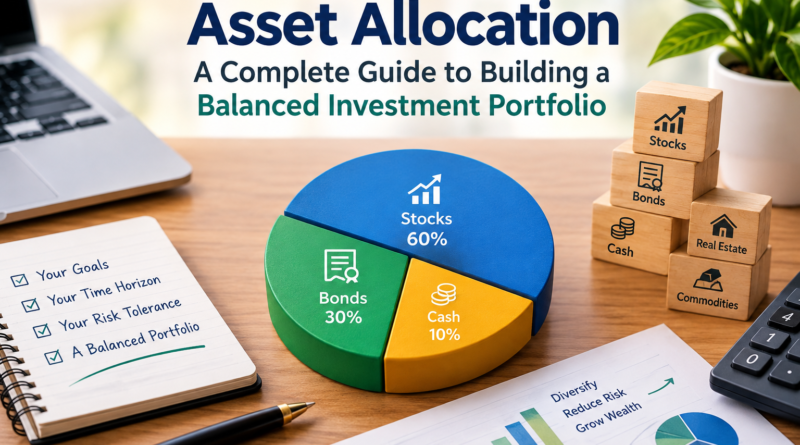
For example, an investor might create a portfolio containing 60% stocks, 30% bonds, and 10% cash. Another investor with a shorter investment horizon might choose a more conservative allocation.
There is no single asset allocation that works for everyone. The appropriate mix depends on individual circumstances.
Why Is Asset Allocation Important?
Asset allocation matters because different investments have different levels of risk and return potential.
If an investor puts all of their money into one asset class, the portfolio can become highly dependent on the performance of that particular investment category.
For example, a portfolio consisting entirely of stocks could experience a large decline during a major stock market downturn. A portfolio containing stocks, bonds, and cash may have different performance characteristics because the assets do not always move in exactly the same direction.
Asset allocation can help investors:
- Spread investment risk
- Manage portfolio volatility
- Match investments with financial goals
- Maintain liquidity
- Create a disciplined investment strategy
- Avoid excessive concentration in one asset class
However, diversification and asset allocation cannot eliminate investment risk or guarantee profits.
Major Asset Classes
Understanding the major asset classes is an important part of creating an investment portfolio.
1. Stocks
Stocks represent ownership in companies. Investors can potentially earn returns through increases in share prices and dividends.
Stocks generally have higher growth potential than cash and many bonds over long periods, but they can also experience significant short-term volatility.
Stocks may be appropriate for investors who have a longer time horizon and can tolerate market fluctuations.
2. Bonds
Bonds are debt securities issued by governments, corporations, or other entities. Investors generally receive interest payments and the return of principal according to the terms of the bond.
Bonds can provide income and may help balance the volatility of a stock-heavy portfolio. However, bonds are not risk-free. Interest-rate risk, credit risk, inflation risk, and other factors can affect their value.
3. Cash and Cash Equivalents
Cash includes money held in savings accounts and other highly liquid instruments. Cash equivalents may include certain short-term securities.
Cash generally offers greater stability and liquidity than stocks, but its purchasing power can decline over time because of inflation.
Cash can be useful for:
- Emergency reserves
- Short-term financial goals
- Planned expenses
- Portfolio stability
4. Real Estate
Real estate can provide potential rental income and long-term appreciation. Investors can gain exposure through direct property ownership or through securities such as real estate investment trusts (REITs).
Real estate can diversify a portfolio, but property investments may have liquidity, financing, valuation, and market risks.
5. Commodities
Commodities include assets such as gold, oil, agricultural products, and other raw materials.
Some investors use commodities as a way to diversify their portfolios or gain exposure to assets that can behave differently from traditional stocks and bonds.
However, commodity prices can be highly volatile and may be influenced by economic conditions, supply and demand, geopolitical developments, and currency movements.
How Asset Allocation Works
A simple asset allocation strategy begins by determining how much of a portfolio should be invested in each major asset class.
For example:
| Asset Class | Example Allocation |
|---|---|
| Stocks | 60% |
| Bonds | 30% |
| Cash | 10% |
If an investor has a $10,000 portfolio, this allocation would mean approximately:
- $6,000 in stocks
- $3,000 in bonds
- $1,000 in cash
The percentages are only an illustration. Investors should consider their own goals, time horizon, and risk tolerance before selecting an allocation.
Asset Allocation and Risk Tolerance
Risk tolerance refers to how much investment loss or volatility an investor can emotionally and financially handle.
Two people with the same income can have very different risk tolerances.
For example, one investor may be comfortable seeing their portfolio decline significantly during a market correction because they have decades before retirement. Another investor may need the money within a few years and therefore prefer less exposure to volatile investments.
A useful way to think about risk tolerance is to consider both:
Financial capacity for risk: How much loss can you afford without damaging your financial situation?
Emotional tolerance for risk: How comfortable are you with seeing the value of your investments fluctuate?
Both factors matter when designing an asset allocation strategy.
Asset Allocation and Investment Time Horizon
Your investment time horizon is the amount of time before you expect to need the money.
A longer time horizon may allow an investor to tolerate more short-term market volatility because there is more time for the portfolio to potentially recover from downturns.
For example, someone investing for a retirement that is several decades away may have different asset allocation considerations than someone saving for a home purchase within three years.
Generally, short-term goals require greater attention to capital preservation and liquidity, while long-term goals may allow more exposure to growth-oriented assets.
Aggressive Asset Allocation
An aggressive portfolio generally has a larger allocation to stocks and other growth-oriented investments.
An illustrative aggressive allocation might be:
- 80% stocks
- 15% bonds
- 5% cash
The primary objective is long-term growth, but the portfolio may experience substantial short-term volatility.
This type of allocation may be considered by investors with long time horizons and a relatively high tolerance for market fluctuations.
Moderate Asset Allocation
A moderate portfolio attempts to balance growth and stability.
For example:
- 60% stocks
- 30% bonds
- 10% cash
This type of portfolio provides meaningful exposure to growth assets while maintaining a larger allocation to relatively stable investments.
The exact percentages can vary depending on the investor and financial objective.
Conservative Asset Allocation
A conservative portfolio generally places more emphasis on stability and income than aggressive growth.
An illustrative allocation could be:
- 30% stocks
- 50% bonds
- 20% cash
A conservative allocation may be relevant to investors with shorter time horizons or lower tolerance for investment volatility.
However, conservative investing still carries risks, including inflation risk and interest-rate risk.
Strategic Asset Allocation
Strategic asset allocation involves establishing long-term target percentages for different asset classes and periodically adjusting the portfolio back toward those targets.
For example, an investor may establish a target allocation of:
- 70% stocks
- 25% bonds
- 5% cash
If stocks perform strongly, the portfolio could eventually become 80% stocks. The investor may then rebalance by reducing some stock exposure and adding to other asset classes.
The purpose is to maintain the intended level of portfolio risk rather than allowing market performance to determine the allocation indefinitely.
Tactical Asset Allocation
Tactical asset allocation involves temporarily changing the portfolio’s allocation based on market conditions, economic expectations, or other factors.
For example, an investor might temporarily reduce stock exposure and increase bonds because they believe market conditions have changed.
This approach requires more active decision-making than strategic asset allocation.
Tactical strategies can be difficult to execute consistently because market movements are unpredictable. Investors considering this approach should understand the costs, risks, and potential consequences of frequent portfolio changes.
How to Choose an Asset Allocation Strategy
Choosing an appropriate allocation requires more than selecting a popular percentage.
Consider the following factors.
1. Define Your Financial Goals
Start by identifying what you are investing for.
Your goals might include:
- Retirement
- Buying a home
- Education
- Building long-term wealth
- Creating an income stream
- Funding a major future expense
Different goals can require different investment approaches.
2. Determine Your Time Horizon
Ask yourself when you expect to need the money.
Money needed soon generally requires more attention to liquidity and stability. Money invested for decades may have greater capacity for market fluctuations.
3. Evaluate Your Risk Tolerance
Think about how you would react if your portfolio declined substantially during a market downturn.
If a large decline would cause you to sell investments in panic, an extremely aggressive allocation may not be suitable for your situation.
4. Consider Your Financial Situation
Your income, emergency savings, debt, financial obligations, and other resources can influence how much investment risk you can reasonably take.
Investing should generally be considered as part of a broader financial plan rather than in isolation.
5. Diversify Within Asset Classes
Asset allocation is not only about dividing money between stocks and bonds.
Diversification can also occur within each asset class.
For example, a stock allocation can be diversified across:
- Different companies
- Industries
- Geographic regions
- Company sizes
- Investment styles
Similarly, a bond allocation can vary by issuer, maturity, and credit characteristics.
Asset Allocation vs. Diversification
Asset allocation and diversification are related but not identical.
Asset allocation determines how much money goes into different asset classes.
Diversification involves spreading investments within and across those categories to reduce concentration risk.
For example, a portfolio containing 70% stocks and 30% bonds represents an asset allocation. Owning stocks from multiple industries and countries within that 70% is diversification.
Using both approaches can help create a more balanced portfolio.
What Is Portfolio Rebalancing?
Portfolio rebalancing is the process of returning a portfolio to its intended asset allocation.
Suppose your target allocation is:
- 60% stocks
- 30% bonds
- 10% cash
After a strong stock market period, your portfolio might become:
- 70% stocks
- 22% bonds
- 8% cash
The portfolio now has more stock exposure than originally planned.
Rebalancing could involve selling some assets that have become overweight and adding to assets that have become underweight.
The objective is to restore the portfolio to its intended allocation.
How Often Should You Rebalance?
There is no universal rebalancing schedule.
Some investors rebalance at regular intervals, such as annually or semiannually. Others use threshold-based rebalancing, meaning they rebalance when an asset class moves a certain percentage away from its target.
For example, an investor could decide to review the portfolio whenever an asset class moves 5 percentage points away from its target.
Taxes, transaction costs, account type, and investment strategy should be considered before making changes.
Example of Asset Allocation for a Beginner
Imagine a 30-year-old investor who has a long-term retirement goal and is comfortable with moderate market volatility.
One hypothetical portfolio could contain:
- 65% diversified stocks
- 30% bonds
- 5% cash
The investor could review the portfolio periodically and rebalance when the allocation moves significantly away from the target.
This is only an educational example. A real portfolio should reflect the investor’s specific circumstances.
Asset Allocation for Retirement
Asset allocation becomes particularly important when planning for retirement.
During the accumulation phase, investors often focus on long-term growth. As retirement approaches, the potential impact of a large market decline can become more significant because the investor may soon need to withdraw money.
Some investors gradually reduce portfolio volatility as retirement approaches, although the appropriate allocation depends on factors such as:
- Retirement age
- Expected expenses
- Other sources of income
- Savings level
- Expected withdrawal rate
- Longevity
- Risk tolerance
Retirement investing should therefore be reviewed as a long-term plan rather than based on a single percentage.
Common Asset Allocation Mistakes
Putting Everything Into One Asset
Concentrating an entire portfolio in a single company, sector, or asset class can create substantial risk.
Ignoring Time Horizon
Using the same allocation for a short-term goal and a decades-long goal may not make sense because the investor has different time constraints.
Changing Allocation Based on Emotions
Selling investments during market declines or aggressively buying after strong rallies can cause investors to move away from their long-term strategy.
Forgetting to Rebalance
A portfolio can gradually become much more aggressive or conservative than intended if it is never reviewed.
Taking More Risk Than Necessary
Higher potential returns generally come with higher risk. Investors should avoid taking more risk simply because an asset has recently performed well.
Ignoring Fees and Taxes
Investment expenses, trading costs, and taxes can affect long-term returns. These factors should be considered when changing an investment portfolio.
Asset Allocation Using Index Funds and ETFs
Many investors use index funds and exchange-traded funds (ETFs) to implement their asset allocation.
For example, instead of purchasing dozens of individual stocks, an investor may use a diversified stock index fund. A bond fund can provide exposure to a broad group of bonds.
This approach can simplify portfolio construction and diversification.
However, investors should review each fund’s holdings, fees, objectives, risks, and tax characteristics before investing.
Asset Allocation for Different Financial Goals
A single investor may have multiple financial goals, and each goal can have its own investment strategy.
For example:
Emergency savings: Primarily focused on liquidity and stability.
Home purchase in two years: May require a relatively conservative approach because the money will be needed soon.
Retirement in 30 years: May provide greater flexibility to include growth-oriented investments.
This approach is sometimes called goal-based investing. Instead of treating all money as one portfolio, investors consider the purpose and time horizon of each pool of money.
How to Review Your Asset Allocation
Reviewing your portfolio does not necessarily mean making frequent changes.
A periodic review can include:
- Checking your current asset percentages.
- Comparing them with your target allocation.
- Reviewing changes in your financial goals.
- Reassessing your time horizon.
- Considering changes in your risk tolerance.
- Reviewing investment fees and taxes.
- Rebalancing if appropriate.
A major life event may also justify reviewing your investment strategy.
Frequently Asked Questions About Asset Allocation
What is asset allocation in simple terms?
Asset allocation means deciding how to divide your investment money among different asset classes, such as stocks, bonds, and cash.
What is a good asset allocation?
There is no single allocation that is appropriate for every investor. The right mix depends on factors such as financial goals, time horizon, risk tolerance, and financial circumstances.
Is asset allocation the same as diversification?
No. Asset allocation determines the percentage invested in different asset classes, while diversification spreads investments to reduce concentration within those assets.
Can asset allocation reduce investment risk?
Asset allocation can help manage portfolio risk by spreading investments among different asset classes. However, it cannot eliminate investment losses.
Should beginners use asset allocation?
Understanding asset allocation can be useful for beginners because it provides a framework for building a diversified portfolio around specific financial goals.
How often should I review my asset allocation?
Many investors review their allocation periodically and after major financial changes. The appropriate review schedule depends on the investor’s strategy and circumstances.
Final Thoughts
Asset allocation provides a framework for building an investment portfolio that balances growth opportunities, stability, liquidity, and risk. Instead of focusing on one investment, investors can consider how different asset classes work together within a broader financial plan.
The most important factors are your financial goals, investment time horizon, risk tolerance, and overall financial situation. A portfolio should also be reviewed periodically because market performance and personal circumstances can change over time.
A disciplined asset allocation strategy can help investors avoid excessive concentration and maintain a clear long-term investment plan. However, asset allocation does not guarantee profits, and every investment carries some level of risk.
For investors building long-term wealth, the key is not simply choosing a percentage of stocks or bonds. It is creating an allocation that fits the purpose of the money and maintaining that strategy with discipline.
Read Next