
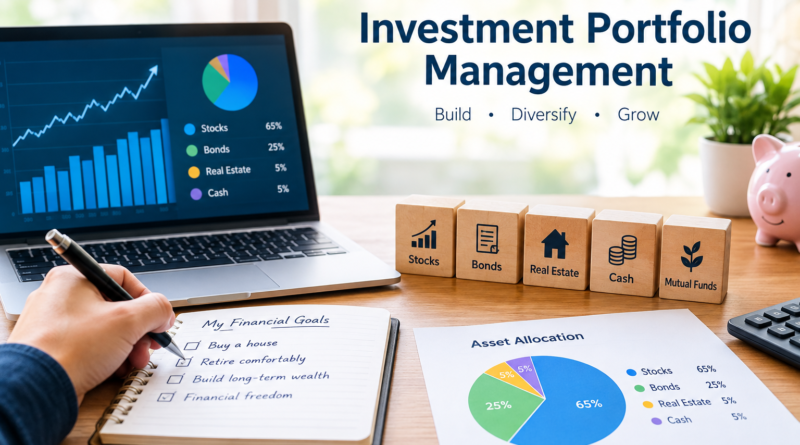
Investment Portfolio Management: A Complete Guide
Investment portfolio management is the process of selecting, organizing, monitoring, and adjusting investments to help achieve specific financial goals. A well-managed portfolio can include stocks, bonds, mutual funds, ETFs, real estate investments, cash, and other assets depending on an investor’s goals, risk tolerance, and time horizon.
Managing a portfolio is not simply about buying investments that appear attractive. It involves creating a strategy, spreading risk across different assets, reviewing performance, and making adjustments when financial circumstances or market conditions change.
Whether you are a beginner building your first portfolio or an experienced investor managing several investments, understanding portfolio management can help you make more structured financial decisions.
What Is Investment Portfolio Management?
Investment portfolio management refers to the ongoing process of managing a collection of investments. The main objective is to balance potential returns with an appropriate level of risk while working toward financial goals.
A portfolio may contain several types of investments, such as:
- Stocks
- Bonds
- Exchange-traded funds (ETFs)
- Mutual funds
- Cash and cash equivalents
- Real estate investments
- Certificates of deposit
- Other investment assets
Portfolio management involves deciding how much money should be allocated to each asset class. This process is often called asset allocation.
For example, an investor with a long-term goal may choose a portfolio containing a larger percentage of stocks and a smaller percentage of bonds and cash. Someone with a shorter time horizon may prefer a more conservative allocation.
The right portfolio depends on the individual investor rather than one universal formula.
Why Investment Portfolio Management Matters
Managing investments without a clear strategy can make it difficult to understand whether your portfolio is actually moving toward your financial goals.
Effective portfolio management can help investors:
- Organize their investments
- Control portfolio risk
- Diversify across different assets
- Maintain an appropriate asset allocation
- Track investment performance
- Reduce emotional investment decisions
- Adjust investments as goals change
- Stay focused on long-term objectives
A portfolio can also become unbalanced over time. For example, if stocks perform strongly, they may become a much larger percentage of the portfolio than originally intended.
Regular portfolio reviews can help identify these changes and determine whether adjustments are appropriate.
Key Components of Investment Portfolio Management
Investment portfolio management includes several important components. Understanding each one can make the overall process easier.
1. Setting Financial Goals
The first step is determining what you are investing for.
Common financial goals include:
- Retirement
- Buying a home
- Education expenses
- Building long-term wealth
- Creating an emergency reserve
- Generating future income
- Saving for a major purchase
Your goal affects how your portfolio should be structured.
For example, money needed within a few years may require a different strategy from money being invested for retirement several decades away.
2. Understanding Risk Tolerance
Risk tolerance refers to how much investment volatility and potential loss you can reasonably handle.
Some investors are comfortable with significant short-term price fluctuations in exchange for potentially higher long-term returns. Others prefer investments with lower volatility, even if their potential returns may also be lower.
Risk tolerance can depend on:
- Income
- Savings
- Investment experience
- Financial obligations
- Age
- Time horizon
- Personal comfort with market losses
It is important to distinguish between the amount of risk you are willing to take and the amount of risk you can financially afford to take.
3. Determining Your Time Horizon
Your investment time horizon is the period before you expect to need the money.
A long-term investor may have decades to recover from temporary market declines. A short-term investor may have much less time.
For example:
| Investment Goal | Possible Time Horizon |
|---|---|
| Short-term purchase | Less than 3 years |
| Medium-term goal | 3–10 years |
| Retirement investing | 10+ years |
| Long-term wealth building | 10–30+ years |
These are general examples rather than fixed rules. Individual circumstances should determine the appropriate strategy.
Asset Allocation in Portfolio Management
Asset allocation is one of the most important parts of investment portfolio management.
It involves dividing investments among different asset classes.
A portfolio might include:
- 60% stocks
- 30% bonds
- 10% cash
Another investor could have a completely different allocation based on their goals and risk profile.
Stocks
Stocks provide ownership in companies and can offer long-term growth potential. However, stock prices can fluctuate significantly.
Stocks may be suitable for investors who have a longer investment horizon and can tolerate market volatility.
Bonds
Bonds generally represent loans made to governments or companies. They can provide interest income and may help diversify a portfolio.
However, bonds are not risk-free. Bond prices can be affected by interest rates, credit conditions, inflation, and other factors.
Cash and Cash Equivalents
Cash and cash equivalents can provide stability and liquidity. They may be useful for short-term needs and emergency reserves.
The trade-off is that cash may have lower long-term growth potential than investments such as stocks.
Real Estate and Other Assets
Some investors include real estate or other assets to diversify their portfolios. These investments can have different risk, liquidity, and return characteristics.
Before adding an asset class, investors should understand how it behaves and how it fits within their overall financial plan.
What Is Diversification?
Diversification means spreading investments across different assets, companies, industries, regions, or investment categories.
The basic idea is to avoid relying too heavily on a single investment.
For example, an investor who owns shares in only one company could experience a major portfolio loss if that company performs poorly.
A diversified portfolio might instead contain:
- Multiple companies
- Different industries
- Domestic and international investments
- Stocks and bonds
- Different types of funds
Diversification does not eliminate investment risk, and a diversified portfolio can still lose value during market declines. However, spreading exposure can reduce the impact of problems affecting a single investment.
Portfolio Construction
Portfolio construction is the process of putting an investment strategy into practice.
A simple portfolio construction process can involve the following steps:
Step 1: Identify Your Goals
Write down the purpose of each investment account and when you expect to need the money.
Step 2: Determine Your Risk Profile
Consider both your financial ability and emotional comfort with investment losses.
Step 3: Choose an Asset Allocation
Determine how much exposure you want to stocks, bonds, cash, and other assets.
Step 4: Select Investments
Choose individual securities or diversified funds that fit the selected allocation.
Step 5: Monitor the Portfolio
Review the portfolio periodically to make sure it remains aligned with your objectives.
Step 6: Rebalance When Necessary
If the portfolio moves significantly away from its intended allocation, consider whether rebalancing is appropriate.
What Is Portfolio Rebalancing?
Portfolio rebalancing means adjusting investments to bring the portfolio back toward its target asset allocation.
Imagine an investor starts with:
- 70% stocks
- 20% bonds
- 10% cash
After a strong stock-market period, stocks increase to 80% of the portfolio.
The investor may decide to rebalance toward the original allocation.
Rebalancing can be performed in several ways. An investor might sell some investments that have increased significantly and purchase investments that now represent a smaller portion of the portfolio. Another approach is directing new contributions toward underrepresented assets.
The appropriate frequency depends on the investor’s strategy. Some people review portfolios on a schedule, while others use percentage-based thresholds.
Active vs. Passive Portfolio Management
Investment portfolio management can generally involve active or passive approaches.
Active Portfolio Management
Active management involves making investment decisions with the goal of achieving a particular outcome, such as outperforming a benchmark.
An active manager may:
- Research individual companies
- Change portfolio holdings
- Adjust sector exposure
- Respond to market developments
- Search for investments they believe are undervalued
Active management may involve higher research requirements and potentially higher fees.
Passive Portfolio Management
Passive management generally aims to track a market index or maintain a predetermined investment strategy.
Index funds and many ETFs use passive approaches.
Instead of frequently selecting individual stocks, an investor may purchase a diversified fund designed to follow a particular index.
Passive investing can offer diversification and may have relatively low costs, although fees and tracking differences can still vary among funds.
Investment Portfolio Management Strategies
There is no single portfolio strategy that works for every investor. Several approaches are commonly used.
Growth Investing
Growth-oriented portfolios focus on investments expected to have above-average growth potential.
These portfolios may have greater exposure to growth stocks and can experience substantial volatility.
Value Investing
Value investing focuses on companies that an investor believes may be priced below their estimated intrinsic value.
Value-oriented strategies require research and can perform differently from growth strategies across different market environments.
Income Investing
Income-focused portfolios emphasize investments that may generate regular income.
Potential income sources include:
- Bond interest
- Stock dividends
- Real estate income
- Other investment distributions
Income investing can be particularly relevant for investors who prioritize cash flow.
Balanced Investing
A balanced strategy combines different asset classes, often including both stocks and bonds.
The goal is generally to balance growth potential with portfolio stability.
How to Monitor Investment Portfolio Performance
Monitoring a portfolio does not mean checking its value every hour.
Instead, investors can focus on meaningful measures such as:
Total Return
Total return considers both changes in investment value and income such as dividends or interest.
Asset Allocation
Check whether the portfolio still matches its intended allocation.
Investment Costs
Fees and expenses can affect long-term investment results. Reviewing costs can help investors understand how much they are paying to maintain their investments.
Risk Exposure
Look for excessive concentration in one company, sector, country, or asset class.
Progress Toward Goals
Perhaps the most important question is whether the portfolio remains appropriate for the investor’s financial objectives.
A portfolio that temporarily declines during a market downturn may still be following its long-term strategy.
Common Investment Portfolio Management Mistakes
Investors can make several common mistakes when managing portfolios.
Putting Too Much Money Into One Investment
Concentration can increase portfolio risk.
Even if an investment has performed well historically, its future performance is uncertain.
Ignoring Fees
Investment costs can reduce returns over time. Investors should understand expense ratios, trading costs, advisory fees, and other applicable charges.
Chasing Market Performance
Buying investments simply because they recently performed well can result in emotional decision-making.
Past performance does not guarantee future results.
Overtrading
Frequent buying and selling can increase costs and may cause investors to react emotionally to short-term market movements.
Forgetting About Rebalancing
A portfolio can gradually become inconsistent with its original strategy as asset prices change.
Failing to Update Financial Goals
Life circumstances can change. Income, expenses, family responsibilities, retirement plans, and financial priorities may all evolve.
Your investment strategy may need to change as well.
Investment Portfolio Management for Beginners
Beginners do not necessarily need a complicated portfolio.
A simple approach can begin with:
- Define financial goals.
- Build an emergency fund separately from long-term investments.
- Understand basic investment risks.
- Determine an appropriate time horizon.
- Choose a diversified asset allocation.
- Consider low-cost diversified investment options.
- Invest consistently.
- Review the portfolio periodically.
- Rebalance when appropriate.
- Avoid making decisions based solely on short-term market movements.
The objective is not to predict every market move. Instead, the focus should be on building a repeatable investment process.
The Role of Technology in Portfolio Management
Technology has made portfolio management more accessible to individual investors.
Modern investment platforms can provide:
- Portfolio tracking
- Performance reports
- Asset allocation information
- Automated investing
- Rebalancing features
- Investment research
- Financial planning tools
Robo-advisors can also automate parts of the investment process based on information provided by the investor.
However, automation does not remove investment risk. Investors should understand the strategy being used and the fees involved.
How Often Should You Review Your Investment Portfolio?
There is no universal review schedule.
Checking investments too frequently can encourage emotional decisions, particularly during periods of market volatility.
A periodic review can instead focus on:
- Whether financial goals have changed
- Whether risk tolerance has changed
- Whether asset allocation remains appropriate
- Whether investment fees remain reasonable
- Whether the portfolio has become concentrated
- Whether rebalancing is necessary
For many long-term investors, reviewing the portfolio periodically rather than reacting to every daily market movement can support a more disciplined approach.
Investment Portfolio Management and Long-Term Wealth Building
Portfolio management is closely connected to long-term wealth building.
A successful long-term approach may combine:
- Regular contributions
- Diversification
- Appropriate asset allocation
- Reinvestment of income
- Cost awareness
- Risk management
- Patience
- Periodic portfolio reviews
Compound growth can become increasingly important over long periods. When investment returns are reinvested, future returns can potentially be earned on both the original investment and previous gains.
However, investment returns are not guaranteed, and markets can experience periods of significant decline.
A Simple Example of Portfolio Management
Consider an investor with a long-term financial goal.
They decide on a hypothetical allocation of:
| Asset Class | Allocation |
|---|---|
| Stocks | 65% |
| Bonds | 25% |
| Cash | 10% |
The investor contributes money regularly and reviews the portfolio periodically.
Suppose stocks increase substantially and eventually represent 75% of the portfolio. The investor now has more stock exposure than originally planned.
Instead of automatically buying or selling based on market headlines, the investor reviews the portfolio and considers whether the current allocation still matches their goals and risk tolerance.
If necessary, they may rebalance toward the intended allocation.
This example demonstrates an important principle: portfolio management is an ongoing process rather than a one-time investment decision.
Questions to Ask Before Managing a Portfolio
Before making investment decisions, consider asking:
- What am I investing for?
- When will I need this money?
- How much investment risk can I tolerate?
- How much risk can I financially afford?
- Is my portfolio diversified?
- Am I too concentrated in one investment?
- What fees am I paying?
- Does my asset allocation match my goals?
- How will I respond to a major market decline?
- When should I review or rebalance my portfolio?
These questions can help create a more structured investment process.
Frequently Asked Questions About Investment Portfolio Management
What is investment portfolio management?
Investment portfolio management is the process of selecting, organizing, monitoring, and adjusting investments to help achieve financial goals while managing risk.
Why is diversification important?
Diversification spreads investments across different assets or investments. It can reduce the impact of poor performance from a single investment, although it cannot eliminate overall market risk.
What is portfolio rebalancing?
Portfolio rebalancing involves adjusting investments to bring a portfolio closer to its desired asset allocation after market movements or other changes.
How many investments should a portfolio have?
There is no universal number. A portfolio can achieve diversification through a relatively small number of broadly diversified funds, while other strategies may contain many individual investments.
Should beginners actively manage their investments?
Beginners can use either active or passive approaches. The appropriate choice depends on their goals, knowledge, risk tolerance, time, costs, and preferred investment strategy.
How often should an investment portfolio be rebalanced?
There is no single correct schedule. Some investors review allocations periodically, while others rebalance when an asset class moves beyond a predetermined percentage from its target.
Can portfolio management eliminate investment risk?
No. Portfolio management can help organize and manage risk, but it cannot eliminate the possibility of investment losses.
Final Thoughts
Investment portfolio management is about creating a structured approach to investing rather than making random investment decisions. A well-organized portfolio starts with clear financial goals, an appropriate time horizon, and an understanding of risk.
Diversification, asset allocation, cost awareness, monitoring, and periodic rebalancing can all play important roles in managing investments.
Most importantly, portfolio management should evolve as your financial goals and circumstances change. By following a consistent strategy and focusing on long-term objectives instead of short-term market noise, investors can build a more organized approach to managing their investments.
Before making investment decisions, consider your individual financial situation and, when appropriate, consult a qualified financial professional.
Read Next