
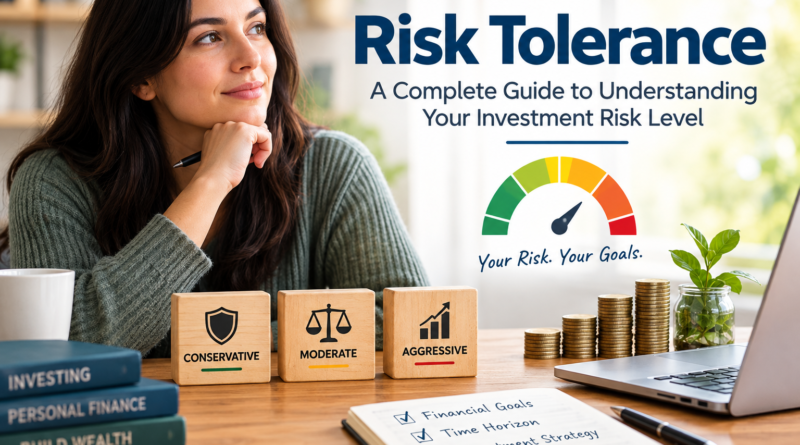
Risk Tolerance: A Complete Guide to Understanding Your Investment Risk Level
Investing involves both opportunities and uncertainty. Before choosing stocks, bonds, mutual funds, or other investments, it is important to understand how much investment risk you can realistically handle. This is where risk tolerance becomes important.
Risk tolerance describes how comfortable you are with losing money or experiencing fluctuations in the value of your investments while pursuing potential long-term returns. Two investors with the same financial goals may have very different risk tolerance levels. One may feel comfortable with significant market fluctuations, while another may prefer investments that are more stable.
Understanding your risk tolerance can help you build an investment portfolio that fits your financial situation, goals, time horizon, and emotional comfort. It can also help you avoid making impulsive decisions when markets become volatile.
In this guide, we will explain what risk tolerance means, the different levels of risk tolerance, factors that affect it, how to assess your own level, and how risk tolerance can influence your investment strategy.
What Is Risk Tolerance?
Risk tolerance is the amount of investment risk an individual is willing and able to accept in exchange for the possibility of earning higher returns.
Every investment carries some level of risk. Stocks can decline in value, bonds can lose value when interest rates change, real estate can experience market downturns, and even cash can lose purchasing power because of inflation.
Risk tolerance helps investors determine how much uncertainty they are comfortable accepting.
For example, imagine two investors:
- Investor A is comfortable seeing a portfolio decline by 20% during a market downturn.
- Investor B would become extremely stressed by a 10% decline and may sell investments immediately.
Even if both investors have similar incomes and financial goals, their risk tolerance may be different.
Understanding this difference is important because an investment strategy should not only consider potential returns. It should also consider whether the investor can remain committed to the strategy during difficult market conditions.
Why Risk Tolerance Matters in Investing
Risk tolerance is an important part of investment planning because it can influence asset allocation, investment selection, and portfolio construction.
If your portfolio contains more risk than you can handle emotionally or financially, you may panic during a market decline and sell at an unfavorable time.
On the other hand, if your portfolio is too conservative for your goals and time horizon, your investments may not have enough growth potential to meet your long-term objectives.
A suitable approach attempts to balance:
- Potential investment returns
- Acceptable levels of risk
- Financial goals
- Investment time horizon
- Personal comfort with market fluctuations
- Ability to absorb financial losses
The goal is not necessarily to eliminate risk. Instead, investors generally need to understand and manage the risks they are taking.
Risk Tolerance vs. Risk Capacity
Risk tolerance and risk capacity are related but different concepts.
Risk Tolerance
Risk tolerance refers mainly to your willingness to accept investment risk.
It is influenced by your personality, experience, emotions, and comfort with uncertainty.
Risk Capacity
Risk capacity refers to your financial ability to withstand losses.
Someone may be emotionally comfortable with high-risk investments but may not have enough financial resources to support a large potential loss.
For example, a person with unstable income, significant debt, and little emergency savings may have limited risk capacity even if they consider themselves aggressive investors.
This distinction is important because an investment strategy should consider both willingness and ability to take risk.
Main Levels of Risk Tolerance
Risk tolerance is often described using three broad categories: conservative, moderate, and aggressive.
However, real investors can fall anywhere along the spectrum.
1. Conservative Risk Tolerance
Conservative investors generally prioritize preserving capital and reducing large fluctuations.
They may prefer investments such as:
- Cash and cash equivalents
- High-quality bonds
- Certificates of deposit
- Money market investments
- Other relatively lower-volatility assets
A conservative investor may accept lower potential returns in exchange for greater stability.
This approach may be suitable for someone who has a short investment horizon or has limited ability to absorb losses.
2. Moderate Risk Tolerance
Moderate investors are generally willing to accept some market fluctuations in pursuit of higher long-term growth.
A moderate portfolio may include a combination of:
- Stocks
- Bonds
- Cash
- Diversified funds
- Other investments
The exact allocation depends on the individual’s financial situation and objectives.
Moderate investors typically seek a balance between growth and stability rather than focusing exclusively on either one.
3. Aggressive Risk Tolerance
Aggressive investors are generally more comfortable with significant fluctuations and potential short-term losses.
They may have greater exposure to:
- Stocks
- Growth-oriented investments
- Small-cap companies
- Emerging markets
- Other higher-volatility investments
Aggressive investing can provide greater growth potential, but it can also expose investors to larger losses.
A high risk tolerance does not mean an investment is guaranteed to perform well.
What Factors Affect Risk Tolerance?
Risk tolerance is not determined by one factor. Several personal and financial circumstances can influence it.
Age
Age can affect how much time an investor has to recover from market downturns.
A younger investor may have decades before needing investment money, while someone approaching retirement may have a shorter time horizon.
However, age alone should not determine risk tolerance.
Two people of the same age can have completely different financial circumstances and risk preferences.
Investment Time Horizon
Time horizon is one of the most important factors to consider.
If you need money in the next few months or years, taking substantial market risk may create a greater chance of having to sell during a downturn.
If you are investing for a long-term goal, you may have more time to potentially recover from temporary market declines.
For example:
| Time Horizon | General Consideration |
|---|---|
| Short term | Lower volatility may be important |
| Medium term | Balanced approach may be considered |
| Long term | Greater exposure to growth assets may be possible |
This is not a universal rule, but it demonstrates why time horizon matters.
Income Stability
Income stability can influence how much investment risk you can financially handle.
Someone with a predictable income may have more flexibility to tolerate market fluctuations than someone whose income varies significantly.
Your employment situation, business income, and other sources of cash flow can therefore affect your overall risk capacity.
Emergency Savings
Emergency savings can provide financial flexibility during unexpected situations.
If you have an adequate emergency fund, you may be less likely to sell long-term investments to cover unexpected expenses.
Without emergency savings, an investor may be forced to liquidate investments during a market decline.
This is one reason emergency planning should generally be considered before taking significant investment risk.
Debt
Debt can also influence risk capacity.
High-interest debt can place pressure on your monthly cash flow and reduce your ability to absorb investment losses.
Before taking substantial investment risk, consider your debt obligations and interest costs as part of your overall financial picture.
Financial Goals
Your financial goals can influence the amount of risk that makes sense for your situation.
For example, saving for:
- Retirement
- A home
- Education
- Emergency expenses
- A major purchase
may involve different time horizons and financial requirements.
The closer and more important a goal is, the more carefully you may need to consider the potential impact of investment losses.
How to Assess Your Risk Tolerance
You can begin assessing your risk tolerance by answering several practical questions.
Question 1: How Would You React to a Market Decline?
Imagine that your investment portfolio falls by 20%.
Would you:
- Sell everything immediately?
- Sell some investments?
- Hold your investments?
- Invest additional money?
- Feel comfortable waiting for a potential recovery?
Your reaction can provide clues about your emotional risk tolerance.
Question 2: How Long Can You Leave Your Money Invested?
Ask yourself when you expect to need the money.
If the money is required soon, you may have less ability to tolerate significant fluctuations.
If you do not need the money for many years, you may have more flexibility.
Question 3: Can You Afford to Lose Part of Your Investment?
This question addresses risk capacity rather than just emotional tolerance.
Consider your:
- Income
- Savings
- Debt
- Emergency fund
- Financial obligations
- Investment goals
A person should not assume they have a high risk tolerance simply because they are comfortable with volatility.
Question 4: Have You Experienced Market Volatility Before?
Investment experience can affect your perception of risk.
Someone who has never experienced a major market decline may underestimate how difficult it can feel to watch a portfolio lose value.
Previous experience can provide useful information about your actual reactions to volatility.
Risk Tolerance Questionnaire
A simple risk tolerance questionnaire can help you think about your investment preferences.
Consider the following:
1. If your portfolio declined 10%, what would you do?
- Sell immediately
- Sell some investments
- Hold
- Buy more
2. If your portfolio declined 20%, how would you feel?
- Extremely uncomfortable
- Somewhat uncomfortable
- Neutral
- Comfortable
3. When will you need the money?
- Within 1 year
- 1–5 years
- 5–10 years
- More than 10 years
4. How stable is your income?
- Very unstable
- Somewhat unstable
- Stable
- Very stable
5. How important is preserving your initial investment?
- Extremely important
- Very important
- Moderately important
- Less important
Your answers can help you understand your general risk profile, but a questionnaire should not be treated as a complete financial assessment.
Risk Tolerance and Asset Allocation
Once an investor understands their risk tolerance, the next consideration is often asset allocation.
Asset allocation refers to how investments are distributed among different asset classes.
Common asset classes include:
- Stocks
- Bonds
- Cash
- Real estate
- Commodities
- Other investments
An investor with a higher risk tolerance may allocate a larger portion of their portfolio toward growth-oriented assets.
A more conservative investor may place greater emphasis on assets designed to provide stability.
The right allocation depends on multiple factors rather than risk tolerance alone.
Example of Different Risk Profiles
Consider three hypothetical investors.
Sarah: Conservative Investor
Sarah expects to need a large portion of her money within a few years. She does not feel comfortable with large portfolio declines.
Her financial strategy may emphasize stability and liquidity.
David: Moderate Investor
David has a longer time horizon and is comfortable with some market fluctuations.
He may use a diversified combination of growth and defensive investments.
Michael: Aggressive Investor
Michael has a long investment horizon and understands that his portfolio could experience substantial short-term fluctuations.
He may be comfortable with a larger allocation to growth-oriented assets.
These examples show why there is no single investment portfolio that is appropriate for every person.
Risk Tolerance Can Change Over Time
Your risk tolerance is not necessarily permanent.
It can change because of:
- Age
- Income changes
- Marriage or family changes
- Job changes
- Debt changes
- Retirement
- Changes in financial goals
- Market experience
- Changes in personal circumstances
For example, someone may be comfortable taking substantial investment risk when they are young and have stable employment. Later, as retirement approaches, their financial priorities may change.
That does not automatically mean they should eliminate investment risk. Instead, their portfolio may need to be reviewed as their circumstances change.
Common Mistakes When Assessing Risk Tolerance
Understanding common mistakes can help investors make more thoughtful decisions.
Mistake 1: Confusing Risk Tolerance With Risk Capacity
Being emotionally comfortable with risk does not necessarily mean you can afford large losses.
Both factors should be considered.
Mistake 2: Chasing High Returns
Some investors focus entirely on potential returns and ignore the possibility of losses.
Higher potential returns generally come with higher levels of uncertainty.
Mistake 3: Panic Selling
Market declines can create emotional pressure.
Selling investments solely because prices have fallen may cause an investor to abandon a long-term strategy.
Mistake 4: Taking Too Little Risk
The opposite problem can also occur.
An investor may become so concerned about losses that they hold almost everything in low-growth assets, potentially making it harder to achieve long-term goals.
Mistake 5: Copying Another Investor
Your friend’s portfolio, a social media investor’s strategy, or a popular investment trend may not match your own financial situation.
Risk tolerance is personal.
How Diversification Can Help Manage Risk
Diversification means spreading investments across different assets rather than concentrating everything in one investment.
For example, instead of investing all your money in one company, a diversified portfolio may hold many companies across different sectors or markets.
Diversification can help reduce the impact of poor performance from any single investment.
However, diversification does not eliminate investment risk.
A broadly diversified stock portfolio can still decline during a major market downturn.
Risk Tolerance During Market Volatility
Market volatility can be a real test of risk tolerance.
When prices rise, investors may feel comfortable taking risk. When prices fall sharply, however, their actual reaction may be very different.
This is why it is useful to think about potential losses before investing.
Ask yourself:
“If the market declined significantly, could I stay committed to my investment plan?”
If the answer is no, your portfolio may contain more risk than you can comfortably manage.
Risk Tolerance and Long-Term Investing
Long-term investing requires patience.
Markets can experience periods of:
- Rapid growth
- Declining prices
- Economic uncertainty
- High volatility
- Slow recovery
Investors with a long-term strategy should understand that short-term market movements can occur even when their long-term goals remain unchanged.
However, long-term investing does not mean ignoring risk.
Instead, investors should regularly review whether their investments continue to match their goals, time horizon, and risk profile.
How to Build a Portfolio Based on Risk Tolerance
A practical process can look like this:
Step 1: Define Your Financial Goals
Identify what you are investing for.
Step 2: Determine Your Time Horizon
Estimate when you will need the money.
Step 3: Evaluate Your Financial Situation
Review your income, savings, debt, expenses, and emergency fund.
Step 4: Assess Your Emotional Comfort With Risk
Consider how you would respond to significant market losses.
Step 5: Choose an Appropriate Asset Allocation
Consider how different asset classes can fit into your overall strategy.
Step 6: Diversify
Avoid excessive concentration in one investment or asset class.
Step 7: Review Your Portfolio Periodically
Your financial situation and goals can change over time.
Risk Tolerance Example
Suppose an investor has $50,000 available for long-term investing.
The investor has:
- Stable income
- An emergency fund
- Manageable debt
- A 20-year investment horizon
- Moderate comfort with market volatility
This investor may have a greater capacity to accept investment risk than someone who needs the $50,000 within two years.
The important point is that the amount invested alone does not determine risk tolerance.
The investor’s financial circumstances, time horizon, and emotional response to losses all matter.
Frequently Asked Questions About Risk Tolerance
What is risk tolerance in investing?
Risk tolerance is the level of investment uncertainty or potential loss an investor is willing to accept in pursuit of potential returns.
Why is risk tolerance important?
It can help investors choose an investment approach that better matches their financial circumstances, goals, time horizon, and comfort with market fluctuations.
What are the three types of risk tolerance?
Risk tolerance is commonly described as conservative, moderate, or aggressive, although real-world risk preferences exist along a broader spectrum.
Can risk tolerance change?
Yes. Risk tolerance and risk capacity can change as your income, goals, age, financial obligations, and investment horizon change.
Is high risk tolerance always better?
No. Higher risk tolerance simply means an investor may be more comfortable accepting greater fluctuations. It does not guarantee higher returns or better investment outcomes.
What is the difference between risk tolerance and risk capacity?
Risk tolerance is your willingness to accept risk, while risk capacity is your financial ability to withstand potential losses.
How can I determine my risk tolerance?
You can consider your financial goals, time horizon, financial situation, experience with market volatility, and emotional response to potential losses. A structured risk questionnaire can also provide a starting point.
Final Thoughts
Understanding risk tolerance is an important part of building a thoughtful investment strategy. Investing is not only about finding opportunities for growth. It is also about understanding how much uncertainty and potential loss you can realistically handle.
Your risk tolerance should be considered alongside your risk capacity, financial goals, time horizon, income, savings, debt, and overall financial situation.
A well-considered investment strategy should allow you to pursue your goals without taking risks that could cause you to abandon your plan during difficult market conditions.
Most importantly, remember that risk tolerance is personal. The portfolio that works for one investor may not be appropriate for another. Regularly reviewing your financial goals and investment strategy can help ensure that your approach continues to match your changing circumstances.
REad Next