
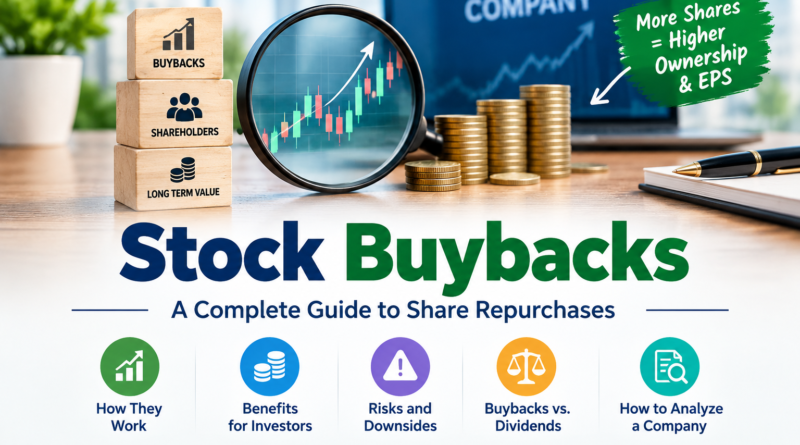
Stock Buybacks: A Complete Guide to Share Repurchases
Introduction to Stock Buybacks
Stock buybacks are an important part of corporate finance and investing. Many publicly traded companies use stock buybacks to return money to shareholders, improve financial ratios, and manage their capital more efficiently. Investors often hear about buybacks in financial news, earnings reports, and stock market analysis, but understanding how they work can help them make better investment decisions.
A stock buyback occurs when a company purchases its own shares from the open market or directly from shareholders. These shares may be retired or held as treasury stock, depending on the company’s plans and applicable regulations. When a company buys back its shares, the number of shares available to investors may decrease, potentially increasing each remaining shareholder’s ownership percentage.
For example, imagine a company has 1 million shares outstanding and earns $5 million in annual profit. If it buys back 100,000 shares and its profit remains unchanged, its earnings per share may increase because the same profit is divided among fewer shares. However, this does not automatically mean the stock’s market price will rise or that the business has become more valuable.
Understanding stock buybacks requires looking beyond headlines and examining a company’s financial health, valuation, cash flow, and long-term strategy. In this guide, we will explore how stock buybacks work, why companies use them, their advantages and disadvantages, and what investors should consider before investing in companies that repurchase their shares.
What Are Stock Buybacks?
Stock buybacks, also known as share repurchases, happen when a company uses its available funds to purchase its own outstanding shares. These transactions reduce the number of shares held by outside investors when the repurchased shares are retired or otherwise removed from outstanding shares.
Companies generally generate money through business operations, investments, borrowing, or issuing shares. When a company earns more cash than it needs for its operations and planned investments, management may decide to return some of that money to shareholders.
There are two common ways to distribute cash to shareholders: dividends and stock buybacks. Dividends provide direct cash payments to eligible shareholders, while buybacks return cash to shareholders who sell their shares to the company. Investors who keep their shares may benefit from an increased ownership percentage if the number of outstanding shares decreases.
Consider a company with 10 million outstanding shares. An investor owns 100,000 shares, representing 1% of the company. If the company repurchases 10% of its outstanding shares and retires them, the company would have 9 million shares remaining.
If the investor continues to own 100,000 shares, their ownership percentage would increase to approximately 1.11%, assuming no other share changes occur.
This illustrates why stock buybacks can matter to long-term investors. However, the actual financial benefit depends on the price paid for the shares, the company’s future performance, and how effectively management uses its capital.
How Do Stock Buybacks Work?
Stock buybacks usually begin when a company’s board of directors authorizes a share repurchase program. The authorization establishes a maximum amount of money or number of shares that the company may repurchase under the program.
An authorization does not necessarily mean the company will purchase every approved share. Management may adjust the timing and amount of repurchases based on market conditions, cash availability, and other financial priorities.
The process typically involves several steps.
1. The Company Evaluates Its Financial Position
Before announcing a buyback, management reviews the company’s cash reserves, operating expenses, debt obligations, expected investments, and future financial needs.
A financially strong company may have sufficient excess cash to repurchase shares without affecting its daily operations. A company with limited cash or significant debt may face greater risks if it commits too much money to buybacks.
2. The Board Authorizes a Repurchase Program
The board of directors approves the program according to applicable corporate rules and regulations. The announcement may include the maximum dollar amount allocated to repurchases.
For example, a company might authorize a $500 million buyback program. This means the company has permission to repurchase shares up to that amount under the program’s terms, not that it must spend the full amount.
3. The Company Purchases Shares
The company can purchase shares through the open market or use another permitted method, such as a tender offer. The method depends on the company’s goals, shareholder participation, and relevant securities regulations.
Open-market purchases allow companies to buy shares over time. Tender offers invite shareholders to sell a specified number of shares at stated terms, which may include a fixed price or a price range.
4. The Company Handles the Repurchased Shares
Repurchased shares may be retired or held as treasury shares. Retired shares are canceled, while treasury shares are held by the company and generally do not carry the same voting and dividend rights as outstanding shares.
The accounting and legal treatment depends on the company’s jurisdiction and applicable rules.
5. Investors Evaluate the Results
Investors can review company filings and financial statements to determine how much the company actually spent, how many shares it repurchased, and whether its outstanding share count declined.
A large authorization alone does not prove that a buyback has created value. The price paid and the company’s financial results are equally important.
Why Do Companies Buy Back Their Shares?
Companies use stock buybacks for several financial and strategic reasons. The most appropriate reason depends on the business’s condition, growth opportunities, and capital allocation priorities.
Returning Excess Cash to Shareholders
One major reason for stock buybacks is to distribute surplus cash. Established companies may generate more money than they need for normal operations and profitable expansion.
Instead of allowing excess cash to accumulate indefinitely, management may return some of it to shareholders through repurchases.
This approach can be useful when the company has already funded necessary investments, maintained adequate reserves, and met its debt obligations.
However, companies should not sacrifice essential business spending merely to continue a buyback program.
Increasing Earnings Per Share
Earnings per share, or EPS, measures how much of a company’s profit is attributable to each outstanding common share.
The basic formula is:
EPS = Net Income ÷ Weighted Average Shares Outstanding
When a company repurchases shares, its weighted average share count may decline. If net income remains unchanged, earnings per share can increase.
For example, suppose a company earns $10 million annually and has 2 million weighted average shares outstanding. Its EPS is $5.
If its weighted average share count falls to 1.8 million while net income stays at $10 million, EPS increases to approximately $5.56.
This improvement results from the lower share count, not from an increase in total company profit. Investors should therefore examine net income, operating performance, and cash flow alongside EPS.
Improving Ownership Concentration
When outstanding shares decrease, shareholders who retain their holdings may own a larger percentage of the company.
This can increase their proportionate claim on future earnings and business assets, although the economic benefit depends on the price paid for the repurchased shares and the company’s subsequent performance.
A higher ownership percentage does not guarantee a higher market value for each share.
Offsetting Employee Stock Compensation
Many companies compensate employees and executives with stock awards or stock options. These programs can increase the number of shares outstanding over time.
Companies sometimes repurchase shares to offset this dilution. If repurchases approximately match the shares issued through compensation plans, the outstanding share count may remain relatively stable.
Investors should check whether a company is genuinely reducing its share count or merely offsetting newly issued shares.
Signaling Management’s Confidence
A buyback announcement may indicate that management believes the company has sufficient financial resources or that its shares are attractively valued.
However, announcements should not be treated as proof that a stock is undervalued. Management can misjudge the company’s prospects or repurchase shares for reasons unrelated to long-term shareholder value.
Investors should evaluate the financial evidence rather than relying entirely on management’s message.
Types of Stock Buybacks
Companies can repurchase their shares through several methods. Each method has different characteristics, and the choice can affect the timing, price, and participation of shareholders.
Open-Market Repurchases
Open-market repurchases are a common method of buying back shares. The company purchases its own stock through the market, often over an extended period.
Management may choose when and how quickly to make purchases, subject to applicable rules and the terms of the program.
Advantages:
- Offers flexibility in the timing of purchases.
- Allows repurchases to take place gradually.
- Can be adjusted as financial conditions change.
Disadvantages:
- The company may pay more if the stock price rises.
- Announced programs may remain partly or entirely unused.
- Repurchases can be poorly timed if management overestimates the company’s value.
Tender Offers
A tender offer invites shareholders to sell shares to the company under specified conditions. The company may offer a fixed price or a price range, depending on the structure.
Tender offers can allow companies to repurchase a substantial number of shares within a defined period.
For example, a company might offer to purchase up to 5% of its outstanding shares at a specified price. Shareholders can decide whether to participate, subject to the offer’s terms.
The company must follow relevant disclosure and securities requirements, and the final number of shares purchased may depend on shareholder participation.
Dutch Auction Buybacks
A Dutch auction is a type of tender offer in which shareholders generally indicate the number of shares they are willing to sell and the minimum price they will accept within a specified range.
The company determines the purchase price according to the offer’s rules and the responses received.
This method can help a company identify a price at which it can purchase the desired amount of shares. However, the process may be more complex than ordinary open-market repurchases.
Private Negotiated Repurchases
In certain circumstances, a company may repurchase shares directly from one or more shareholders through a negotiated transaction.
These transactions can involve specific contractual conditions and may be subject to additional legal and regulatory restrictions. They are not necessarily available to every shareholder on the same terms.
Investors should review company disclosures to understand the purpose and potential consequences of a significant negotiated repurchase.
Advantages of Stock Buybacks
Stock buybacks can benefit companies and shareholders when they are implemented responsibly and at appropriate valuations.
1. Potential Growth in Earnings Per Share
A reduced share count can increase EPS if profits remain stable. This can make it easier to compare a company’s per-share earnings over time, although investors must distinguish share-count effects from genuine business growth.
2. Flexible Capital Allocation
Unlike a recurring dividend commitment, a buyback program often gives management flexibility to vary the pace of repurchases.
Companies may increase purchases when they have surplus cash and reduce them when investment opportunities or financial conditions change. This flexibility does not eliminate the need for responsible planning.
3. Potentially Better Returns for Continuing Shareholders
When a company purchases undervalued shares, continuing shareholders may benefit because the company acquires a larger claim on the remaining business for a relatively low price.
The key condition is valuation. Buying back shares below a reasonable estimate of intrinsic value can create value, while repurchasing overvalued shares can destroy it.
4. Reduced Cash Accumulation
A company that holds excessive cash without a clear purpose may earn relatively low returns on those funds. Returning genuinely surplus capital can improve the efficiency of its balance sheet.
Nevertheless, an appropriate emergency reserve and sufficient funds for future growth remain important.
5. Potential Tax Differences
In some jurisdictions, shareholders may face different tax treatment for dividends and capital gains. A shareholder who does not sell shares during a buyback may not receive an immediate cash payment from the transaction.
However, the tax consequences depend on local laws, individual circumstances, and whether shares are sold. Buybacks should not automatically be considered more tax-efficient than dividends.
Disadvantages and Risks of Stock Buybacks
Although buybacks can be beneficial, they also carry risks. A company can make poor capital allocation decisions even when a repurchase program appears attractive at first.
1. Buying Overvalued Shares
The most important risk is paying too much for the company’s own stock.
Imagine a company believes its shares are worth $50 each but repurchases them for $80. The company spends more than its estimated underlying value on each share purchased.
That money could potentially have been used for productive investments, debt reduction, or other shareholder distributions.
For this reason, investors should consider valuation measures such as the price-to-earnings ratio, free cash flow, and reasonable estimates of future business performance.
2. Increasing Debt
Some companies borrow money to finance buybacks. This can increase leverage and leave the company with less financial flexibility.
Debt-funded repurchases may be especially risky when interest rates are high, earnings are unstable, or significant debt payments are approaching.
Investors should check whether a buyback is funded by sustainable free cash flow or by additional borrowing.
3. Hiding Weak Business Performance
A company may report higher EPS after repurchasing shares even when total net income is stagnant or declining.
This can create an incomplete picture if investors focus only on per-share measures.
To understand performance, investors should examine revenue growth, operating income, net income, free cash flow, and the number of shares outstanding.
4. Reducing Funds for Growth
Cash spent on repurchases is no longer available for other uses. A company may miss opportunities to develop products, expand into new markets, improve technology, or strengthen its competitive position if it prioritizes buybacks excessively.
A sensible capital allocation strategy compares the expected benefits of repurchases with the returns available from business investments.
5. Potential Conflicts of Interest
Executive compensation sometimes depends on EPS, share prices, or other financial metrics. This can create incentives for management to prioritize short-term results over long-term business health.
Not every buyback reflects a conflict of interest, but investors should review executive incentives, governance practices, and the company’s broader capital allocation record.
6. Unequal Participation Among Shareholders
Shareholders who sell into a buyback receive cash, while shareholders who retain their shares do not receive a direct payment from the repurchase itself.
The benefits and consequences can differ depending on the transaction’s price, tax treatment, and the shareholder’s goals.
Stock Buybacks vs. Dividends
Stock buybacks and dividends are two common ways companies return capital to shareholders. Both can be useful, but they work differently.
| Feature | Stock Buybacks | Dividends |
|---|---|---|
| How shareholders receive value | Sellers receive cash; continuing holders may benefit indirectly | Eligible shareholders receive cash or other declared distributions |
| Share count | May decrease | Usually unchanged |
| EPS effect | May increase if earnings remain unchanged | No automatic increase from the dividend itself |
| Flexibility | Repurchases can often be varied | Regular dividends may create expectations of continued payments |
| Tax treatment | Depends on share sales and local rules | Depends on dividend taxation and local rules |
| Main risk | Overpaying for shares | Paying dividends that the company cannot sustainably afford |
Neither approach is universally superior. A company may choose buybacks when its shares appear undervalued, pay dividends when it wants to distribute recurring cash, or use both methods.
Investors should consider the company’s financial strength, the sustainability of its cash flow, its valuation, and their own financial objectives.
How Stock Buybacks Affect Stock Prices
Stock buybacks can influence stock prices, but the effect is not guaranteed.
When a company purchases shares in the open market, it creates additional demand for those shares. This demand may support the price, particularly when the repurchases are significant relative to normal trading activity.
A reduced share count can also increase EPS, which may influence how investors value the company.
However, stock prices depend on many factors, including interest rates, economic conditions, competition, earnings expectations, market sentiment, and the company’s future growth prospects.
A buyback cannot permanently compensate for a business that is losing customers, facing declining profits, or struggling with excessive debt.
It is also important to understand that spending cash on repurchases reduces the company’s cash balance. In a simplified example, if a company is worth $1 billion and spends $100 million on a buyback at fair value, the remaining business and the reduced share count must be considered together. The transaction does not automatically create $100 million of new economic value.
Therefore, investors should not purchase a stock solely because the company has announced a large buyback.
How to Analyze a Company’s Stock Buyback
Investors can evaluate stock repurchases by reviewing several financial indicators and company disclosures.
Examine the Outstanding Share Count
Compare the company’s current shares outstanding with those from previous years.
If the share count is falling consistently, repurchases may be reducing the number of shares held by outside investors. If the count remains unchanged, buybacks may be offsetting stock-based compensation or other share issuance.
Review Free Cash Flow
Free cash flow generally represents the cash generated by a business after capital expenditures, although definitions can vary.
A company that regularly generates healthy free cash flow may be better positioned to fund repurchases without borrowing. Investors should also consider whether that cash flow is sustainable.
Evaluate Debt Levels
Review total debt, interest expenses, debt maturities, and leverage measures. A buyback that weakens an already strained balance sheet may increase financial risk.
Compare Repurchase Prices With Valuation
Consider whether the company is buying shares at attractive prices relative to its earnings, cash flow, assets, and long-term prospects.
No single valuation ratio provides a complete answer. A low price-to-earnings ratio, for example, may reflect genuine undervaluation or expectations of declining earnings.
Read Company Filings
Annual reports, quarterly reports, earnings releases, and other regulatory disclosures can provide information about repurchases, outstanding shares, cash flow, debt, and management’s capital allocation decisions.
Investors should use these documents to determine whether the company completed its announced program and how the transactions affected its financial position.
Real-World Example of a Stock Buyback
Consider a fictional company called GreenTech Industries.
The company has 5 million shares outstanding and earns $25 million in annual net income. Its earnings per share are:
\[ EPS=\frac{\$25,000,000}{5,000,000}=\$5 \]
GreenTech decides to repurchase 500,000 shares using available cash. Assume those shares are retired and the company’s annual profit remains unchanged.
The new share count becomes 4.5 million.
\[ EPS=\frac{\$25,000,000}{4,500,000}\approx \$5.56 \]
EPS rises from $5 to approximately $5.56, an increase of about 11.1%.
However, this example simplifies the situation. In practice, the cash spent on repurchases could otherwise have earned income or supported business growth. The repurchase price also determines whether the company made an economically attractive decision.
If GreenTech pays too much for its shares, the EPS improvement may not translate into better value for continuing shareholders. If it repurchases shares at an attractive price while maintaining a healthy balance sheet, the transaction may be more beneficial.
The lesson is that investors should evaluate both the mathematical effect of fewer shares and the economic value of the transaction.
Are Stock Buybacks Good for Long-Term Investors?
Stock buybacks can be useful for long-term investors when companies use them as part of a disciplined financial strategy.
A company with strong cash flow, manageable debt, attractive growth opportunities, and undervalued shares may create value through repurchases. Continuing shareholders may own a larger percentage of the business without needing to purchase additional shares themselves.
On the other hand, a company that borrows excessively, overpays for its shares, or neglects essential investments may weaken its long-term position.
Long-term investors should focus on business quality rather than treating buyback announcements as automatic buying signals. Sustainable profits, competitive advantages, responsible management, and sensible valuations remain important.
It is also worth comparing buybacks with other uses of capital. Sometimes investing in research, improving operations, acquiring a complementary business, reducing debt, or paying dividends may offer a better outcome.
The strongest companies evaluate these alternatives instead of treating repurchases as a goal in themselves.
Common Mistakes Investors Make About Stock Buybacks
Investors can misinterpret buyback announcements when they focus on only one financial metric or assume that every repurchase is beneficial.
Assuming buybacks always increase stock prices: Market prices depend on many factors, and a repurchase does not guarantee appreciation.
Confusing EPS growth with profit growth: EPS can rise because the share count falls even if total earnings do not increase.
Ignoring the repurchase price: Buying undervalued shares and buying overvalued shares can have very different effects on shareholder value.
Overlooking debt: Borrowing to repurchase shares may increase financial risk, especially when cash flow is weak.
Ignoring stock-based compensation: A company may buy back shares without meaningfully reducing its outstanding share count.
Treating authorization as completed spending: A company may announce a program but purchase only some of the authorized shares.
Avoiding these mistakes can help investors evaluate buybacks more objectively and make decisions based on a company’s overall financial condition.
Frequently Asked Questions About Stock Buybacks
1. What is a stock buyback in simple terms?
A stock buyback occurs when a company purchases its own shares from investors. The repurchased shares may be retired or held as treasury shares. Buybacks can reduce the outstanding share count and increase continuing shareholders’ ownership percentage.
2. Why do companies buy back their own shares?
Companies may repurchase shares to return excess cash to shareholders, reduce the outstanding share count, offset employee stock compensation, or invest in their own shares when management believes they are undervalued.
3. Do stock buybacks increase earnings per share?
They can. If net income remains unchanged and the weighted average share count declines, EPS generally increases. However, a higher EPS does not necessarily mean the company’s total profit has improved.
4. Are stock buybacks better than dividends?
Neither is always better. Buybacks can offer flexibility and may benefit continuing shareholders, while dividends provide direct cash payments to eligible shareholders. The appropriate choice depends on the company’s valuation, financial position, tax rules, and investor preferences.
5. Can stock buybacks be bad for investors?
Yes. Buybacks can destroy value when companies overpay for shares, borrow excessively, or sacrifice productive investments. Investors should examine the repurchase price, cash flow, debt, and long-term business outlook.
6. Do stock buybacks always increase stock prices?
No. Although repurchases can influence demand and per-share financial metrics, stock prices are also affected by company performance, economic conditions, interest rates, and investor expectations.
7. How can investors find out whether a company is buying back shares?
Investors can review annual reports, quarterly filings, earnings releases, and company announcements. These documents may disclose repurchase amounts, average prices, remaining authorizations, and changes in shares outstanding.
8. What is the difference between shares outstanding and treasury stock?
Shares outstanding are shares currently held by outside shareholders and included in the outstanding share count. Treasury stock consists of a company’s own shares that it has repurchased and holds rather than retiring. Treasury shares generally do not have the same voting and dividend rights as outstanding shares.
Conclusion
Stock buybacks are an important corporate finance strategy that can influence earnings per share, shareholder ownership, and a company’s capital allocation decisions. When businesses have excess cash and repurchase undervalued shares, buybacks may create value for shareholders who continue to hold their investments.
However, buybacks are not automatically beneficial. Overpaying for shares, increasing debt, neglecting growth opportunities, or focusing excessively on EPS can weaken a company’s long-term financial position.
Investors should examine the company’s cash flow, debt levels, valuation, outstanding share count, and overall business performance before deciding how much importance to place on a buyback announcement. Comparing repurchases with dividends and other uses of capital can also provide a clearer picture of management’s financial priorities.
Ultimately, the most effective approach is to view stock buybacks as one part of a broader investment analysis. A disciplined strategy based on business fundamentals, reasonable valuations, and long-term financial goals can help investors make more informed decisions.
Read Next